

Mijia Air Conditioner Pro Eco LABEL EGAT NO.5 (3 Star) 12000BTU Inverter FAQ
1. Q: What are the selling points of the Mijia Air Conditioner Pro Eco LABEL EGAT NO.5 (3 Star) 12000BTU Inverter?
A: The selling points of the Mijia Air Conditioner Pro Eco LABEL EGAT NO.5 (3 star) 12000BTU Inverter are listed below:
1. There is no burden if you turn on the air conditioner every day. You do not need to worry about circuit breaker if the power is unstable:
(1) Industry's highest energy efficiency + AI energy saving: No burden to turn on the air conditioner every day;
(2) [LOW WATT]: No worry about circuit breaker when multiple appliances are turned on simultaneously;
(3) [STABILIZER]: Normal operation even when the power is unstable;
2. Fast cooling with the wind that is not blown directly:
(1) Soft wind feeling: The cold wind is not blown directly and the airflow is softened;
(2) Rapid cooling in 30s and Turbo mode: Maximum cooling value with singly pressing;
3. Smart experiences with the Xiaomi Home App:
(1) Smart control through the Xiaomi Home App;
(2) Voice control through Google or Alexa smart speaker (voice assistant);
(3) AI smart control;
(4) Infrared control through Xiaomi phones;
(5) Full-link OTA upgrade.
2. Q: What are the package contents of the Mijia Air Conditioner Pro Eco LABEL EGAT NO.5 (3 Star) 12000BTU Inverter?
A: The package contents of the Mijia Air Conditioner Pro Eco LABEL EGAT NO.5 (3 star) 12000BTU Inverter are listed below:
1.Indoor Unit and Indoor Unit Accessories:
Indoor Unit * 1, Remote Control * 1, User Manual * 1, Screw Pack * 1, AAA Battery * 2, Remote Control Holder * 1, Groove Strip for Remote Control Holder * 1, Warranty Notice;
2.Outdoor Unit and Outdoor Unit Accessories:
Outdoor Unit * 1, Connecting Copper Tube * 2, Drainage Hose * 1.
3. Q: What is the appearance of the Mijia Air Conditioner Pro Eco LABEL EGAT NO.5 (3 Star) 12000BTU Inverter?
A: The details about the appearance of the Mijia Air Conditioner Pro Eco LABEL EGAT NO.5 (3 Star) 12000BTU Inverter are listed below:
1. Geometric shape, avoid too many decorative lines, and maintain a minimalist design;
2. The shape is round and friendly, with a strong sense of home;
3. With a small black LED screen, maintain the classic design image of milook, making the product have a sense of set and recognizability.
4. Q: What are the colors of the Mijia Air Conditioner Pro Eco LABEL EGAT NO.5 (3 Star) 12000BTU Inverter?
A: The colors of the Mijia Air Conditioner Pro Eco LABEL EGAT NO.5 (3 Star) 12000BTU Inverter are white and gray.
1. Versatile color matching, suitable for all kinds of home decoration styles;
2. Neutral color matching to prevent color preferences from affecting the purchasing decisions;
3. White and gray color matching aligns with the brand tone of Xiaomi products.
5. Q: What are the package dimensions of the Mijia Air Conditioner Pro Eco LABEL EGAT NO.5 (3 Star) 12000BTU Inverter?
A: 1. Indoor unit: 915 × 292 × 382 (W × H × D, mm);
2. Outdoor unit: 925 × 625 × 389 (W × H × D, mm).
6. Q: Is the Mijia Air Conditioner Pro Eco LABEL EGAT NO.5 (3 Star) 12000BTU Inverter an inverter air conditioner?
A: Yes. The air conditioner can intelligently adjust the compressor operating frequency according to the actual environment, set temperature and fan speed, etc.
7. Q: What are the unit dimensions of the Mijia Air Conditioner Pro Eco LABEL EGAT NO.5 (3 Star) 12000BTU Inverter?
A: 1. Indoor unit: 840 × 200 × 311 (W × H × D, mm);
2. Outdoor unit: 860 × 551 × 331 (W × H × D, mm).
8. Q: What is the net weight of the Mijia Air Conditioner Pro Eco LABEL EGAT NO.5 (3 Star) 12000BTU Inverter?
A: The net weight of the indoor unit is 10kg, and the outdoor unit is 24.3kg. (The final product weight can vary based on the actual product received).
9. Q: What is the gross weight of the Mijia Air Conditioner Pro Eco LABEL EGAT NO.5 (3 Star) 12000BTU Inverter? (net weight + outer packaging + accessories)
A: The gross weight of the indoor unit is 12kg, and the outdoor unit is 28.2kg. (The final product weight can vary based on the actual product received).
10. Q: What APP does the Mijia Air Conditioner Pro Eco LABEL EGAT NO.5 (3 Star) 12000BTU Inverter connect to?
A: The Mijia Air Conditioner Pro Eco LABEL EGAT NO.5 (3 Star) 12000BTU Inverter supports connecting to the Xiaomi Home App.
11. Q: What is the networking method of the Mijia Air Conditioner Pro Eco LABEL EGAT NO.5 (3 Star) 12000BTU Inverter connecting to APP?
A: The Mijia Air Conditioner Pro Eco LABEL EGAT NO.5 (3 Star) 12000BTU Inverter uses 2.4GHz Wi-Fi module.
12. Q: Does the Mijia Air Conditioner Pro Eco LABEL EGAT NO.5 (3 Star) 12000BTU Inverter support firmware upgrade?
A: It supports remote firmware upgrade. It has full-link OTA technology and continuously upgrades products to provide you with a frequently used and new product experience.
Note:
During an OTA upgrade, the indoor unit display lights up as shown in the figure below. Do not power off or perform any operation, otherwise the upgrade can fail. During the upgrade, the air conditioner restarts, stops, and no indicator is displayed. After the upgrade is complete, the air conditioner returns to normal. The whole upgrade process takes 2-15 minutes, please wait patiently.

13. Q: What is the rated voltage of the Mijia Air Conditioner Pro Eco LABEL EGAT NO.5 (3 Star) 12000BTU Inverter?
A: The rated voltage of the air conditioner is 220V/50Hz.
14. Q: What is the voltage fluctuation range of the Mijia Air Conditioner Pro Eco LABEL EGAT NO.5 (3 Star) 12000BTU Inverter?
A: The air conditioner can withstand the general voltage fluctuation range of 220-240V, and can operate in a wide voltage environment of 130-265V in the limit state, but it will affect the service life of the air conditioner.
15. Q: What is the rated current of the Mijia Air Conditioner Pro Eco LABEL EGAT NO.5 (3 Star) 12000BTU Inverter?
A: The rated current of the air conditioner is 4.51A, and the maximum operating current is 6.0A.
16. Q: What power plug does the Mijia Air Conditioner Pro Eco LABEL EGAT NO.5 (3 Star) 12000BTU Inverter use?
A: The air conditioner does not have a power cord plug, but a 1.5m long power cord without a plug is provided.
17. Q: What is the cooling power of the Mijia Air Conditioner Pro Eco LABEL EGAT NO.5 (3 Star) 12000BTU Inverter during cooling?
A: The rated cooling power of the air conditioner when cooling is 973W.
18. Q: What is the operating temperature range of the Mijia Air Conditioner Pro Eco LABEL EGAT NO.5 (3 Star) 12000BTU Inverter?
A: The normal operation temperature range when cooling is 18 ℃-43℃.
19. Q: Is the Mijia Air Conditioner Pro Eco LABEL EGAT NO.5 (3 Star) 12000BTU Inverter waterproof? What is its waterproof rating?
A: The outdoor unit of the air conditioner can be waterproof and rainproof, and the IP rating is IPX4.
20. Q: What certification information does the Mijia Air Conditioner Pro Eco LABEL EGAT NO.5 (3 Star) 12000BTU Inverter have?
A: The main certification information of air conditioner includes TISI, EGAT No.5, and NBTC.
21. Q: What is the cooling capacity of the Mijia Air Conditioner Pro Eco LABEL EGAT NO.5 (3 Star) 12000BTU Inverter?
A: The cooling capacity of the air conditioner is 12K BTU/h (British thermal unit).
22. Q: What is the recommended room size of the Mijia Air Conditioner Pro Eco LABEL EGAT NO.5 (3 Star) 12000BTU Inverter?
A: The recommended room size for the Mijia Air Conditioner Pro Eco LABEL EGAT NO.5 (3 Star) 12000BTU Inverter is 16-20m2.
23. Q: What is the energy efficiency rating of the Mijia Air Conditioner Pro Eco LABEL EGAT NO.5 (3 Star) 12000BTU Inverter?
A: The energy efficiency rating of the air conditioner is No.5 (3 Star) inverter.
24. Q: What refrigerant does the Mijia Air Conditioner Pro Eco LABEL EGAT NO.5 (3 Star) 12000BTU Inverter use?
A: The air conditioner uses R32 refrigerant.
25. Q: What is the normal noise level of the Mijia Air Conditioner Pro Eco LABEL EGAT NO.5 (3 Star) 12000BTU Inverter?
A: 1. Indoor unit noise (level 1-level 4-level 7): 22-30-39dB(A);
Note:
The minimum noise of the indoor unit is 22dB(A), which is the lowest noise generated by the air supply of the indoor unit.
26. Q: Does the Mijia Air Conditioner Pro Eco LABEL EGAT NO.5 (3 Star) 12000BTU Inverter use DC motor?
A: Yes, both the indoor and outdoor motors used in the air conditioner are DC motors, the indoor motor model is RD20HR, and the outdoor motor model is ZKFN-37-10-1.
27. Q: Is the compressor of the Mijia Air Conditioner Pro Eco LABEL EGAT NO.5 (3 Star) 12000BTU Inverter an inverter compressor?
A: Yes, the compressor used in the air conditioner is a full DC inverter compressor, and the model is GSX073CKSF6JV8.
28. Q: What is the compressor brand of the Mijia Air Conditioner Pro Eco LABEL EGAT NO.5 (3 Star) 12000BTU Inverter?
A: The air conditioner uses HIGHLY compressor.
29. Q: How many rows of the condensers and evaporators does the Mijia Air Conditioner Pro Eco LABEL EGAT NO.5 (3 Star) 12000BTU Inverter have?
A: The air conditioner uses a single-row condenser and a double-row evaporator.
30. Q: How many filters does the Mijia Air Conditioner Pro Eco LABEL EGAT NO.5 (3 Star) 12000BTU Inverter have and what types are they?
A: The air conditioner has one filter located at the top of the indoor unit, which is a PETK anti-mildew and antibacterial filter.
31. Q: Is the filter of the Mijia Air Conditioner Pro Eco LABEL EGAT NO.5 (3 Star) 12000BTU Inverter antibacterial and anti-mildew?
A: Yes, the air conditioner uses an antibacterial and mildew-proof filter.
32. Q: What are the length, diameter and material of the drainage hose of the Mijia Air Conditioner Pro Eco LABEL EGAT NO.5 (3 Star) 12000BTU Inverter?
A: The drainage hose of the air conditioner is 2m in length and 18mm in diameter. The material is LDPE + EVA + anti-aging agent and anti-oxidant.
33. Q: What is the length of the high pressure and low pressure pipes in the package of the Mijia Air Conditioner Pro Eco LABEL EGAT NO.5 (3 Star) 12000BTU Inverter?
A: The air conditioner package contains 4 meters copper connecting pipe (including 4 connecting nuts), and the high pressure pipe is the same length as the low pressure pipe.
34. Q: What are the sizes of the connecting pipes of the Mijia Air Conditioner Pro Eco LABEL EGAT NO.5 (3 Star) 12000BTU Inverter (inner and outer diameters of the high pressure and low pressure pipe)?
A: The diameters of the copper connecting pipes of the air conditioner are as follows:
The air conditioner's copper connection pipes diameters are Φ6mm and Φ9mm. The Φ6 pipe has an outer diameter of 6.35mm with a wall thickness of 0.6mm or 0.7mm, while the Φ9 pipe has an outer diameter of 9.52mm with a wall thickness of 0.7mm.
35. Q: What are the materials of the connecting pipe of the Mijia Air Conditioner Pro Eco LABEL EGAT NO.5 (3 Star) 12000BTU Inverter?
A: The connecting pipe of the indoor and outdoor units of the air conditioner is a seamless copper pipe for phosphorus deoxidation, and the material is labeled TP2M.
36. Q: What is the maximum length of the connecting pipe of the Mijia Air Conditioner Pro Eco LABEL EGAT NO.5 (3 Star) 12000BTU Inverter that can be extended?
A: The maximum length of the air conditioner connecting pipe is 10m. At the same time, when the pipe length is greater than 7m, it is required to supplement the refrigerant 15g/m, so as not to affect the cooling effect.
37. Q: What is the maximum vertical height difference between the indoor and outdoor unit when installing the Mijia Air Conditioner Pro Eco LABEL EGAT NO.5 (3 Star) 12000BTU Inverter?
A: When the air conditioner is installed, the maximum vertical height difference between the indoor and outdoor units is 5m.
38. Q: What is the throttling method of the Mijia Air Conditioner Pro Eco LABEL EGAT NO.5 (3 Star) 12000BTU Inverter?
A: The air conditioner uses an electronic expansion valve to throttle.
39. Q: What is the circulating air volume of the Mijia Air Conditioner Pro Eco LABEL EGAT NO.5 (3 Star) 12000BTU Inverter?
A: The circulating air volume of the air conditioner is 690m³/h.
40. Q: What is the maximum current of the Mijia Air Conditioner Pro Eco LABEL EGAT NO.5 (3 Star) 12000BTU Inverter?
A: The maximum operating current of the air conditioner is 6.0A.
41. Q: What is the swing mode of the Mijia Air Conditioner Pro Eco LABEL EGAT NO.5 (3 Star) 12000BTU Inverter?
A: The air conditioner supports Up/Down Swing and Left/Right Swing.
42. Q: Does the Mijia Air Conditioner Pro Eco LABEL EGAT NO.5 (3 Star) 12000BTU Inverter support automatic defrosting?
A: This air conditioner is a single cooler and does not involve defrosting.
43. Q: Does the Mijia Air Conditioner Pro Eco LABEL EGAT NO.5 (3 Star) 12000BTU Inverter support smart dehumidification?
A: The air conditioner only supports ordinary dehumidification, Dry Mode, for the time being. Pay attention to the push of OTA upgrade information. After the upgrade is successful, AI Dry Mode can be realized.
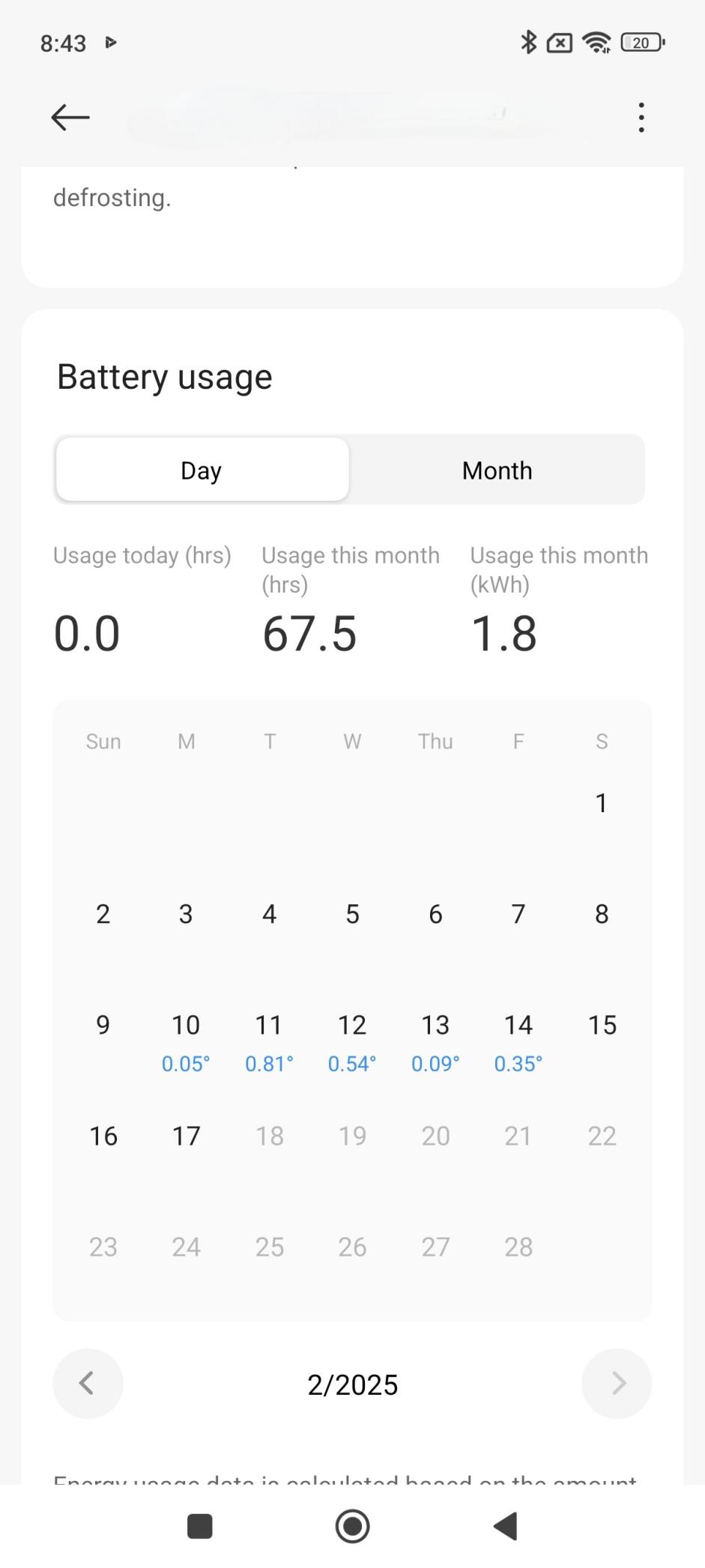
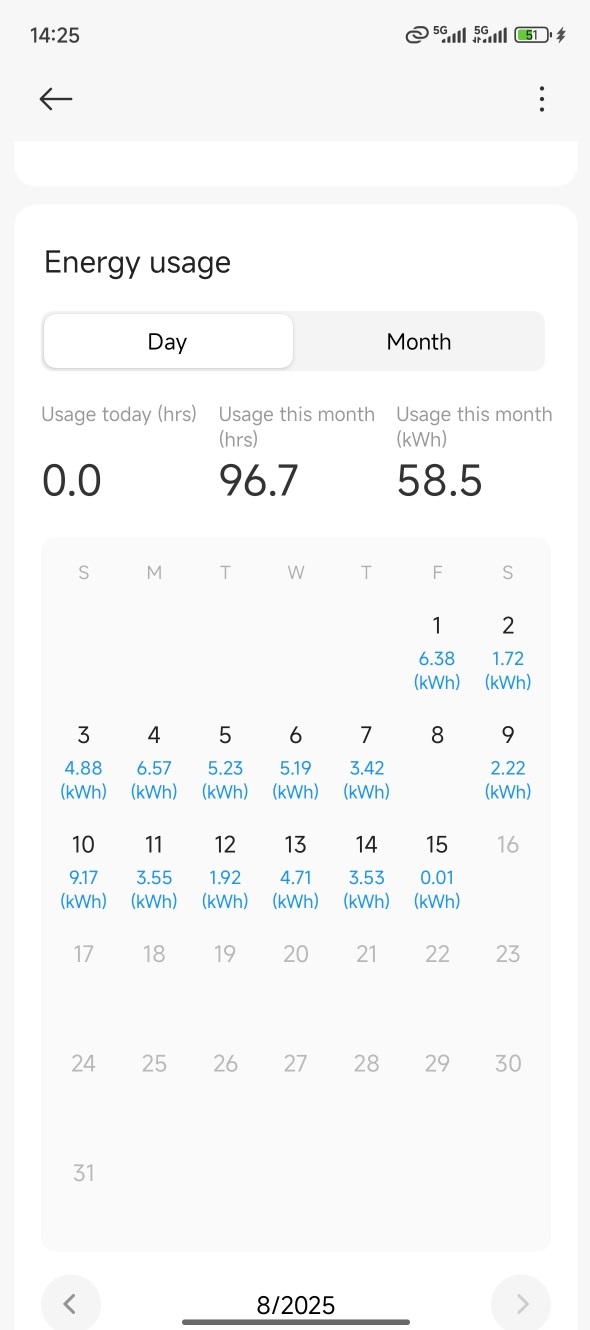
44. Q: Does the Mijia Air Conditioner Pro Eco LABEL EGAT NO.5 (3 Star) 12000BTU Inverter support battery usage?
A: Support. Please refer to the Xiaomi Home App. After selecting the corresponding product, swipe down to view the battery usage.
45. Q: Does the Mijia Air Conditioner Pro Eco LABEL EGAT NO.5 (3 Star) 12000BTU Inverter support anti-direct blowing?
A: The air conditioner is equipped with a soft wind guide plate. You can press the Air Flow Button to cycle through the feeling modes: gentile airflow, upward airflow, downward airflow, circulating airflow, and off.
46. Q: Does the Mijia Air Conditioner Pro Eco LABEL EGAT NO.5 (3 Star) 12000BTU Inverter use infrared remote control or Bluetooth remote control?
A: Infrared remote control.
47. Q: What material does the display of the Mijia Air Conditioner Pro Eco LABEL EGAT NO.5 (3 Star) 12000BTU Inverter use?
A: The material of the indoor unit display of the air conditioner is PC.
48. Q: Does the remote control of the Mijia Air Conditioner Pro Eco LABEL EGAT NO.5 (3 Star) 12000BTU Inverter have an LED indicator?
A: There is no LED indicator for the air conditioner remote control.
49. Q: What battery does the remote control of the Mijia Air Conditioner Pro Eco LABEL EGAT NO.5 (3 Star) 12000BTU Inverter use?
A: The remote control of the air conditioner uses AAA batteries.
50. Q: What is the power consumption when using the Mijia Air Conditioner Pro Eco LABEL EGAT NO.5 (3 Star) 12000BTU Inverter per day?
A: The actual power consumption of the air conditioner is related to the operating environment. The environmental temperature, thermal insulation, etc. have a great impact and cannot evaluate the power consumption. If you want to know the power consumption, you can check [Battery usage] on the Xiaomi Home App.
52. Q: How to clean the Mijia Air Conditioner Pro Eco LABEL EGAT NO.5 (3 Star) 12000BTU Inverter and how often does it need to be cleaned?
A: It is recommended that you clean the inside of the air conditioner once a year. Please clean it up by professionals. The appearance cleaning can be operated by yourself.
To clean the indoor unit, please refer to the following steps:
1. Before performing the care & maintenance on the air conditioner, make sure the air conditioner is turned off and the power supply is cut off;
2. When performing the care & maintenance on the air conditioner, avoid accidents such as tumbling or falling to avoid injury;
3. After removing the indoor unit panel, do not touch the metal fins of the heat exchanger to avoid injury;
4. Do not clean this product with water. If water gets into the indoor unit, malfunction or electric shocks will occur;
5. Do not use chemicals or solvents such as alcohol, gasoline, lacquer thinner, polishing powder, essential balm, toothpaste or laundry detergent to clean any parts of this product to avoid damage;
6. After cleaning, make sure all parts are completely dry before installing and using them. Avoid direct sunlight.
To clean the air conditioner body, please use a soft cloth or sponge dipped in clean water or diluted neutral detergent to wipe the surface of the air conditioner body.
Note:
1. Do not apply excessive force when cleaning the indoor unit panel to avoid damage;
2. Do not wipe the panel and remote control casing with wire cleaning balls, brushes, etc. to avoid damaging the casing.
53. Q: How to clean the filter of the Mijia Air Conditioner Pro Eco LABEL EGAT NO.5 (3 Star) 12000BTU Inverter and how often does it need to be cleaned?
A: It is recommended that you clean the filter every three months. After the air conditioner is connected to the Internet, you can receive the cleaning notification automatically pushed by the system.
If you receive the push message, please clean the filter according to the following methods:
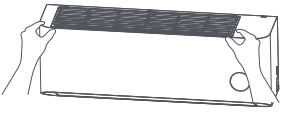
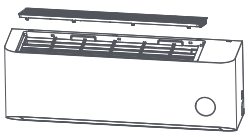
1. Removing the filter: As shown in the figure, open the clips at both ends and the middle of the filter, and pull upward to remove the filter;
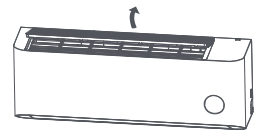
2. Cleaning the filter: After the filter is removed, use a vacuum cleaner to remove the dust or rinse the filter with clean water;
3. Reinstalling the filter: Align the clips with the snapping positions and reinstall the filter correctly.
Note:
1. Do not use steel wool or brush to clean the air filter, so as not to damage the filter;
2. Do not clean the unit with water to avoid accidents such as air conditioning failure or electric shock caused by water ingress;
3. Do not clean the remote control with water to avoid malfunction of the remote control;
4. Do not use alcohol, gasoline, lacquer thinner, polishing powder, wind oil essence, toothpaste, washing powder and other chemicals or solvents to clean the air conditioner, so as not to damage the product.
54. Q: What is the anti-mildew function of the Mijia Air Conditioner Pro Eco LABEL EGAT NO.5 (3 Star) 12000BTU Inverter targeted to and what is the specific standard?
A: The air conditioner uses a PETK anti-mildew and antibacterial filter, and the test mold (Aspergillusniger CGMCC3.5487, Chaetomium globosum CGMCC3.3601, Penicillium funiculosum CGMCC3.3875) , under the standard test environment, showed no obvious mold growth for 28 days.
55. Q: How to find the serial number of the Mijia Air Conditioner Pro Eco LABEL EGAT NO.5 (3 Star) 12000BTU Inverter?
A: The SN information of the air conditioner can be found in the following ways:
1. The label on the packaging box of both the indoor and outdoor units;
2. The label on the right-side panel of the indoor unit;
3. Inside the accessory bag of the indoor unit (SN sticker);
4. The label inside the large handle of the outdoor unit.
56. Q: What are the key features of the split air conditioners?
A: The key features of split air conditioners are as follows:
1. Composition: It is composed of indoor unit and outdoor unit, which are installed indoors and outdoors respectively, and are connected by pipelines and indoor and outdoor unit cables in the middle;
2. Classification: Wall-mounted, cabinet type, ceiling type, embedded, floor type;
3. Advantages:
(1) Beautiful appearance, many styles, small footprint, low noise and flexible use;
(2) The installation position of the indoor unit is flexible, and the external dimensions of the outdoor unit are not limited;
(3) The noise is very small, it can be lower than 40-50dB, and the noise of the window air conditioner is about 60dB;
(4) The split air conditioner does not affect the indoor lighting and does not produce the phenomenon that the window vibrates with the air conditioner;
(5) Easy installation and maintenance;
(6) Economical, practical and durable.
57. Q: What are the safety instructions for using the air conditioner?
A: The safety instructions are as follows:
1. This product can only use the power supply indicated on the label. Please use the specified power cord and do not change it by yourself;
2. Do not connect the grounding wire of the power supply to a gas tank or water pipe. Insufficient grounding will result in electric shock;
3. Make sure that the wiring harness, drainage pipe, and compressor pipe are connected correctly. Improper connection will cause the air conditioner not to function normally or reduce performance after some time or even have problems of water leakage, electrical leakage, fluorine leakage, electric shock, or fire accidents;
4. Use the button to turn the product on or off instead of plugging or unplugging the power plug during daily use. Please turn off the product and unplug the power plug when not in use for a long time;
5. When the ambient humidity is high, please increase the fan speed or adjust the air guide blade angle to the maximum using the wind direction button to prevent water droplets from falling;
6. Do not install the air conditioner in places where flammable or explosive gases will leak, where the environment is humid, or where electromagnetic interference is significant. The indoor unit of this air conditioner is not waterproof, so do not use it in humid environments such as laundry rooms or bathrooms;
7. When indoor ventilation equipment is used together with indoor heating equipment or gas stoves, it should be ensured to avoid hypoxic accidents caused by insufficient ventilation;
8. Do not blow the air from the air conditioner directly to animals or plants, otherwise it will cause adverse effects;
9. When cleaning the air conditioner, be sure to turn it off and cut off the power supply, and make sure that the air conditioner has completely stopped before operating;
10. Do not poke your fingers or sticks into the exhaust inlet or exhaust outlet of the air conditioner. Otherwise, it will cause damage to the air conditioner or even personal injury;
11. Do not place any objects on the outdoor unit and check its mounting bracket frequently. If there is any damage, repair it in time, otherwise, the outdoor unit will fall and cause injury;
12. If any abnormality in the air conditioner (such as a burnt smell) is found, turn the air conditioner off, cut off the power supply immediately, and contact the after-sales service team;
13. For the sake of safety, cut off the power supply before touching the air conditioner;
14. Do not install the air conditioner in special places such as ships or vehicles.
Note:
The operating temperature range when cooling is 18℃ to 43℃. The temperature that is too high or too low will stop the air conditioner operating.
58. Q: How to deal with the numbness in hands when mistakenly touching the Mijia Air Conditioner Pro Eco LABEL EGAT NO.5 (3 Star) 12000BTU Inverter?
A: To ensure your safety, please do not touch the inner and outer units of the air conditioner during the working process of the air conditioner. If you find that your hands are numb when you accidentally touch the outdoor unit of the air conditioner, please contact the engineer to connect the ground wire of the air conditioner to avoid accidents such as electric shock.
59. Q: What is the dehumidification capacity of the Mijia Air Conditioner Pro Eco LABEL EGAT NO.5 (3 Star) 12000BTU Inverter?
A: The dehumidification capacity of the air conditioner is 1.2L/h.
60. Q: How to find the production date of the Mijia Air Conditioner Pro Eco LABEL EGAT NO.5 (3 Star) 12000BTU Inverter?
A: On the label of the indoor and outdoor units of the air conditioner, you can view the production year/month information of the air conditioner.
61. Q: What does the letter in the model of the Mijia Air Conditioner Pro Eco LABEL EGAT NO.5 (3 Star) 12000BTU Inverter mean?
A: Air conditioner model: ASC-12WO/N1C3-TH
The letter meanings in the air conditioner model are listed below:
1. Category code: A-Air Conditioner;
2. Form code: S-Split;
3. Cooling and heating code: C-Cooling (single cooling);
4. Capability code: 12-12000BTU;
5. Indoor unit code: W-Wall-mounted;
6. Outdoor unit code: O-Outdoor unit;
7. Series, product iteration code: N1-ultra power saving series;
8. Refrigerant code: C-R32 refrigerant;
9. Energy efficiency rating: No.5 (3 Star);
10. Energy efficiency standard code: TH-Thailand.
A: The Seasonal Energy Efficiency Ratio (SEER) is a crucial metric that measures the "seasonal energy efficiency" of air conditioners. It indicates the operating efficiency of these devices across various outdoor temperatures throughout the year. SEER is particularly useful for evaluating the actual energy consumption performance of inverter air conditioners.
The SEER value for the Mijia Air Conditioner Pro Eco LABEL EGAT NO.5 (3 Star) 12000 BTU Inverter air conditioner, launched by Xiaomi in Thailand, is an impressive 22.96. This figure highlights its capability to provide effective cooling while maintaining energy efficiency, making it an excellent choice for you looking for an environmentally friendly option without compromising on performance.
Function and Usage
1. Q: How to connect the Mijia Air Conditioner Pro Eco LABEL EGAT NO.5 (3 Star) 12000BTU Inverter to the Xiaomi Home App?
A: To connect the air conditioner to the Xiaomi Home App, please refer to the following steps:
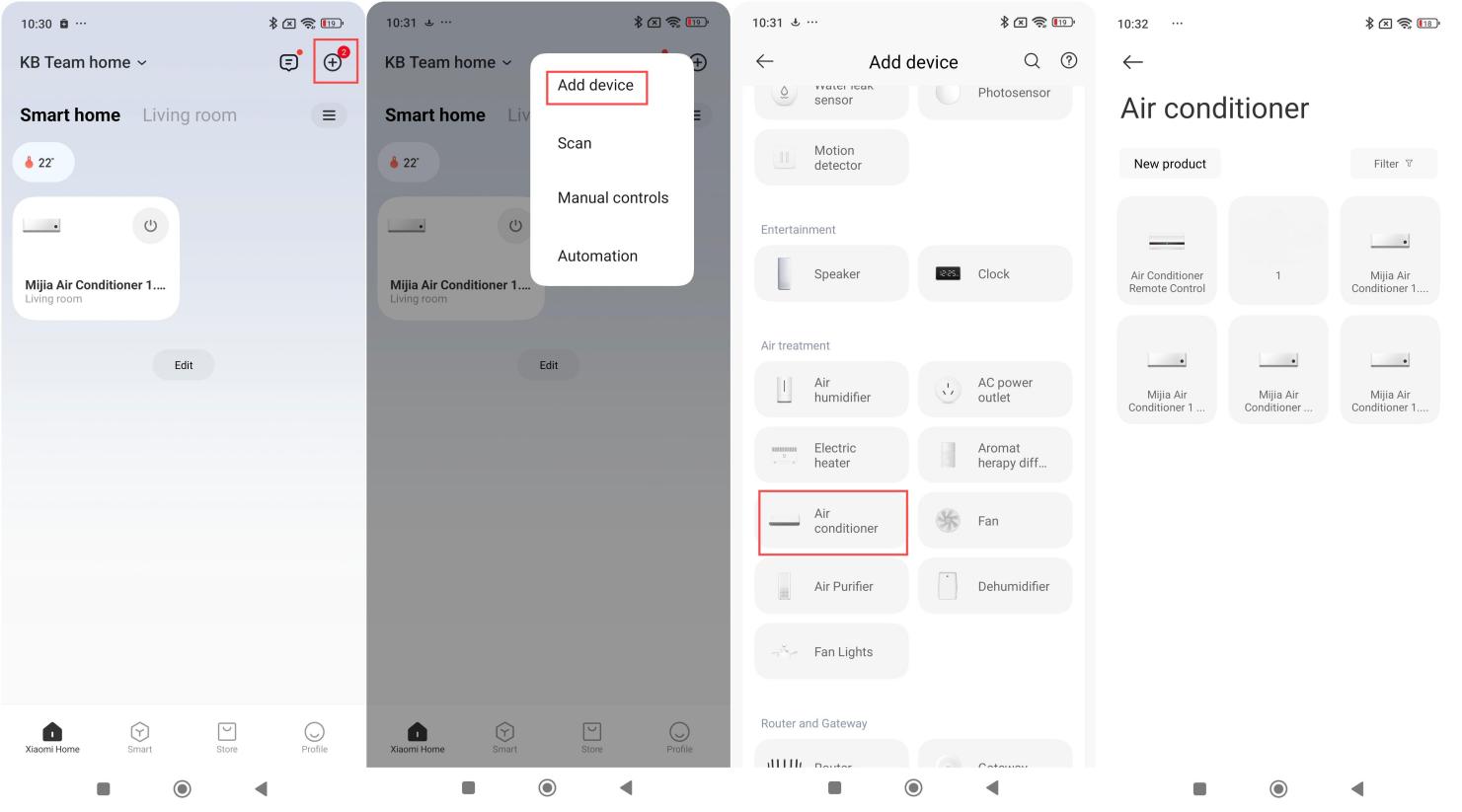
1. First connect the mobile phone to the Wi-Fi at home, then open the Xiaomi Home App, tap the + icon in the upper right corner, tap [Add device], and tap the selected air conditioner to enter the Wi-Fi configuration interface;
2. Follow the instructions for the next step until the icon of successful adding of the device displays.
Note:
1. You can select [Discover nearby devices] or [Add devices manually] in the Xiaomi Home App on the Android phones to add device. On the iOS phones, you can tap the + icon in the upper right corner to manually add device or select the new device after tapping the Bluetooth icon to add device;
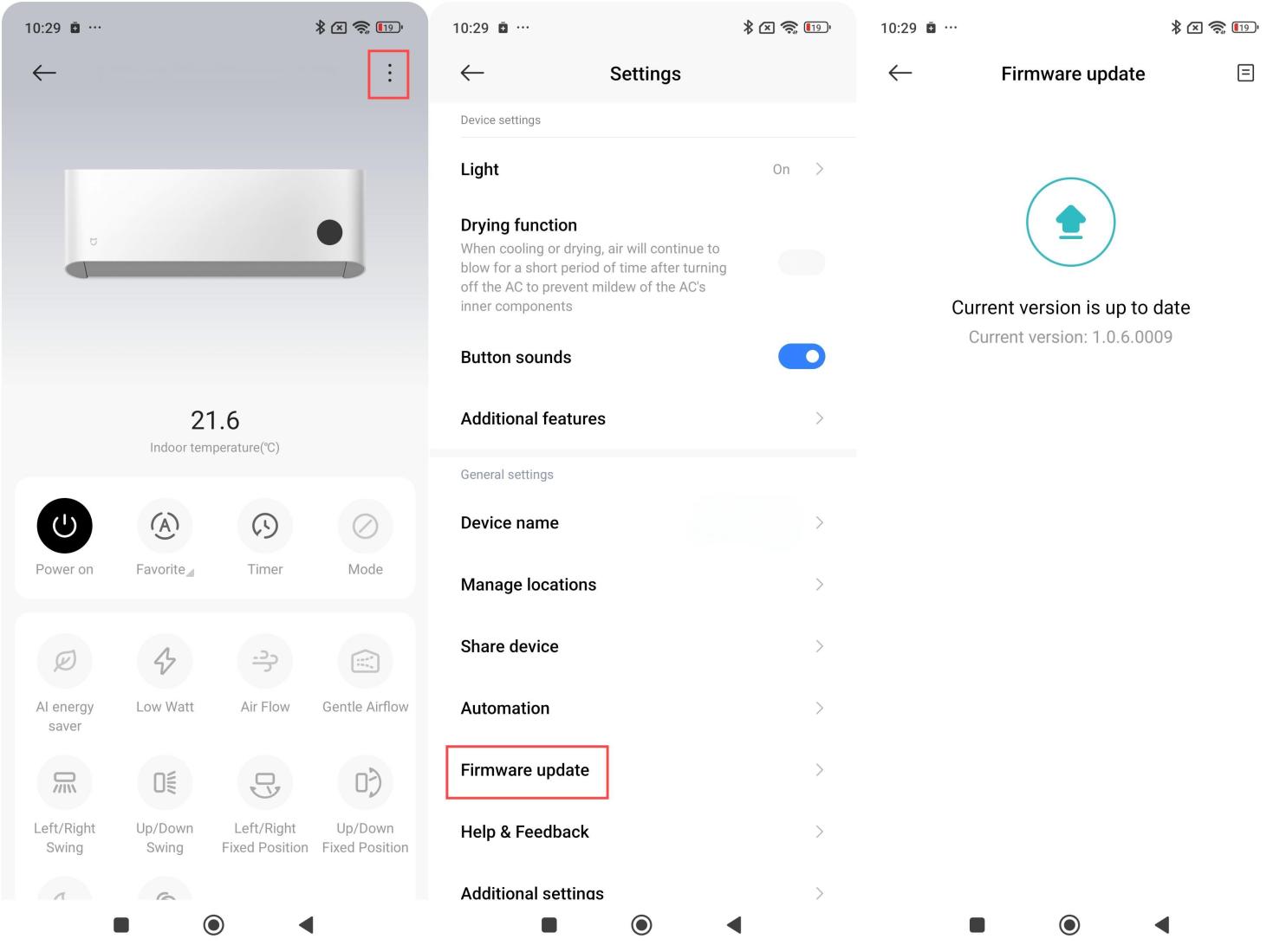
2. You can go to the Xiaomi Home App >> [Mijia Air Conditioner Pro Eco LABEL EGAT NO.5 (3 Star) 12000BTU Inverter] >> tap the three-dot icon at the upper right corner >> [Firmware update] to upgrade the indoor and outdoor units.
2. Q: How to reset the Wi-Fi of the Mijia Air Conditioner Pro Eco LABEL EGAT NO.5 (3 Star) 12000BTU Inverter?
A: Simultaneously press and hold the Sleep Button and Light Button for 5 seconds to reset the Wi-Fi.
3. Q: How to adjust the temperature of the Mijia Air Conditioner Pro Eco LABEL EGAT NO.5 (3 Star) 12000BTU Inverter?
A: In the cooling mode, the temperature adjustment range is 16℃~ 31℃. Press the Temperature Up and Temperature Down button of the remote control to adjust the temperature of the air conditioner, and adjust 0.5℃ with singly pressing.
4. Q: How to use the remote control of the Mijia Air Conditioner Pro Eco LABEL EGAT NO.5 (3 Star) 12000BTU Inverter?
A: The remote control adopts infrared control. When using, pick up the remote control and align it with the front (display screen) of the air conditioner to control.
Note:
1. The infrared receiver is located behind the display (the display has certain light transmission characteristics);
2. The front distance is less than 8m. The left-to-right range is within 45°.
5. Q: How to install the battery on the remote control of the Mijia Air Conditioner Pro Eco LABEL EGAT NO.5 (3 Star) 12000BTU Inverter?
A: To install the battery on the remote control, please refer to the following steps:
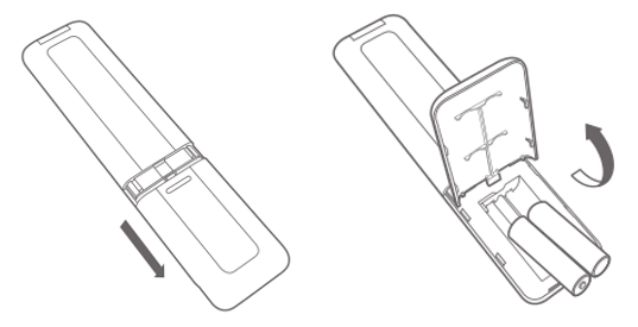
1. Press the upper groove of the battery cover with your finger and slide the battery cover down (left in the pictures below);
2. Open the battery cover, load the two AAA batteries into the battery compartment in the direction shown on the right in the pictures below, and then cover the battery cover tightly.
Note:
When installing, please pay attention to the positive and negative electrodes of the battery. If installed upside down, the remote control will not work normally. Do not pull hard or remove the battery cover with brute force.
6. Q: How to upgrade the firmware of the Mijia Air Conditioner Pro Eco LABEL EGAT NO.5 (3 Star) 12000BTU Inverter?
A: When there is a new version, you can see the upgrade prompt in the three-dot icon in the upper right corner of the air conditioner interface. The firmware will be continuously upgrade and optimized. For a better experience, it is recommended that you upgrade to the latest version.
7. Q: How to install the Mijia Air Conditioner Pro Eco LABEL EGAT NO.5 (3 Star) 12000BTU Inverter?
A: The air conditioner needs to be installed before it can be used. The installation of the air conditioner has a certain professionalism. It is recommended that you make an appointment for on-site installation services, and it is not recommended that you install it by yourself.
8. Q: How to use Timer on the Mijia Air Conditioner Pro Eco LABEL EGAT NO.5 (3 Star) 12000BTU Inverter?
A: When the air conditioner is turned on, the remote control can be used to set a turn-off timer. When the air conditioner is turned off, the remote control can be used to set a turn-on timer. Press the Timer Button to enter the timer mode, and then press + or - to adjust the time. The timer is set successfully if there is no operation for two seconds.
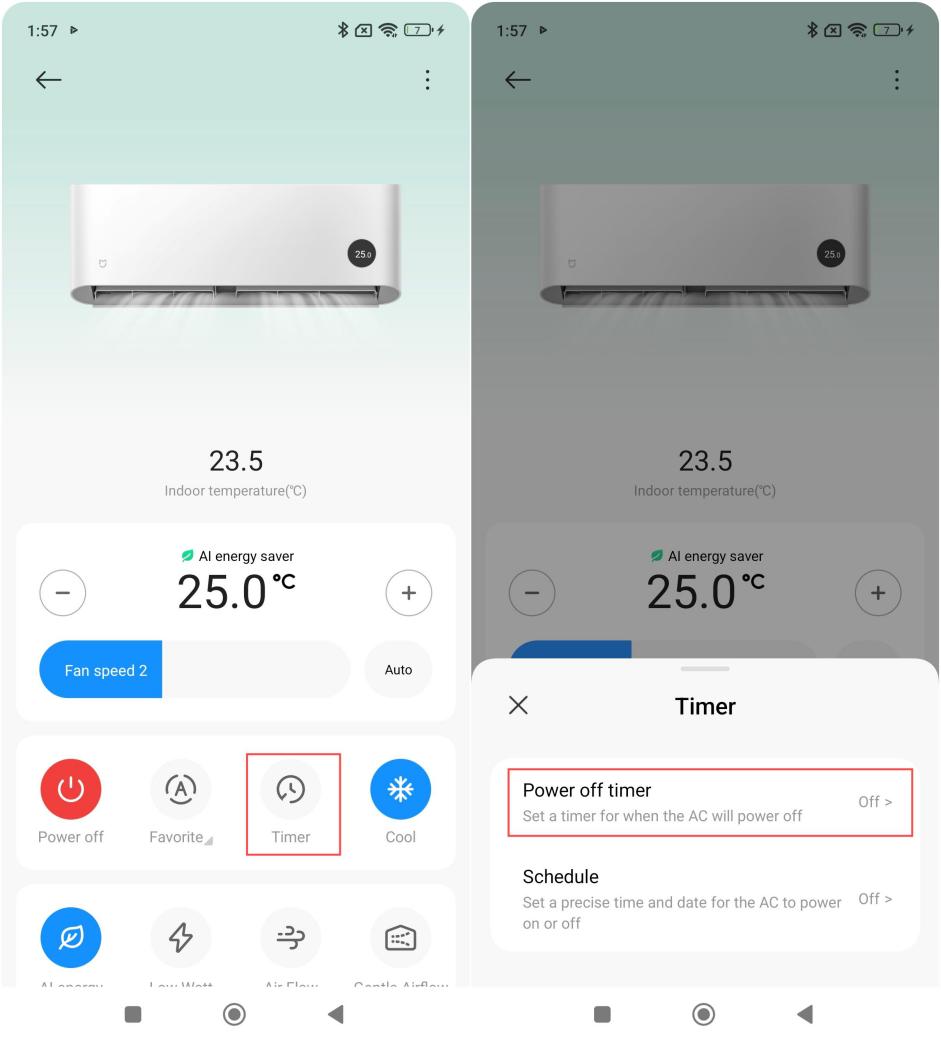
To use Timer in the Xiaomi Home App, please refer to the following details:
1. Through Timer on the homepage of the air conditioner interface, you can configure the automatic turning-off after 30 minutes, 1 hour, 2 hours and customization;
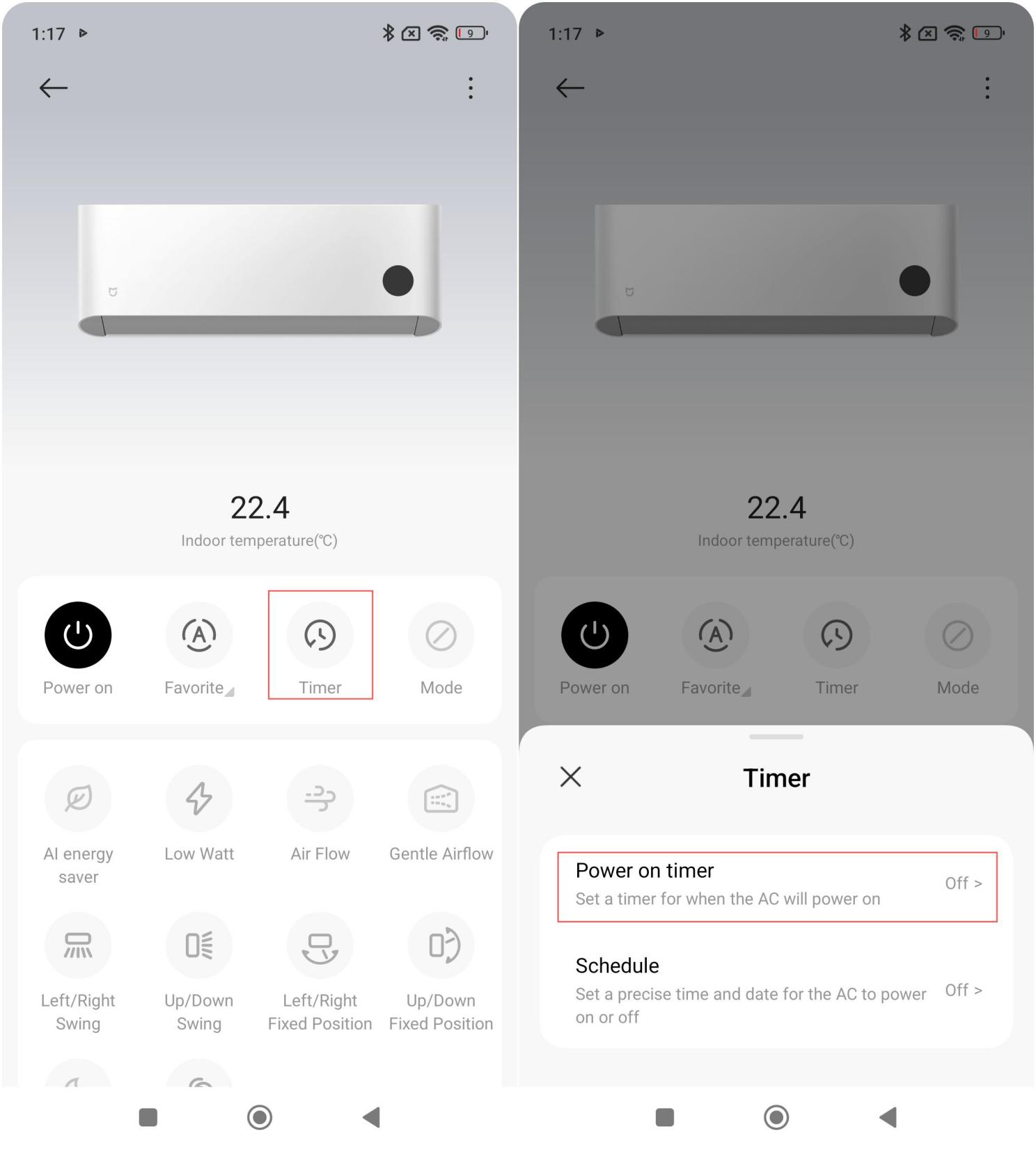
2. You can select [Schedule] after tapping [Timer] on the homepage of the air conditioner interface to configure the designated time to turn on or turn off;
Note:
This function has both turn-on and turn-off time. The air conditioner will be turned on in the start of the designated duration and turned off when the duration ends.
3. You can also add smart scenes in the Xiaomi Home App to set the time to make the air conditioner turn on or turn off.
Note:
When the air conditioner is turned on, you can set the time to turn off. When the air conditioner is turned off, you can set the time to turn on.
9. Q: How to control the Mijia Air Conditioner Pro Eco LABEL EGAT NO.5 (3 Star) 12000BTU Inverter through several accounts?
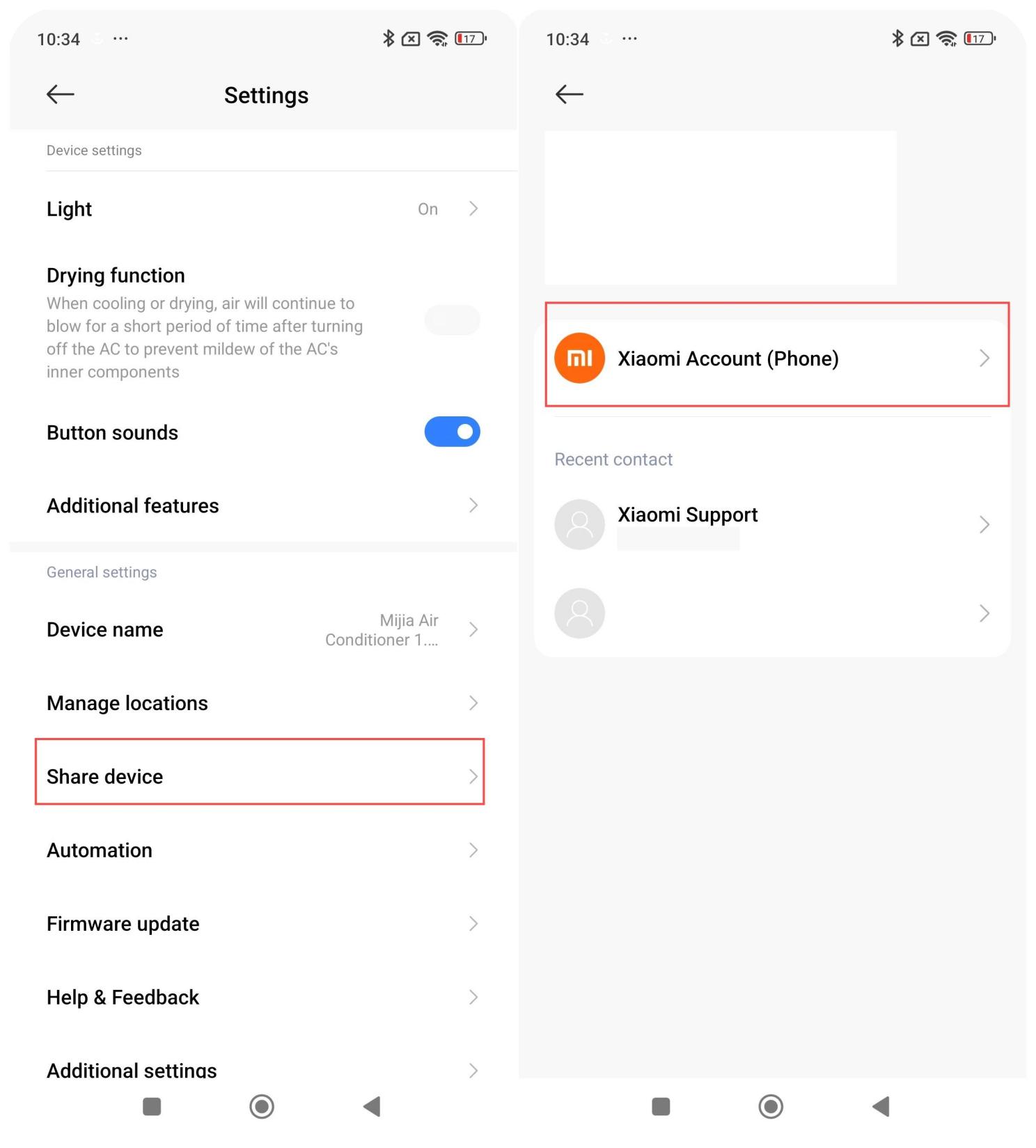
A: After using the Mi Home/Xiaomi Home to connect and bind, you can share the air conditioner with your family, so that Mi accounts can control the air conditioner.
10. Q: How link the Mijia Air Conditioner Pro Eco LABEL EGAT NO.5 (3 Star) 12000BTU Inverter with other devices?
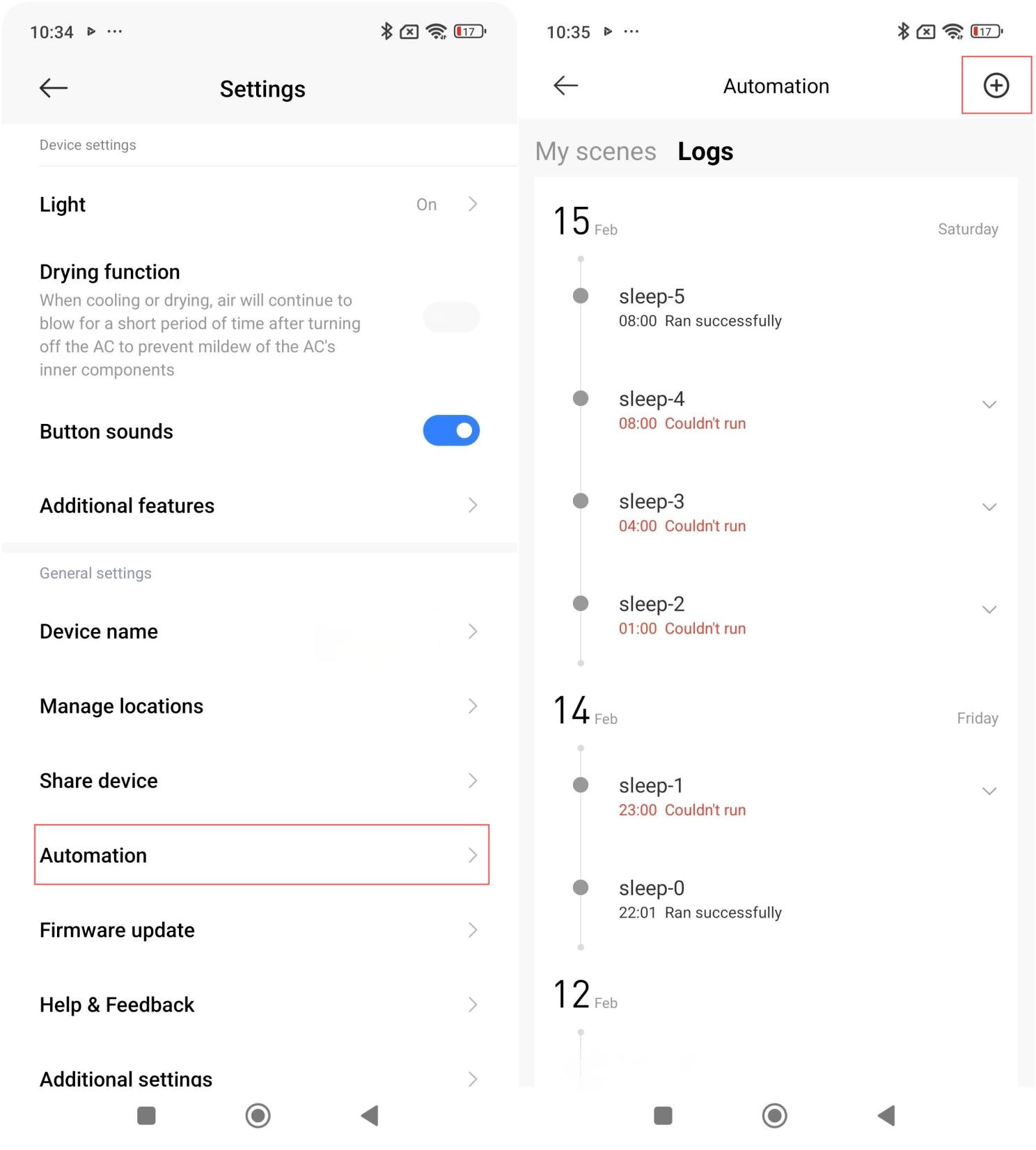
A: The air conditioner supports setting up smart scenes and can be linked with other devices.
You can go to the Xiaomi Home App >> select the air conditioner >> tap the three-dot icon at the upper right corner >> select [Automation] >> tap the [+] icon at the upper right corner to select from [Manual controls] or [Automation].
11. Q: How to adjust the mode of the Mijia Air Conditioner Pro Eco LABEL EGAT NO.5 (3 Star) 12000BTU Inverter?
A: Press the Mode Button on the remote control to adjust the mode in sequence: cooling mode, dry mode, and fan mode.
12. Q: How to adjust the fan speed of the Mijia Air Conditioner Pro Eco LABEL EGAT NO.5 (3 Star) 12000BTU Inverter?
A: Press the Fan Speed Button on the remote control to adjust the speed: automatic, quite (level 1), low (level 2), low-medium (level 3), medium (level 4), medium-high (level 5), high (level 6), super-high (level 7).
Note:
The fan speed is not adjustable in Dry mode.
13. Q: How to enable the child lock function of the Mijia Air Conditioner Pro Eco LABEL EGAT NO.5 (3 Star) 12000BTU Inverter?
A: Simultaneously press and hold the + and - buttons for more than 3 seconds to enable or disable the child lock function of the remote control.
14. Q: How to use Auto clean of the Mijia Air Conditioner Pro Eco LABEL EGAT NO.5 (3 Star) 12000BTU Inverter?
A: To use Auto clean of the air conditioner, please refer to the following details:
When the air conditioner is turned off, simultaneously press and hold the LOW WATT Button and the Timer Button for more than three seconds to enable Auto clean. The remote control will show Auto clean, and the display of the air conditioner is blinking. Then the air conditioner will run for about 40 minutes, and automatically exit Auto clean and shut down.
Note:
1. It is normal that the duration displayed on the remote control and the air conditioner display vary;
2. There will be noise, breeze, and cold air during Auto clean, which is normal;
3. When the ambient temperature is too high or too low, the air conditioner will automatically activate the protection function, which will cause Auto clean to be exited or fail to start;
4. Auto clean can only clean the heat exchanger.
15. Q: How to adjust the airflow direction of the Mijia Air Conditioner Pro Eco LABEL EGAT NO.5 (3 Star) 12000BTU Inverter?
A: To adjust the airflow direction of the air conditioner, please refer to the following details:
1. Press the Left/Right button to turn the horizontal oscillation on or off;
2. Press the Up/Down button to turn the vertical swing function on or off.
16. Q: How to adjust the screen brightness of the Mijia Air Conditioner Pro Eco LABEL EGAT NO.5 (3 Star) 12000BTU Inverter?
A: The air conditioner supports the turning-on and turning-off of the display light. Press the Light Button to turn the display of the indoor unit on or off.
17. Q: How to turn on or turn off the Mijia Air Conditioner Pro Eco LABEL EGAT NO.5 (3 Star) 12000BTU Inverter?
A: Press the On/Off Button to turn the air conditioner on or off.
18. Q: What is the best location for installing the air conditioner and what are the precautions for installation?
A: The installation of air conditioners is professional. It is recommended that you make an appointment for on-site installation services, and it is not recommended to install them by yourself.
Outdoor Unit Location Selection:
1. Avoid exposure to direct sunlight or strong wind;
2. Keep away from heat sources, steam sources, and places with flammable gas leakage and smoke;
3. Select a place that is not exposed to rain and has good ventilation;
4. Choose a place where the air outlet and operating noise of the air conditioner will not disturb other people or animals or plants;
5. Make sure the installation space is not smaller than the requirements in the lower left picture;
6. Make sure the air outlet is open and unobstructed to avoid affecting the performance;
7. The outdoor unit shall not occupy public sidewalks. If the outdoor unit is installed along buildings on both sides of the road, the distance from the bottom of the outdoor unit mounting bracket to the ground shall be greater than 25cm. On the condition that the outdoor unit mounting bracket does not affect the people flow, the distance from the bottom of the outdoor unit to the ground shall be greater than 25cm;
8. To ensure the room temperature regulation effect, it is recommended that you remove the obstructions like the shutter in front of the outdoor unit when installing. If such obstructions cannot be removed, the air outlet of the outdoor unit shall be placed as close to the shutter as possible;
9. The installation location shall be firm and reliable, otherwise it will increase operating noise and vibration and bring danger.
Indoor Unit Location Selection:
1. Avoid direct sunlight;
2. There are no obstacles at the air inlet and outlet to maintain good air circulation;
3. It's convenient for the drainage hose to drain water;
4. The distance to radio devices (such as TV or radio) is greater than 1m;
5. The air conditioner shall be installed on a wall that can bear the weight of the indoor unit and does not increase the operating noise and vibration;
6. The minimum clearance between the auxiliary electric heating air conditioners and the surfaces of combustible materials is 1.5 m;
7. The auxiliary electric heating components are assembled and fixed in the indoor unit evaporator. They are ceramic PTC electric heating elements. The input power can be found in the “Input Power for the Auxiliary Electric Heater PTC” on the label.
Note:
Models without "input Power for the Auxiliary Electric Heater PTC" on the label do not have this component.
19. Q: How to enable the sleep function of the Mijia Air Conditioner Pro Eco LABEL EGAT NO.5 (3 Star) 12000BTU Inverter?
A: To enable the sleep function of the air conditioner, please refer to the following details:
1. In cooling mode, press the Sleep Button to turn the sleep function on or off. In sleep mode, the air conditioner will automatically adjust the temperature;
2. In sleep mode, the air conditioner will automatically adjust the temperature according to the sleep curve.
Note:
The sleep mode can be turned on only in cooling mode.
20. Q: How to enable the dry mode of the Mijia Air Conditioner Pro Eco LABEL EGAT NO.5 (3 Star) 12000BTU Inverter?
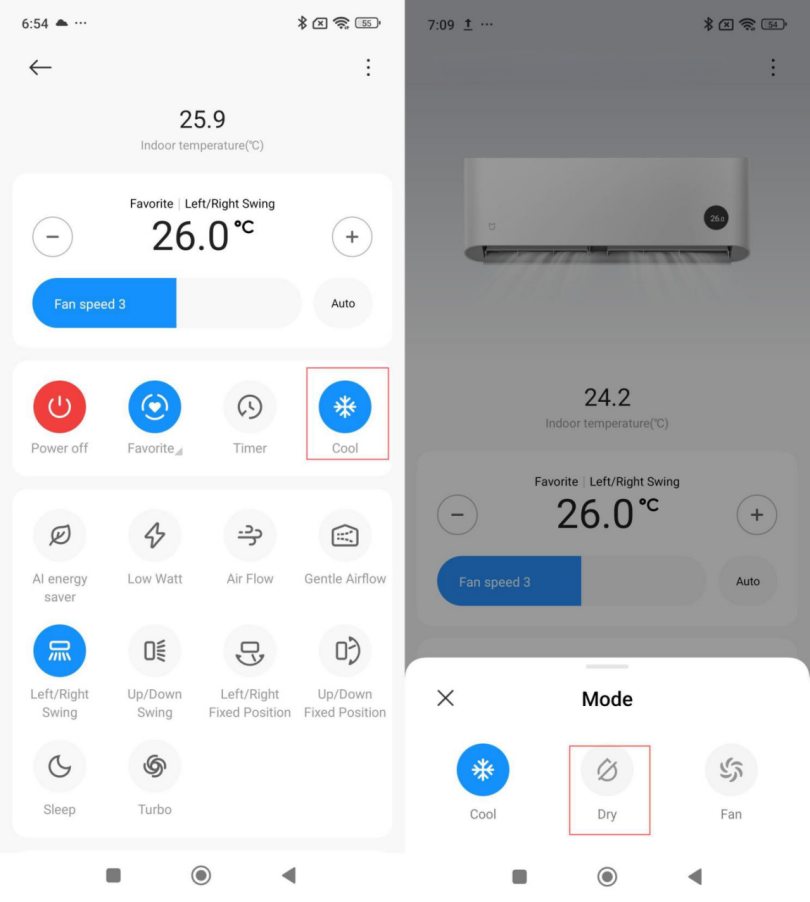
A: Press the Mode Button on the remote control of the air conditioner to adjust the mode, and adjust it to the Dry mode as it is showed on the remote control display.
You can also go to the Xiaomi Home App>> [Mijia Air Conditioner Pro Eco LABEL EGAT NO.5 (3 Star) 12000BTU Inverter] >> tap the mode icon >> select [Dry].
21. Q: How to restore the Mijia Air Conditioner Pro Eco LABEL EGAT NO.5 (3 Star) 12000BTU Inverter to factory settings?
A: Within five minutes of the air conditioner connecting to power (make sure it is turned off), quickly press the Light Button on the remote control six times in five seconds, and then the air conditioner makes a buzzer sound for two seconds. Disconnect the power and reconnect the power, and the factory settings will be restored.
Note:
1. When restored to the factory settings, the air conditioner will delete all data including but not limited to the set temperature, fan speed, timing information, function switches, and accumulated electricity consumption;
2. It is not recommended that you restore the factory settings unless necessary, so as not to affect the experience of some functions. For example, the accumulated electricity consumption value will be significantly different from the actual electricity consumption value.
22. Q: What are the safety instructions for using the air conditioner?
A: The safety instructions are as follows:
1. This product can only use the power supply indicated on the label. Please use the specified power cord and do not change it by yourself;
2. Do not connect the grounding wire of the power supply to a gas tank or water pipe. Insufficient grounding will result in electric shock;
3. Make sure that the wiring harness, drainage pipe, and compressor pipe are connected correctly. Improper connection will cause the air conditioner not to function normally or reduce performance after some time or even have problems of water leakage, electrical leakage, fluorine leakage, electric shock, or fire accidents;
4. Use the button to turn the product on or off instead of plugging or unplugging the power plug during daily use. Please turn off the product and unplug the power plug when not in use for a long time;
5. When the ambient humidity is high, please increase the fan speed or adjust the air guide blade angle to the maximum using the wind direction button to prevent water droplets from falling;
6. Do not install the air conditioner in places where flammable or explosive gases will leak, where the environment is humid, or where electromagnetic interference is significant. The indoor unit of this air conditioner is not waterproof, so do not use it in humid environments such as laundry rooms or bathrooms;
7. When indoor ventilation equipment is used together with indoor heating equipment or gas stoves, it should be ensured to avoid hypoxic accidents caused by insufficient ventilation;
8. Do not blow the air from the air conditioner directly to animals or plants, otherwise it will cause adverse effects;
9. When cleaning the air conditioner, be sure to turn it off and cut off the power supply, and make sure that the air conditioner has completely stopped before operating;
10. Do not poke your fingers or sticks into the exhaust inlet or exhaust outlet of the air conditioner. Otherwise, it will cause damage to the air conditioner or even personal injury;
11. Do not place any objects on the outdoor unit and check its mounting bracket frequently. If there is any damage, repair it in time, otherwise, the outdoor unit will fall and cause injury;
12. If any abnormality in the air conditioner (such as a burnt smell) is found, turn the air conditioner off, cut off the power supply immediately, and contact the after-sales service team;
13. For the sake of safety, cut off the power supply before touching the air conditioner;
14. Do not install the air conditioner in special places such as ships or vehicles.
Note:
The operating temperature range when cooling is 18℃ to 43℃. The temperature that is too high or too low will stop the air conditioner operating.
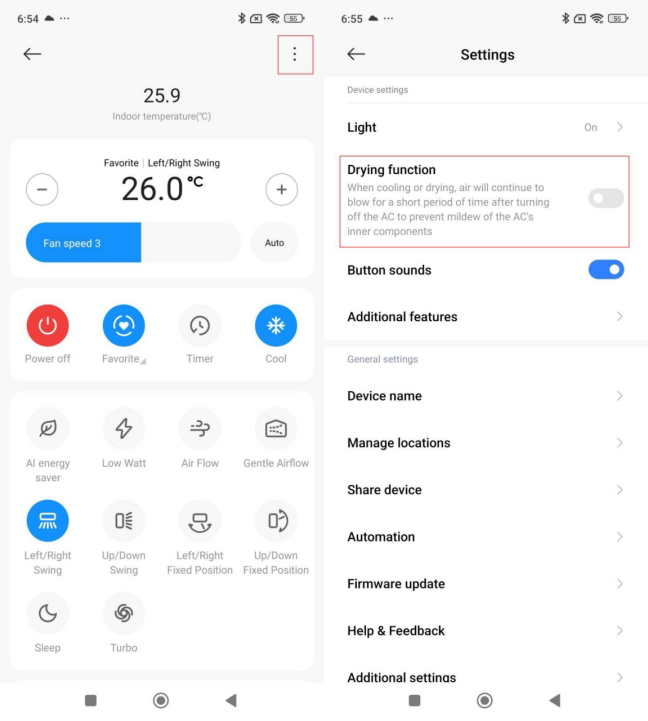
23. Q: How to use drying function on the Mijia Air Conditioner Pro Eco LABEL EGAT NO.5 (3 Star) 12000BTU Inverter?
A: You can go to the Xiaomi Home App >> [Mijia Air Conditioner Pro Eco LABEL EGAT NO.5 (3 Star) 12000BTU Inverter] >> tap the three-dot icon at the right top of the screen >> enable [Drying function].
24. Q: How to use the AI function on the Mijia Air Conditioner Pro Eco LABEL EGAT NO.5 (3 Star) 12000BTU Inverter?
A: To use the AI function on the air conditioner, please refer to the following details:
1. Smart voice control with Google Home APP and Amazon Alexa APP:
(1) Download and log in Google Home APP and Amazon Alexa APP;
(2) Connect the required voice-controlled air conditioner in the voice assistant. If you have a Google or Alexa smart speaker device at home, you can also bind the air-conditioning equipment with the speaker device;
(3) In the networked state, the voice control function can be used.
2. AI energy saver: Achieve long-term energy saving and improve environmental adaptability through the fully self-developed deep learning algorithm in the cloud.
After the air conditioner is connected to the Internet, it automatically detects the environment and location where the air conditioner is located, and intelligently selects the mode according to the scene. For example, when the ambient temperature is 40°C and the room area is 16m², the air conditioner will quickly cool down. In the cooling state, turning on the AI energy saver mode on the Xiaomi Home App (the button name will be adjusted) can control the temperature accurately and stably, achieving long-term energy saving.
Note:
The AI functions are currently tested. The estimated release date of the AI functions is at the end of April. Please pay attention to the upgrade of the Xiaomi Home App to enjoy the latest functions.
25. Q: How to check the service life of the filter on the Mijia Air Conditioner Pro Eco LABEL EGAT NO.5 (3 Star) 12000BTU Inverter?
A: The air conditioner has no filter element, and the filter will not be damaged in the general conditions. Pay attention to cleaning it according to the prompts.
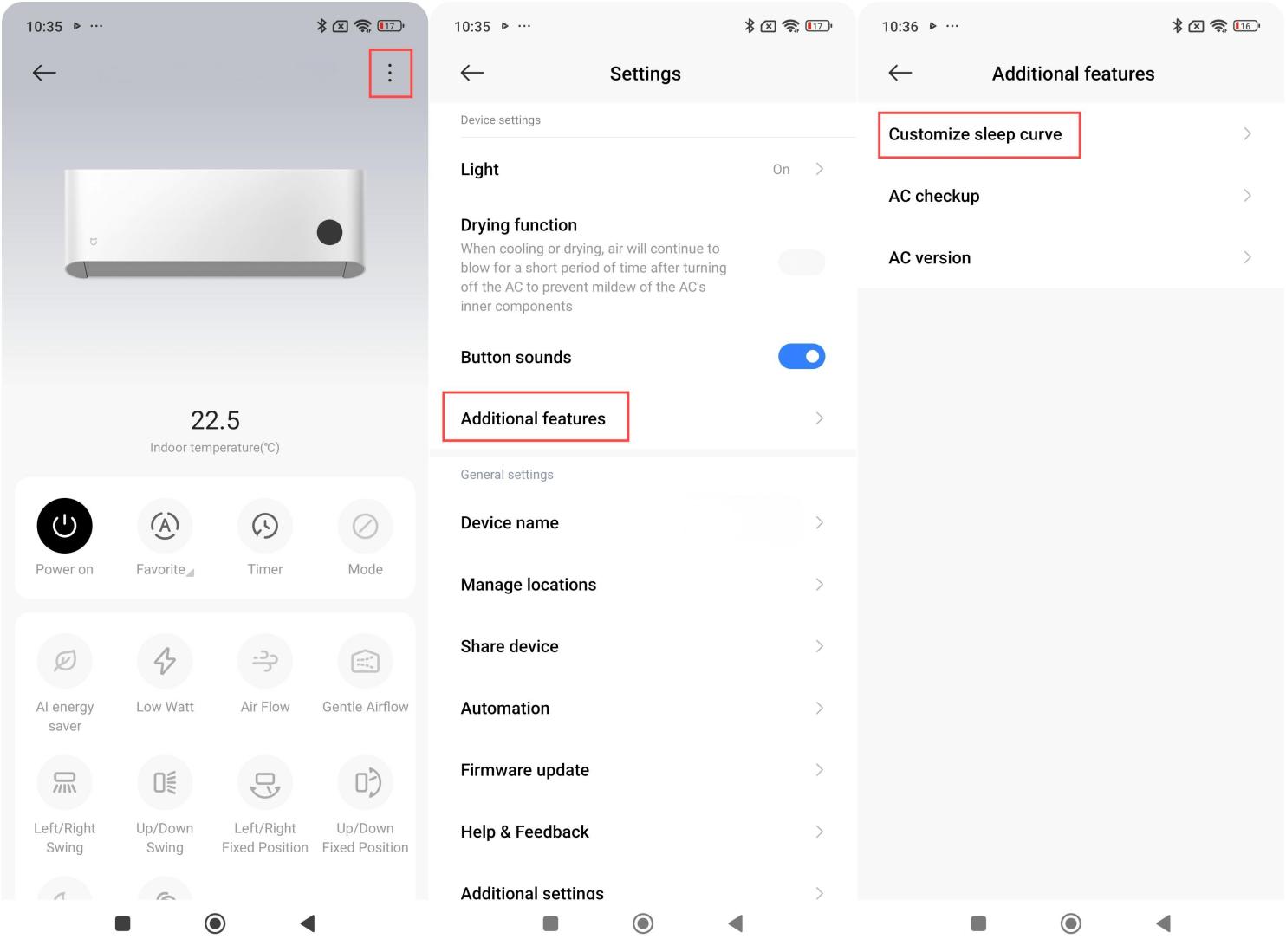
26. Q: How to check the sleep curve of the Mijia Air Conditioner Pro Eco LABEL EGAT NO.5 (3 Star) 12000BTU Inverter?
A: To check the sleep curve of the air conditioner, please refer to the following details:
1. Go to the Xiaomi Home App;
2. Tap [Mijia Air Conditioner Pro Eco LABEL EGAT NO.5 (3 Star) 12000BTU Inverter];
3. Tap the three-dot icon at the upper right corner;
4. Tap [Additional features];
5. Tap [Customize sleep curve] to check the sleep curve.
27. Q: How to change the name of the Mijia Air Conditioner Pro Eco LABEL EGAT NO.5 (3 Star) 12000BTU Inverter?
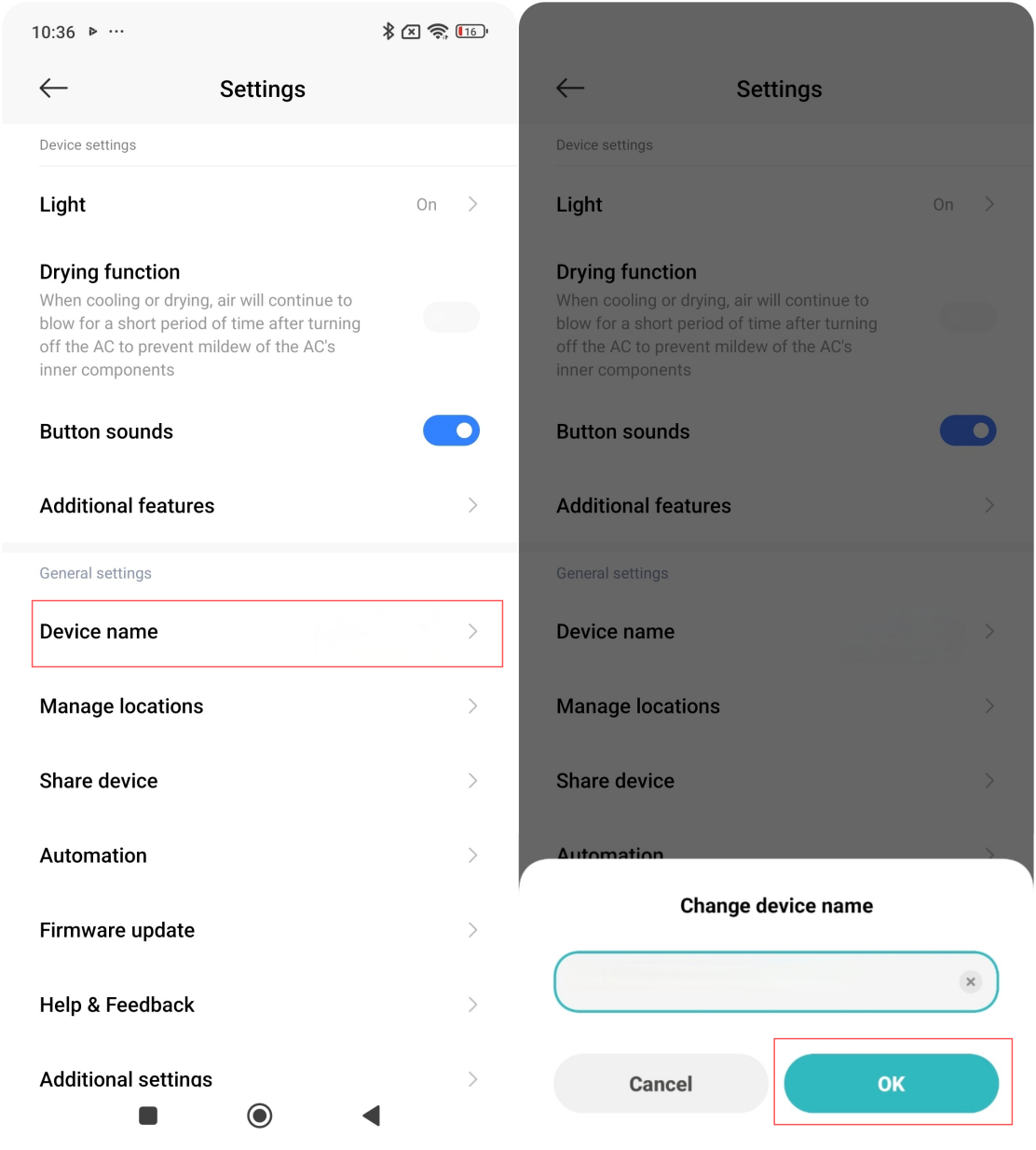
A: To change the name of the air conditioner, please refer to the following details:
1. Go to the Xiaomi Home App;
2. Tap [Mijia Air Conditioner Pro Eco LABEL EGAT NO.5 (3 Star) 12000BTU Inverter];
3. Tap the three-dot icon at the upper right corner;
4. Tap [Device name];
5. Input the desired name and tap [OK].
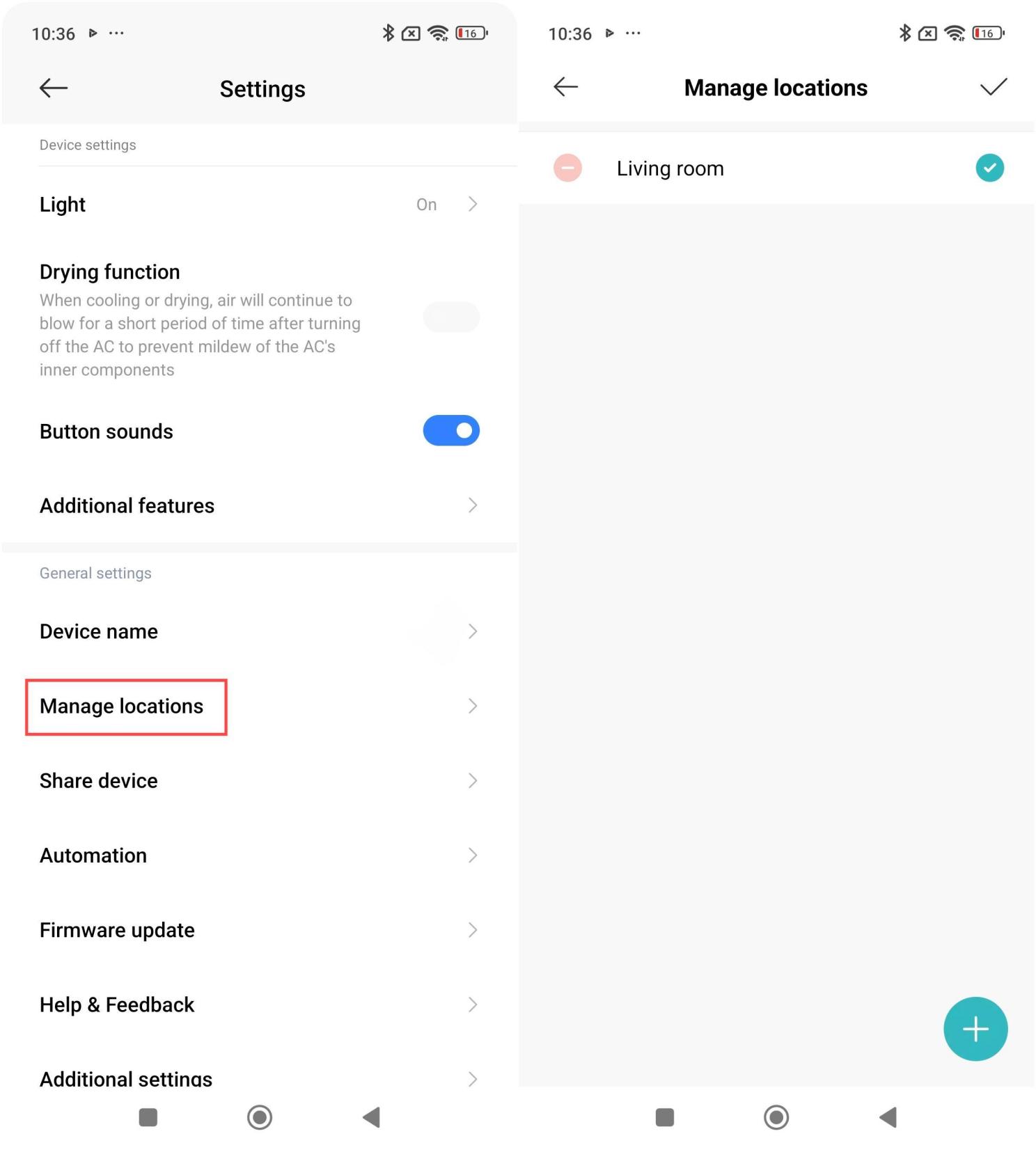
28. Q: How to manage the location of the Mijia Air Conditioner Pro Eco LABEL EGAT NO.5 (3 Star) 12000BTU Inverter?
A: To manage the location of the air conditioner, please refer to the following details:
1. Go to the Xiaomi Home App;
2. Tap [Mijia Air Conditioner Pro Eco LABEL EGAT NO.5 (3 Star) 12000BTU Inverter];
3. Tap the three-dot icon at the upper right corner;
4. Tap [Manage locations];
5. Configure the relevant settings.
29. Q: How to add the shortcut of the Mijia Air Conditioner Pro Eco LABEL EGAT NO.5 (3 Star) 12000BTU Inverter to home screen?
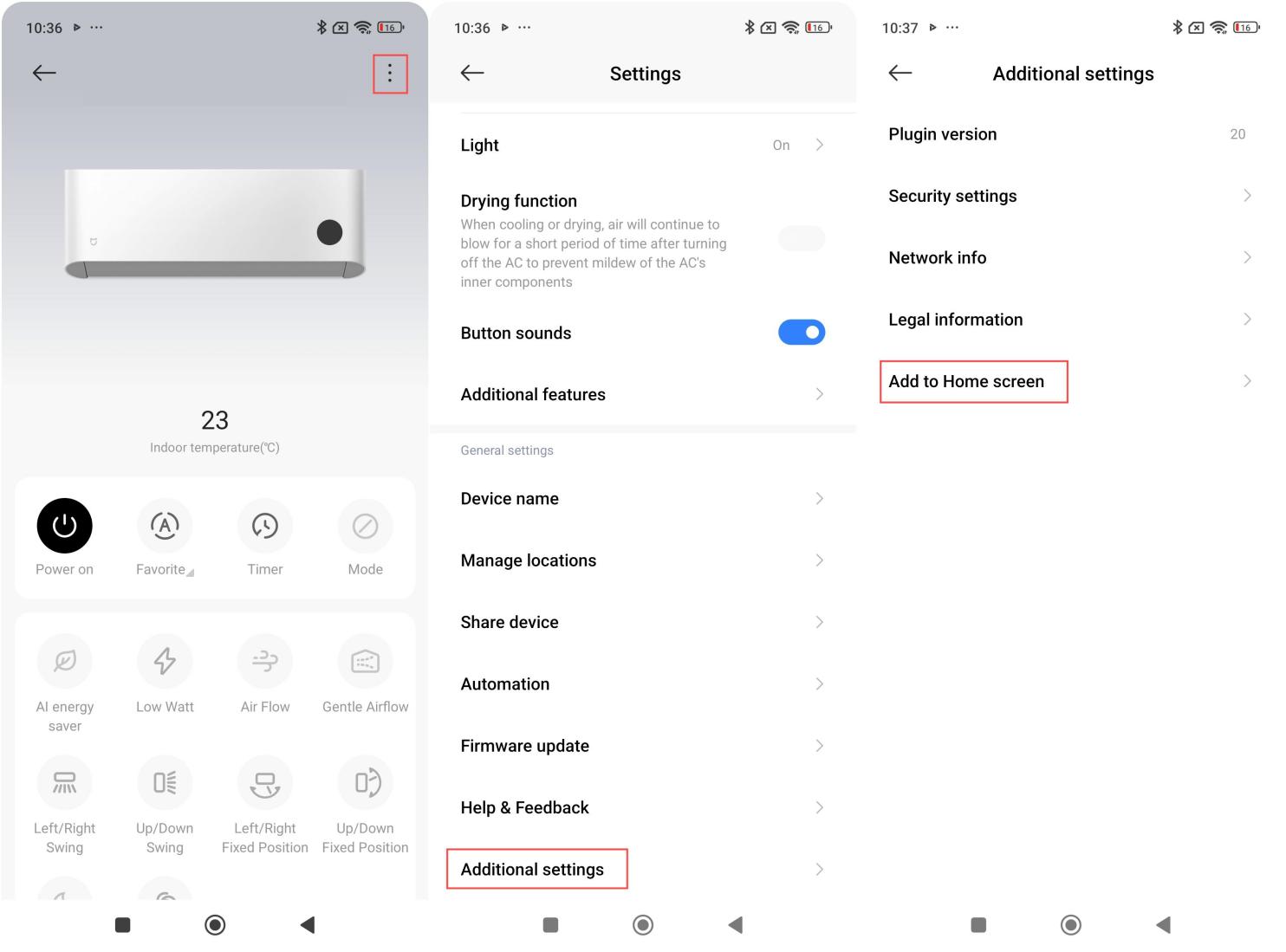
A: To add the shortcut of the air conditioner, please refer to the following details:
1. Go to the Xiaomi Home App;
2. Tap [Mijia Air Conditioner Pro Eco LABEL EGAT NO.5 (3 Star) 12000BTU Inverter];
3. Tap the three-dot icon at the upper right corner;
4. Tap [Additional settings];
5. Tap [Add to Home screen].
30. Q: What is the most energy-saving configuration of the Mijia Air Conditioner Pro Eco LABEL EGAT NO.5 (3 Star) 12000BTU Inverter?
A: When the air conditioner is running, the energy saving is closely related to the size of the room and the insulation situation. Under normal circumstances, considering the comfort and energy saving economy, the air conditioner refrigeration setting at 26°C has the best effect.
31. Q: How to bind the Mijia Air Conditioner Pro Eco LABEL EGAT NO.5 (3 Star) 12000BTU Inverter to the band and how to control the air conditioner through the band?
A: This air conditioner does not support direct pairing with a smart band.
32. Q: Does the Mijia Air Conditioner Pro Eco LABEL EGAT NO.5 (3 Star) 12000BTU Inverter support memory function? (Will the air conditioner restore to the previous configuration after the power-off?)
A: The air conditioner has a power-off memory function, but it will only record and save the running status of the air conditioner before the last power-off. It will not turn on the air conditioner by itself after powering on again, and the you still need to turn it on manually.
33. Q: How to use Auto-clean of the Mijia Air Conditioner Pro Eco LABEL EGAT NO.5 (3 Star) 12000BTU Inverter?
A: When the air conditioner is turned off, simultaneously press and hold the LOW WATT Button and the Timer Button for more than three seconds to enable Auto-clean. The remote control will show automatic cleaning, and the display of the air conditioner is blinking. Then the air conditioner will run for about 40 minutes, and automatically exit Auto-clean and shut down.
34. Q: How to use the LOW WATT function of the Mijia Air Conditioner Pro Eco LABEL EGAT NO.5 (3 Star) 12000BTU Inverter?
A: LOW WATT supports 6-level adjustment: level 1, level 2, level 3, level 4, level 5, level 6, and off. In cooling mode, press the LOW WATT Button to turn on, turn off or cycle through LOW-WATT levels.
35. Q: How to turn on and turn off the Mijia Air Conditioner Pro Eco LABEL EGAT NO.5 (3 Star) 12000BTU Inverter?
A: To turn on and turn off the air conditioner, please refer to the following details:
1. The remote control is aligned with the display of the air conditioner, and press the On/Off Button to turn on or turn off the air conditioner;
2. After the air conditioner is connected to the network, you can tap the power icon on the air conditioner interface in the Xiaomi Home App;
3. If you need to turn on and turn off the air conditioner as a scheduled time, you can tap the Timer icon on the air conditioner interface in the Xiaomi Home App or press the Timer Button on the remote control to complete the timing function.
36. Q: What are the modes of the Mijia Air Conditioner Pro Eco LABEL EGAT NO.5 (3 Star) 12000BTU Inverter?
A: Cooling mode, dry mode, and fan mode.
37. Q: Does the filter of the Mijia Air Conditioner Pro Eco LABEL EGAT NO.5 (3 Star) 12000BTU Inverter need to be replaced regularly?
A: If the filter is not damaged or deformed, it does not need to be replaced.
38. Q: How to clean the evaporator of the Mijia Air Conditioner Pro Eco LABEL EGAT NO.5 (3 Star) 12000BTU Inverter?
A: When the air conditioner is powered off, remove the inner frame. First spray the fins of the internal evaporator with cleaning agent, and then rinse with water after 5-10min. Pay attention to the cleaning process to avoid water ingress of the electronic control box and display board terminals to avoid electronic control failures caused by water ingress.
If you use Auto clean mode for cleaning, please refer to the Auto clean mode instructions. Because the evaporator cleaning requires the removal of the internal panel, it is not recommended to do it yourself.
39. Q: Can the direction of indoor unit pipeline of the Mijia Air Conditioner Pro Eco LABEL EGAT NO.5 (3 Star) 12000BTU Inverter be adjusted?
A: The direction of the indoor unit pipeline can be adjusted to left, back, and right.
40. Q: Why is the filter on the top of the Mijia Air Conditioner Pro Eco LABEL EGAT NO.5 (3 Star) 12000BTU Inverter and what are the advantages?
A: The integrated filter that simplifies the design and development of the air conditioner meets the needs of the above air intake to block dust.
The advantages of the location of the filter are listed below:
1. It is convenient to disassemble the filter. Only one operation is required, and other parts do not need to be disassembled;
2. Integrated filter, the filter does not need to be cleaned separately, and the operation is simpler.
41. Q: How to use the Turbo mode of the Mijia Air Conditioner Pro Eco LABEL EGAT NO.5 (3 Star) 12000BTU Inverter?
A: After the air conditioner is turned on normally, press the Turbo Button on the remote control to turn on or off the Turbo mode of the air conditioner. You can also turn on or turn off the Turbo mode through tapping [Turbo] on the air conditioner interface in the Xiaomi Home App.
42. Q: How does the Turbo mode of the Mijia Air Conditioner Pro Eco LABEL EGAT NO.5 (3 Star) 12000BTU Inverter work?
A: The Turbo mode maximizes the air conditioner's cooling capacity with one touch to achieve rapid cooling. After the Turbo mode is turned on, the system adjusts the operating frequency and speed of the air conditioner compressor, fan, etc. to the maximum value to achieve the purpose of rapid cooling.
43. Q: How to use the gentle airflow function of the Mijia Air Conditioner Pro Eco LABEL EGAT NO.5 (3 Star) 12000BTU Inverter?
A: Press the Air Flow Button to cycle through the feeling modes: gentle airflow, upward airflow, downward airflow, circulating airflow, and off. When the Airflow icon on the remote control display is showed as gentle airflow, the current airflow is gentle airflow.
44. Q: How does the gentle airflow of the Mijia Air Conditioner Pro Eco LABEL EGAT NO.5 (3 Star) 12000BTU Inverter work?
A: The air conditioner is equipped with a soft wind guide plate. When the gentle airflow is enabled, the left and right sweeping stepper motors drive the wind guide plate to switch the angle perpendicular to the air outlet direction, and use the holes reserved on the left and right wind guide plates to disperse the blown wind to form a soft wind effect.
45. Q: How often does the Auto clean function of the Mijia Air Conditioner Pro Eco LABEL EGAT NO.5 (3 Star) 12000BTU Inverter run?
A: It is recommended that use the Auto clean function once a month. If the use environment is poor, such as dusty, it is recommended to shorten the cycle.
46. Q: After the Mijia Air Conditioner Pro Eco LABEL EGAT NO.5 (3 Star) 12000BTU Inverter is connected to Wi-Fi, will it automatically connect when it is powered on again after a power outage?
A: After the Mijia Air Conditioner Pro Eco LABEL EGAT NO.5 (3 Star) 12000BTU Inverter is connected to Wi-Fi, the device will automatically connect to APP when it is powered on again after a power outage. However, if the power outage is too long and you cannot connect, please reset the Wi-Fi and reconnect.
A: The OTA upgrade will be rolled out progressively starting from September 25, 2025.
Here are the update contents of the Mijia Air Conditioner Pro Eco LABEL EGAT NO.5 (3 Star) 12000BTU Inverter:
1. Multiple cooling modes;
2. Adjustable noise levels;
3. Smart anti-condensation;
4. Cloud-based filter cleaning reminder.
50. Q: What are the cooling modes of the Mijia Air Conditioner Pro Eco LABEL EGAT NO.5 (3 Star) 12000BTU Inverter after OTA update?
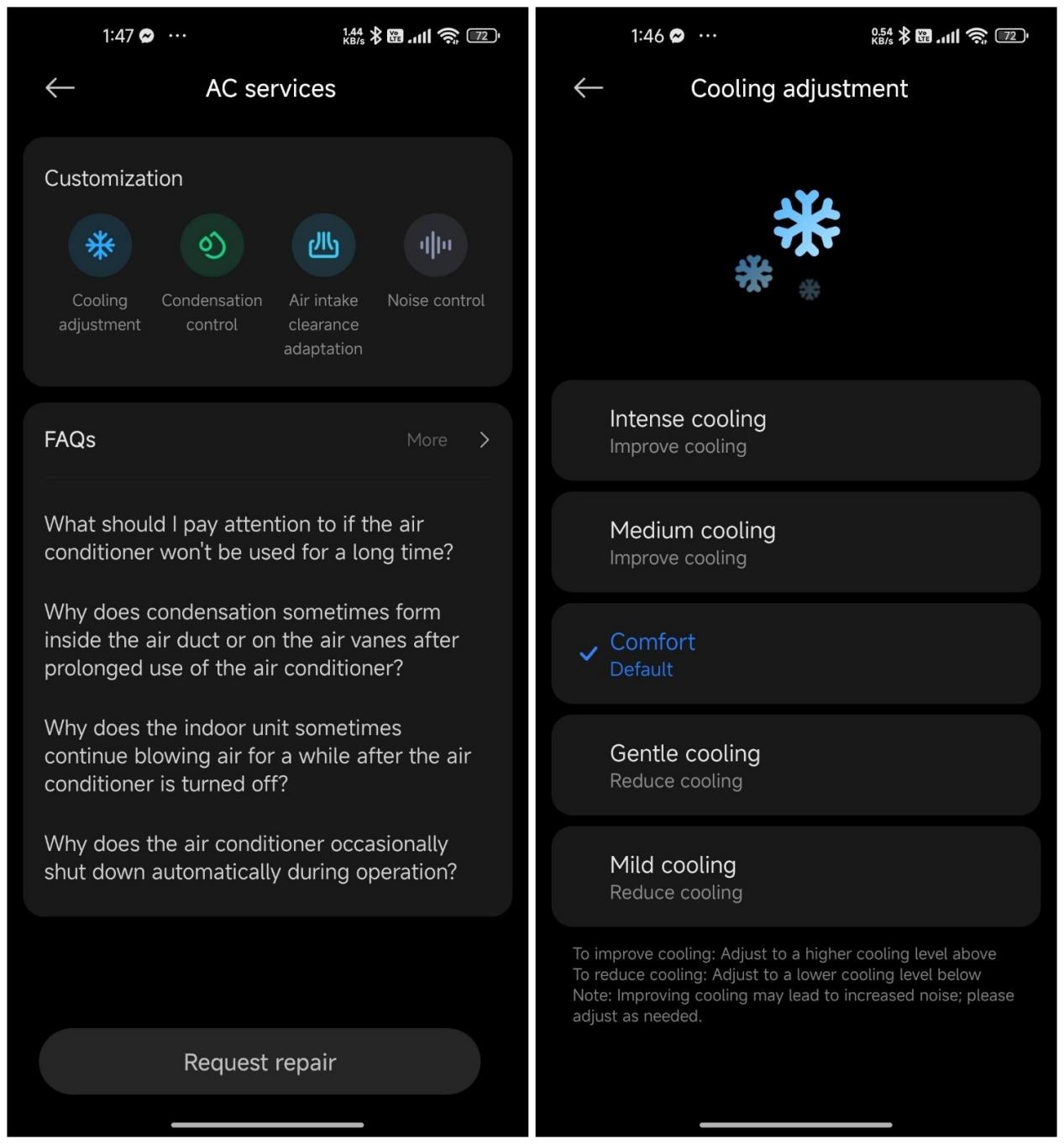
A: After the OTA update, there are multiple cooling modes added to the Mijia Air Conditioner Pro Eco LABEL EGAT NO.5 (3 Star) 12000BTU Inverter. The cooling modes include Intense cooling, Medium cooling, Comfort, Gentle cooling, and Mild cooling.
To improve cooling, please adjust the cooling mode to a higher cooling level above.
To reduce cooling, please adjust the cooling mode to a lower cooling level below.
Note:
Improving cooling may lead to increased noise, please adjust as needed.
51. Q: What is filter cleaning reminder on the Mijia Air Conditioner Pro Eco LABEL EGAT NO.5 (3 Star) 12000BTU Inverter?
A: The Cloud-based filter cleaning reminder is calculated based on the difference between the air outlet temperature and the air inlet temperature, pipe temperature and other parameters detected by the air conditioner, not based on the number of days or hours of operation.
Troubleshooting
1. Q: What to do if the Mijia Air Conditioner Pro Eco LABEL EGAT NO.5 (3 Star) 12000BTU Inverter fails to connect to the Xiaomi Home App?
A: If the air conditioner fails to connect to the Xiaomi Home App, please refer to the following details:
1. Check whether the air conditioner is turned on and waiting for connection, unplug the power supply for 10 seconds and then power on, or directly reset the Wi-Fi of the air conditioner and try to connect to Wi-Fi;
2. Check whether the Wi-Fi is 2.4GHz network. The air conditioner does not support connecting to 5GHz Wi-Fi network;
3. Make sure that the router is not too far from the air conditioner, and the router can access the network normally;
4. Confirm that the SSID and password of the router do not have special characters, and ensure that the SSID and password entered are correct;
5. You can also use the hotspot of the mobile phone to verify whether it is a router problem;
6. To upgrade the Xiaomi Home App to the latest version, please follow the steps prompts of Xiaomi Home App to connect to the air conditioner.
2. Q: What to do if the firmware upgrade of the Mijia Air Conditioner Pro Eco LABEL EGAT NO.5 (3 Star) 12000BTU Inverter in the Xiaomi Home App fails?
A: If the firmware upgrade of the air conditioner fails, please refer to the following details:
1. Please update the Xiaomi Home App to the latest version;
2. Please check whether the Wi-Fi network is normal;
3. Please change the network environment and check whether the upgrade can be carried out normally;
4. During the firmware upgrade process, please do not exit the upgrade page or the Xiaomi Home App to ensure that the upgrade is accomplished completely.
If the above steps still cannot solve the problem, it is recommended that you apply for after-sales inspection.
3. Q: What to do if the cooling of the Mijia Air Conditioner Pro Eco LABEL EGAT NO.5 (3 Star) 12000BTU Inverter stops?
A: If the air conditioner stops cooling, please refer to the following details:
1. Please confirm whether the ambient temperature reaches the temperature. When it reaches the temperature, the air conditioner will reduce the frequency and fan speed;
2. Please enable LOW WATT mode and observe whether the air conditioner can work normally;
3. Please confirm whether the air conditioner shows the fault code, and some of the codes are protection codes. Power off the air conditioner for a while and power it on again to check whether the air conditioner can work normally.
If the above steps still cannot solve the problem, it is recommended that you apply for after-sales inspection.
4. Q: What are the Wi-Fi indicator statuses of the Mijia Air Conditioner Pro Eco LABEL EGAT NO.5 (3 Star) 12000BTU Inverter?
A: The Wi-Fi indicator statuses of the air conditioner are listed below:
1. Wi-Fi indicator blinking: Wi-Fi is not connected within half an hour;
2. Wi-Fi indicator is off in the power-on status: Wi-Fi is not connected more than half an hour;
3. Wi-Fi indicator is always on in the power-on status: Wi-Fi is connected;
4. Wi-Fi indicator is always on in the power-off status: Standby indicator.
5. Q: Why is the Wi-Fi indicator of the Mijia Air Conditioner Pro Eco LABEL EGAT NO.5 (3 Star) 12000BTU Inverter abnormal?
A: Please check whether the air conditioner can connect to the network. If the network connection is abnormal, please apply for the after-sales inspection.
6. Q: What to do if the temperature of the Mijia Air Conditioner Pro Eco LABEL EGAT NO.5 (3 Star) 12000BTU Inverter cannot be adjusted?
A: If the temperature of the air conditioner cannot be adjusted when using the remote control, please refer to the following details:
1. Please first confirm whether the battery of the remote control has remaining power. If the remote control cannot be operated due to the dead battery, replace the new battery and it can be used normally;
2. When confirming that the battery of the remote control has remaining power, confirm whether the remote control is displayed normally and whether other buttons of the remote control can operate normally;
3. Please check whether the air conditioner is at the Low Watt mode or Sleep mode, which will affect the temperature adjustment;
4. After confirming that there is no abnormality in the remote control, confirm whether the air conditioner can receive the remote control signal of the remote control (such as: whether to hear the beep);
5. Please power off the air conditioner for 3 to 5 minutes and restart it to check whether the issue can restore.
If the methods cannot solve the problem, please apply for the after-sales inspection.
If the temperature of the air conditioner cannot be adjusted when using the Xiaomi Home App, please refer to the following details:
1. Disconnect the Xiaomi Home App (need to be completely disconnected, delete the device on the APP and reset the air conditioner Wi-Fi), only use the remote control to control;
2. Check whether it is the remote control interference of other devices in the home, and confirm whether the remote control of other device is operated when the air conditioner is abnormal;
3. If the problem still reappears after the above methods, it is recommended that you apply for after-sales service;
4. If the problem does not recur, it will be a problem with the setting of the Xiaomi Home App (some smart scenes, such as sleep curve, Low Watt mode, etc.). You can reset the air conditioner Wi-Fi, reconnect to the Xiaomi Home App, and clear the historical data.
When neither of the remote control and the Xiaomi Home App can control the air conditioner, please apply for after-sales inspection.
7. Q: What to do if the airflow temperature of the Mijia Air Conditioner Pro Eco LABEL EGAT NO.5 (3 Star) 12000BTU Inverter is not suitable?
A: If the airflow temperature of the air conditioner is not suitable, please refer to the following details:
1. Check the setting mode of the air conditioner to ensure that the mode suitable for the current season (cooling or fan mode) is selected;
2. Adjust the temperature setting to increase or decrease the set temperature according to your comfort level;
3. Adjust the fan speed setting. Adjusting the fan speed can also help improve the comfort of the airflow temperature;
4. Please check whether the filter of the indoor unit is blocked and dirty and clean it.
8. Q: What to do if the airflow direction of the Mijia Air Conditioner Pro Eco LABEL EGAT NO.5 (3 Star) 12000BTU Inverter cannot be changed?
A: If the airflow direction of the air conditioner cannot be changed, please refer to the following details:
1. Please confirm that the function is not set fault first, and the fan mode has been turned on;
2. Shake to check whether the air guide blade is stuck, and check the cause of interference when encountering stuck.
If it cannot be ruled out, it is recommended that you apply for after-sales inspection.
9. Q: What to do if the fan speed of the Mijia Air Conditioner Pro Eco LABEL EGAT NO.5 (3 Star) 12000BTU Inverter cannot be adjusted?
A: If the fan speed of the air conditioner cannot be adjusted when using the remote control, please refer to the following details:
1. Please first confirm whether the battery of the remote control has remaining power. If the remote control cannot be operated due to the dead battery, replace the new battery and it can be used normally;
2. When confirming that the battery of the remote control has remaining power, confirm whether the remote control is displayed normally and whether other buttons of the remote control can operate normally;
3. Please check whether the fan speed level is displayed on the remote control screen, and press the Fan Speed Button to adjust;
4. After confirming that there is no abnormality in the remote control, confirm whether the air conditioner can receive the remote control signal of the remote control (such as whether the beep can be heard);
5. Please power off the air conditioner for 3 to 5 minutes and restart it to check whether the issue can restore.
If the methods above cannot solve the problem, please apply for after-sales inspection.
If the fan speed of the air conditioner cannot be adjusted when using the Xiaomi Home App, please refer to the following details:
1. Disconnect the Xiaomi Home App (need to be completely disconnected, delete the device on the APP and reset the air conditioner Wi-Fi), only use the remote control to control;
2. Check whether it is the remote control interference of other devices in the home, and confirm whether the remote control of other device is operated when the air conditioner is abnormal;
3. If the problem still reappears after the above methods, it is recommended that you apply for after-sales service;
4. If the problem does not recur, it will be a problem with the setting of the Xiaomi Home App. You can reset the Wi-Fi of the air conditioner, reconnect to the Xiaomi Home App, and clear the historical data.
10. Q: What to do if Timer of the Mijia Air Conditioner Pro Eco LABEL EGAT NO.5 (3 Star) 12000BTU Inverter cannot be used?
A: If Timer of the air conditioner cannot be used, please refer to the following details:
1. First of all, please check whether the air conditioner is connected to the network normally. Timer requires the network to be normal to perform;
2. If the air conditioner is connected to the network normally, but Timer still cannot be used, please try to restart the air conditioner to see if it can solve the problem;
3. If the problem persists after restarting the air conditioner, please check whether you have set Timer through the Xiaomi Home App. If so, make sure that the memory chip of the air conditioner is not reset due to power failure. If the air conditioner is configured with Timer through the Mi Home/Xiaomi Homme APP, it will not be able to execute after disconnection, because the Xiaomi Home App needs to send instructions to the air conditioner through the network.
11. Q: Why is the cooling effect of the Mijia Air Conditioner Pro Eco LABEL EGAT NO.5 (3 Star) 12000BTU Inverter poor?
A: If the cooling effect of the air conditioner is poor, please refer to the following details:
1. Please check the air conditioner configuration, disable sleep mode and increase the fan speed to improve the cooling effect;
2. Please check whether the usage environment has heat source and whether the door and windows are closed;
3. Please check whether the inlet and outlet are blocked to ensure the air circulation;
4. Please check whether the filter of the indoor unit is blocked and dirty and clean it;
5. Please check whether the outdoor temperature is too high, which will affect the cooling effect of the air conditioner.
If the above steps still cannot solve the problem, it is recommended that you apply for after-sales inspection.
12. Q: What to do if the Mijia Air Conditioner Pro Eco LABEL EGAT NO.5 (3 Star) 12000BTU Inverter does not cool?
A: If the air conditioner does not cool, please refer to the following details:
1. Please check the air conditioner configuration, enable the cool mode and adjust the fan speed to the highest level;
2. After 5 minutes of powering on, please place your hand at the air outlet to feel whether there is cold air blowing out. If there is cold air blowing out, it means the air conditioner is working properly. It takes a certain amount of time for the refrigeration to lower the temperature in the room.
If the above steps cannot solve the problem, it is recommended that you apply for after-sales inspection.
13. Q: Why is the airflow volume of the outlet of the Mijia Air Conditioner Pro Eco LABEL EGAT NO.5 (3 Star) 12000BTU Inverter small?
A: If the airflow volume of the air conditioner is small, please refer to the following details:
1. Please adjust the fan speed to the highest level and check;
2. Please check whether the filter of the indoor unit is blocked and dirty, which will affect the airflow volume. It is recommended that you check and clean the filter of the air conditioner to solve the problem of small air output.
If the above steps still cannot solve the problem, it is recommended that you apply for after-sales inspection.
14. Q: What to do if the Mijia Air Conditioner Pro Eco LABEL EGAT NO.5 (3 Star) 12000BTU Inverter cannot be turned on?
A: If the air conditioner cannot be turned on, please refer to the following details:
1. Check whether the socket is powered. If you use a power socket, you can use other electrical appliances to try whether the power supply is powered (there will be a beep sound when the air conditioner is powered on. If there is a sound, it proves that the air conditioner is powered normally);
2. Check whether the battery of the remote control is depleted and replace the battery. (Please use the camera function of your mobile phone to point the camera at the remote control to observe whether there is a signal transmission. If you can see a red flashing dot, it means that the signal transmission of the remote control is normal.);
3. If the air conditioner is connected to the Xiaomi Home App, you can turn it on in the APP. If the air conditioner can be turned on through the APP, the problem will be caused by the remote control.
If the above steps still cannot solve the problem, it is recommended that you apply for after-sales inspection.
15. Q: What to do if there is a circuit breaker tripped when using the Mijia Air Conditioner Pro Eco LABEL EGAT NO.5 (3 Star) 12000BTU Inverter?
A: If the air conditioner has circuit breaker tripped during use, please use the Low Watt function of the air conditioner to observe whether it can work normally. If it can work normally, it is due to power limitation. If it still cannot be solved, please apply for after-sales inspection.
16. Q: What to do if the Mijia Air Conditioner Pro Eco LABEL EGAT NO.5 (3 Star) 12000BTU Inverter makes noise during operation?
A: If the Mijia Air Conditioner Pro Eco LABEL EGAT NO.5 (3 Star) 12000BTU Inverter makes noise during operation, please follow these steps:
1. Identify the type of noise, for example, airflow sound, relay clicking sound, thermal expansion or contraction of plastic parts, compressor operation noise, or water flow sound. These are considered normal;
2. If there are external speakers nearby, they can produce noise due to electromagnetic interference after the air conditioner is turned on. Try adjusting the position of the external speakers;
3. If you hear other unusual sounds or the noise level is excessively loud, please contact after-sales service for inspection.
17. Q: How to prevent the Mijia Air Conditioner Pro Eco LABEL EGAT NO.5 (3 Star) 12000BTU Inverter from freezing?
A: The air conditioner only has cooling mode. During normal operation, the indoor and outdoor units will not freeze. If the indoor unit is found to be frozen, please apply for after-sales inspection.
18. Q: How to deal with the water leakage of the indoor unit of the Mijia Air Conditioner Pro Eco LABEL EGAT NO.5 (3 Star) 12000BTU Inverter?
A: If there is the water leakage of the indoor unit, please refer to the following details:
1. Please check if the indoor unit filter is too dirty. If the filter is too dirty, the air intake will not be smooth, causing water accumulation and leakage. Please clean the indoor unit filter;
2. Please observe whether there are occasional condensation of water droplets at the indoor unit outlet. It is caused by high humidity in the air and condensation of water vapor when it encounters cold. This is a normal phenomenon. You can close the doors and windows appropriately, increase the setting temperature, increase the wind speed, enable Left/Right Swing or Up/Down Swing, etc;
3. If there is a large amount of water leakage in the indoor unit, please turn off the air conditioner immediately, disconnect the power of the air conditioner, wipe off the water, apply for after-sales inspection and ensure that the air conditioner is not used before the service personnel handle it.
19. Q: How to deal with the water leakage of the outdoor unit of the Mijia Air Conditioner Pro Eco LABEL EGAT NO.5 (3 Star) 12000BTU Inverter?
A: The air conditioner only supports cooling mode, and the outdoor unit will not produce condensed water. If the outdoor unit leaks during cooling, it is because some pipes of the outdoor unit are in a low-temperature state when the air conditioner is cooling. When the outdoor air humidity is high, condensed water will form on the surface of the low-temperature pipe. The condensed water will drip onto the chassis and be discharged through the chassis drain port. This is a normal phenomenon and does not require maintenance.
Note:
1. It will also be that the residual rainwater is discharged from the drain port after the rain;
2. If you think this situation needs to be dealt with, you can apply to the after-sales services to install a drain nozzle and drainage hose on the bottom of the outdoor unit.
20. Q: What to do if the remote control of the Mijia Air Conditioner Pro Eco LABEL EGAT NO.5 (3 Star) 12000BTU Inverter does not work or experiences button failure?
A: If the remote control of the air conditioner does not work or experiences button failure, please refer to the following details:
1. First confirm whether the remote control battery is normal;
2. If you still can't use the remote control, try to power off and restart;
3. Check for other disturbances around the use environment, such as devices, routers or high-power appliances placed nearby, that affect the signal;
4. Please use the camera of your mobile phone to point the camera at the remote control to observe whether there is a signal transmission. If you can see a red flashing dot, it means that the signal transmission of the remote control is normal.
If the above steps are useless, it is recommended that you apply for after-sales inspection.
21. Q: What to do if the Mijia Air Conditioner Pro Eco LABEL EGAT NO.5 (3 Star) 12000BTU Inverter emits abnormal odors?
A: If the air conditioner has abnormal odors, please check whether the filter is too dirty. Please clean the filter and observe whether the odor still exists. If it still cannot be solved, please apply for after-sales inspection.
22. Q: What to do if the outdoor unit of the Mijia Air Conditioner Pro Eco LABEL EGAT NO.5 (3 Star) 12000BTU Inverter smokes?
A: If there are smokes from the outdoor unit, shut down as soon as possible and apply for after-sales inspection.
23. Q: What to do if Auto clean of the Mijia Air Conditioner Pro Eco LABEL EGAT NO.5 (3 Star) 12000BTU Inverter fails or has bad effects?
A: If Auto clean of the air conditioner fails or has bad effects, please refer to the following details:
1. Ensure that after Auto clean is turned on, the air conditioner can complete the entire cleaning process. The Auto clean time is about 30 to 40 minutes. According to the working environment, the time varies slightly;
2. If Auto clean starts the protection due to too high or too low temperature during operation, it will cause Auto clean to fail to operate normally or exit halfway. It is recommended that you start Auto clean in a suitable temperature environment to avoid the situation of too high or too low temperature;
3. During operation, there will be noise, smaller indoor air volume, cold or hot air that is blown out. The above phenomena indicate that the cleaning function is running normally. In order to avoid discomfort, it is recommended that you ventilate the room.
Note:
1. These temperatures cannot make Auto clean work: the indoor temperature over 30℃ and the outdoor temperature over 40℃, the indoor temperature over 38℃, the indoor temperature below 16℃ and the outdoor temperature below 0℃;
2. During Auto clean process, press the power button, and Auto clean will not be exited immediately. Depending on the current operation process, you can choose a reasonable operation mode to complete or end the function to prevent damage to the air conditioner.
24. Q: How to clean the filter of the Mijia Air Conditioner Pro Eco LABEL EGAT NO.5 (3 Star) 12000BTU Inverter and how often does it need to be cleaned?
A: To clean the filter of the air conditioner, please refer to the following methods:
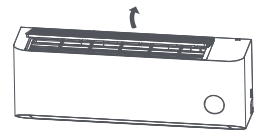
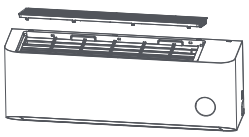
1. Removing the filter: As shown in the figure, open the clips at both ends and the middle of the filter, and pull upward to remove the filter;
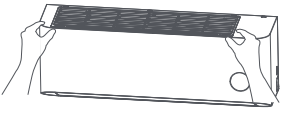
2. Cleaning the filter: After the filter is removed, use a vacuum cleaner to remove the dust or rinse the filter with clean water. If the filter is dirty, clean it with neutral detergent or soapy water, then rinse it with clean water and put it in a cool place to dry;
3. Reinstalling the filter: Align the clips with the snapping positions and reinstall the filter correctly.
25. Q: What to do if Auto-clean of the Mijia Air Conditioner Pro Eco LABEL EGAT NO.5 (3 Star) 12000BTU Inverter cannot be used?
A: If Auto-clean of the air conditioner cannot be used, please refer to the following details:
1. Please confirm whether you press and hold the LOW WATT button and the Timer Button on the remote control for more than 3 seconds to enable the auto-clean function;
2. These temperatures cannot make Auto-clean work: the indoor temperature over 30℃ and the outdoor temperature over 40℃, the indoor temperature over 38℃, the indoor temperature below 16℃ and the outdoor temperature below 0℃.
If the problem still cannot be solved, please apply for the after-sales inspection.
26. Q: What to do if the indoor unit of the Mijia Air Conditioner Pro Eco LABEL EGAT NO.5 (3 Star) 12000BTU Inverter blows water or mist?
A: When the air conditioner indoor unit blows water or mist into the room, it is caused by high humidity in the room. The air conditioner's cold air temperature is low. After being blown out of the indoor unit, the cold air encounters hot air with high humidity on its way, forming water vapor condensation. In the normal conditions, no additional treatment is required. If the air humidity in the room is too high, the temperature of the evaporator and connecting pipe is low, resulting in continuous condensation on the surface of the panel and connecting pipe. This is also normal.
27. Q: What to do if the Mijia Air Conditioner Pro Eco LABEL EGAT NO.5 (3 Star) 12000BTU Inverter has abnormal odors after unpacking?
A: If the air conditioner has abnormal odors after unpacking, please refer to the following details:
1. Check whether the air conditioner is covered by other items for a long time, resulting in moisture or mildew in the air outlet;
2. If the odor comes from the smell of the plastic inside the air conditioner itself, this is a normal phenomenon of the new device, and it will disappear on its own after a while, please rest assured to use it.
28. Q: What to do if there is burning smell when using the Mijia Air Conditioner Pro Eco LABEL EGAT NO.5 (3 Star) 12000BTU Inverter?
A: If you smell an obvious burning smell when using the air conditioner, it is recommended that you immediately cut off the power and stop using it, and contact professional after-sales personnel for inspection and maintenance.
29. Q: What to do if the Mijia Air Conditioner Pro Eco LABEL EGAT NO.5 (3 Star) 12000BTU Inverter is not powered on?
A: If the air conditioner is not powered on, please refer to the following details:
1. Check whether the power cord is installed and the plug is in place;
2. Please confirm whether the socket is powered. If you use a power socket, you can use other appliances to test whether the power supply is powered;
3. Please confirm whether there is a beeping sound after the air conditioner is powered on. If there is a sound, it means that the air conditioner is powered normally.
If the problem still cannot be solved, please apply for after-sales inspection.
30. Q: What to do if the air guide blade of the Mijia Air Conditioner Pro Eco LABEL EGAT NO.5 (3 Star) 12000BTU Inverter is not tightly closed?
A: If the air guide blade of the air conditioner is not closed tightly, please turn off the air conditioner and unplug the power supply. Wait for two minutes and then plug the power supply again to see if it can be restored to normal. If it still cannot be solved, please apply for after-sales inspection.
31. Q: What to do if the remote control of the Mijia Air Conditioner Pro Eco LABEL EGAT NO.5 (3 Star) 12000BTU Inverter does not display the full content or does not display?
A: If the remote control of the air conditioner does not display the full content or does not display, please refer to the following details:
1. Check if the battery of the remote control is exhausted and try to replace the battery;
2. Please check whether the remote control is turned on. Press the On/Off Button to check whether the remote control displays.
If the above methods cannot solve the problem, please contact the after-sales service for inspection.
32. Q: What to do if the screen of the Mijia Air Conditioner Pro Eco LABEL EGAT NO.5 (3 Star) 12000BTU Inverter does not display the full content or does not display?
A: If the screen of the air conditioner does not display the full content or does not display, please refer to the following details:
1. Please press the Light Button on the remote control to check whether the screen displays;
2. Power off for 2 minutes and re-power to observe whether the air conditioner can display normally.
If the above steps cannot solve the problem, it is recommended to apply for after-sales inspection.
33. Q: What to do if the remote control display of the Mijia Air Conditioner Pro Eco LABEL EGAT NO.5 (3 Star) 12000BTU Inverter does not light up?
A: The remote control display of the air conditioner has no backlight. If the displayed numbers and icons are normal, it is normal for the screen not lighting up.
34. Q: How to deal with the error code on the display of the Mijia Air Conditioner Pro Eco LABEL EGAT NO.5 (3 Star) 12000BTU Inverter?
A: The error codes explanations and solutions are listed below:
Serial Number | Error Code Category | New Error Code | Error Definition | Error explanation | Solution |
1 | Sensor Fault Protection | F1.1 | Indoor ambient temperature sensor failure | Indoor unit ambient temperature sensing pack failure | 1. Find the corresponding sensor according to the displayed error code, re-plug the sensor, and confirm whether the sensor failure is caused by poor contact; |
2 | F1.2 | Outdoor ambient temperature sensor failure | Outdoor unit ambient temperature sensing pack failure | ||
3 | F2.1 | Indoor coil temperature sensor failure | Indoor unit pipe temperature sensing pack failure | ||
4 | F2.2 | Outdoor coil temperature sensor failure | Outdoor unit pipe temperature sensing pack failure | ||
5 | F2.3 | Indoor pipe temperature sensing pack failure | Indoor unit pipe temperature sensing pack failure protection | ||
6 | F2.4 | Outdoor pipe temperature sensing pack failure protection | Outdoor unit pipe temperature sensing pack failure protection | ||
7 | F3.1 | Outdoor exhaust temperature sensor failure | Outdoor unit exhaust temperature sensing pack failure | ||
8 | F3.2 | Exhaust temperature sensing pack failure protection | Outdoor unit exhaust temperature sensing pack failure protection | ||
9 | Electronic Control Hardware Error | E1 | Outdoor EEPROM failure | Outdoor unit electronic control program failure | 1. If you use an after-sales board, check whether the EEPROM parameters match; |
10 | E3 | Communication failure between the indoor unit board and the display board | Communication failure between the indoor unit board and the display board | 1. Check the connection wires between the main board and the display board to ensure that the wire sequence and connection are reliable: replug and connect; | |
11 | E6.1 | Indoor and outdoor communication: Data cannot be received indoors | Communication failure between the indoor and outdoor units main boards | 1. Eliminate communication failures caused by poor power supply and wiring; | |
12 | E6.2 | Indoor and outdoor communication: Data cannot be received outdoors | Communication failure between the indoor and outdoor units main boards | ||
13 | E8.1 | Communication failure between the outdoor unit compressor chip and the fan chip | Outdoor unit electronic control communication failure | Replace the outdoor unit electrical control panel. | |
14 | E8.2 | Communication failure between indoor unit board and fan chip | Indoor unit electronic control communication failure | Replace the indoor unit electrical control panel. | |
15 | FF | The indoor unit cannot receive the Internet module (SOC, Wi-Fi) communication failure | Indoor unit display panel communication failure | Request and replace the display board. | |
16 | Fan Error | E0 | Indoor PG/DC fan failure | Indoor unit fan failure | 1. Move the fan to confirm whether it is stuck. If the fan blade is stuck, remove it and reassemble it; |
17 | E2 (E2.1/E2.2/E2.3/E2.4/E2.5/E2.6/E2.7) | Outdoor DC fan failure | Outdoor unit fan failure | 1. Move the fan to see if it is stuck. If so, reassemble or replace the deformed parts; | |
18 | Outdoor Unit Electronic Control Drive Protection | U0 | U0.0: Inverter DC over-voltage fault | Outdoor unit electronic control voltage failure | 1. First check whether the input voltage at both ends of the N and L lines on the white wiring terminal of the outdoor unit is within the normal allowable range (160V, 260V) and test it in the power-on state. If it exceeds this range, it is normal protection; |
19 | U1.1 | Inverter module fault/inverter module hardware over-current fault | Outdoor unit electric control module current fault | 1. Check the compressor wiring, if the wiring is bad, rewire | |
20 | U1.2 | Outdoor current sensor failure | Outdoor unit electric control current fault | ||
21 | U1.3 | Compressor phase current circuit detection fault | Outdoor unit compressor current fault | ||
22 | U2(U2.1/U2.2/U2.3) | Over-current protection | Outdoor unit electric control over-current protection | 1. Check if the voltage is too low; | |
23 | U3 | Drive initialization fault | Outdoor unit drive start failure | 1. Check whether the main power supply voltages of the outdoor unit (DC310V, DC15V, DC12V, DC5V) are normal; | |
24 | U4(U4.1/U4.2/U4.3/U4.4) | Step loss detection/Compressor step loss protection | Outdoor unit compressor out-of-step protection | 1. System pressure imbalance, insufficient shutdown time-wait for 3-5 minutes before restarting; | |
25 | U5 | Compressor phase loss/Reverse phase protection | Outdoor unit compressor missing/reverse phase protection | ||
26 | U6.1 | Module temperature protection | Outdoor unit electronic control module temperature protection | 1. Check the voltage; it should be between 170V and 270V—use a voltage stabilizer; | |
27 | U6.2 | Module temperature sensor circuit fault | The temperature sensing pack of the outdoor unit electronic control module is faulty | 1. Check if the module board is making proper contact with the heat sink. Ensure tight, debris-free, and seamless contact between the module and the heat sink. Secure the module board screws properly. If needed, replace the outdoor unit control board; | |
28 | U8.1 | PFC hardware over-current | Outdoor unit electronic control PFC circuit over-current protection | 1. System pressure imbalance, insufficient shutdown time—wait for 3–5 minutes before restarting | |
29 | U8.2 | PFC software over-current | Outdoor unit electronic control PFC circuit over-current protection | 1. Sudden fluctuation in mains voltage—normal protection; use a voltage stabilizer; | |
30 | U8.3 | PFC RMS over-current protection | Outdoor unit electronic control PFC circuit over-current protection | 1. System pressure imbalance, insufficient shutdown time-wait for 3–5 minutes before restarting; | |
31 | Drive Limit Frequency Reduction (display 17) | C1 | Module current (compressor phase current) protection limit/frequency reduction | Outdoor unit electric control module current limit/frequency reduction | 1. Check if the voltage is too low; use a voltage stabilizer; |
32 | C2 | External AC current protection limit/frequency reduction | Outdoor unit electric control AC current limit/frequency reduction | ||
33 | C3 | Compressor module temperature limit frequency reduction | Outdoor unit electric control module temperature limit/frequency reduction | ||
34 | C4 | Whole machine current peak limit frequency reduction | Outdoor unit electric control current peak limit/frequency reduction | ||
35 | C5 | Drive protection limit/frequency reduction | Outdoor unit electric control drive protection limit/frequency reduction | ||
36 | System Protection | P1 | Outdoor unit exhaust temperature over-high protection | Outdoor unit exhaust temperature over-high protection | 1. Check if the outdoor unit is operating under extreme high-temperature conditions. This protection is for the safety of the air conditioner; |
37 | P2 | Limit/Reduction frequency (display 17) |
|
| |
38 | P2.1 | Exhaust protection limit/reduction frequency | Outdoor unit exhaust temperature over-high limit/reduction frequency | P2.1 Check according to P1 | |
39 | P2.2 | Anti-freezing protection limit/reduction frequency | Refrigerant anti-freezing limit/reduction frequency | P2.2 Check according to P5 | |
40 | P2.3 | Anti-condensation protection limit/reduction frequency | Indoor unit evaporator anti-condensation limit/reduction frequency | P2.3 Anti-condensation protection: When humidity is too high and the device is operating at low speed, reduce the frequency to prevent excessive condensation. This is a normal protection. Close windows and doors or adjust the fan speed to high. | |
41 | P2.4 | Power over-high limit/reduction frequency | Overall unit power over-high limit/reduction frequency | P2.4 Check according to U2 | |
42 | P2.5 | Overload protection limit/reduction frequency | Overall unit overload limit/reduction frequency | P2.5 Heating overheat protection: Same as P4 or P6 | |
43 | P5 | Over-cooling protection in cooling mode | Evaporator over-cooling protection in cooling mode | 1. Check if the indoor unit filter is clogged. If so, clean it; | |
44 | P8 | Outdoor unit high/low temperature protection | Outdoor unit high/low temperature protection | 1. Check if the outdoor ambient temperature is normal for cooling operation. If the ambient temperature is abnormal, it is normal protection. This occurs when the cooling temperature exceeds the protection range (low-temperature cooling is more likely to occur); | |
45 | PA | Refrigerant shortage protection/abnormal refrigerant circulation protection | Overall unit refrigerant shortage protection/abnormal refrigerant circulation protection |
|
35. Q: What to do if the Mijia Air Conditioner Pro Eco LABEL EGAT NO.5 (3 Star) 12000BTU Inverter temperature is lower than the set temperature?
A: If the Mijia Air Conditioner Pro Eco LABEL EGAT NO.5 (3 Star) 12000BTU Inverter is cooling below the set temperature, please check whether the room size is too small, which can cause the cold air to blow directly at you. The air conditioner is designed with a temperature compensation mechanism to enhance cooling performance, ensuring effective cooling even at a distance from the device.
36. Q: What to do if the display shows rotating lines after the Mijia Air Conditioner Pro Eco LABEL EGAT NO.5 (3 Star) 12000BTU Inverter is turned off and does not shut off automatically?
A: When the Mijia Air Conditioner Pro Eco LABEL EGAT NO.5 (3 Star) 12000BTU Inverter is turned off, if the evaporator temperature is still low and a large amount of condensate remains, the device will keep the indoor unit fan running for a while. This is to help dry the evaporator and prevent microbial growth or mold caused by prolonged moisture inside the sealed unit. The display shows rotating lines during this process and will turn off automatically afterward.
37. Q: What to do if the Mijia Air Conditioner Pro Eco LABEL EGAT NO.5 (3 Star) 12000BTU Inverter's region shows as Singapore when connected to the Xiaomi Home App?
A: This is because the Xiaomi Home App server is located in Singapore. Therefore, it is normal for the region to show as Singapore. You can change the region to the location where the device is used via Xiaomi Home App >> [Profile] >> [Additional settings] >> [Region].
Does it help?