

Xiaomi Tabletop Dishwasher FAQ
Version Differences
1. Q: What are the differences between the Hong Kong version and the Taiwan version of the Xiaomi Tabletop Dishwasher?
A: The differences between the Hong Kong version and the Taiwan version are as follows:| Product name | Xiaomi Tabletop Dishwasher | |
| Version | Hong Kong version (UK standard) | Taiwan version (Taiwan standard) |
| Model | QMDW0503M | QMDW0504M |
| Rated voltage | 220V~ | 110V- |
| Rated current | ≥10A | ≥15A |
Overview
1. Q: What are the selling points of the Xiaomi Tabletop Dishwasher?
A: The selling points of the Xiaomi Tabletop Dishwasher are as follows:1. Ultra-slim body with folding door, maximizing kitchen space. The 350mm ultra-slim design has a door that extends less than 600mm into the kitchen when opened, minimizing the risk of bumps and collisions;
2. 5 + 1 large capacity, perfect for 2 to 5 person households. Capable of cleaning up to 39 pieces of tableware at once, the upper movable dish rack provides flexible expansion;
3. Three-layer four-dimensional washing system for deeper cleaning. The bottom jets tackle heavy grease while the upper jets scrub stubborn residues for a more thorough clean;
4. Dual-effect sterilization with high temperature and UV. Prevent illnesses transmitted through food;
5. PTC ceramic drying for safer constant temperature. Featuring 80°C high-efficiency heat combined with residual heat drying;
6. 96 hours long-lasting UV dry storage with 99.9% sterilization rate. Ensuring bacteria have no breeding ground;
7. Intelligent dirt detection and program matching to eliminate choice paralysis. The built-in turbidity sensor intelligently identifies the level of soiling on tableware;
8. Multiple wash modes for flexible cleaning of various greases. Five washing modes plus one added value function cover all household needs;
9. Intelligent soft water system for effective water softening. Ensuring cleaner and shinier dishes while prolonging the device's service life;
10. Two-year worry-free warranty for complete trust.
2. Q: What is the dishwasher?
A: The dishwasher is a device that automatically cleans dishes, bowls, plates, forks, knives, and other tableware. Household dishwashers come in built-in, countertop, and sink styles, and they primarily use spray rinsing for cleaning. Using a dishwasher significantly reduces the tedious labor of hand washing. The high-temperature spray not only removes food residues and grease but also kills common viruses and bacteria, such as Escherichia coli. In terms of water consumption, mainstream dishwashers generally use less than 10 liters of water, which is only about a quarter of what is used for hand washing, making them more water-efficient. The drying function of dishwashers effectively addresses the issue of dishes not drying easily when washed by hand. Regarding washing capacity, mainstream dishwashers are available in various capacities, such as 5 sets, 8 sets, and 15 sets, to meet daily household needs. As living standards continue to rise, dishwashers have gradually become essential kitchen appliances in homes.3. Q: What are the differences among countertop, built-in, and sink dishwashers?
A: Household dishwashers are generally classified into three types: built-in, countertop, and sink models.The differences among countertop, built-in, and sink dishwashers are as follows:
1. Countertop dishwashers have a capacity of 4 sets to 5 sets, are easy to install, and do not require cabinet modifications. They are suitable for renovated homes and families of five or fewer, allowing for one wash per meal, which is more hygienic;
2. Sink dishwashers also have a smaller capacity, usually around 4 sets. They occupy both countertop and under-sink space;
3. Built-in dishwashers are the mainstream product, offering larger capacities, generally accommodating more than 8 sets.
4. Q: What does the set capacity mean in the Xiaomi Tabletop Dishwasher?
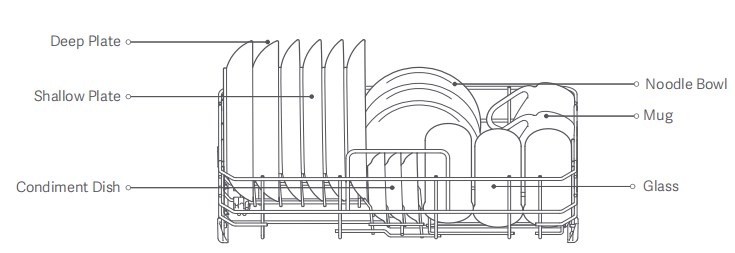
A: The capacity of the dishwasher is determined by the number of sets of tableware it can hold. The more sets it can accommodate, the larger the capacity. If dishwashers have 5 sets or 8 sets, it means that the maximum number of sets that can be loaded. The choice of how many sets a dishwasher should have depends on the number of people in the household and the quantity of tableware. A 5-set dishwasher is suitable for families of up to 5 people.The Xiaomi Tabletop Dishwasher can wash 5 rice bowls, 3 noodle bowls, 3 glasses, 2 mugs, 10 chopsticks, 5 spoons, 2 deep plates, 4 shallow plates, 3 condiment dishes, 1 rice paddle, and 1 soup ladle in one cycle.
The image below shows a reference for the tableware:
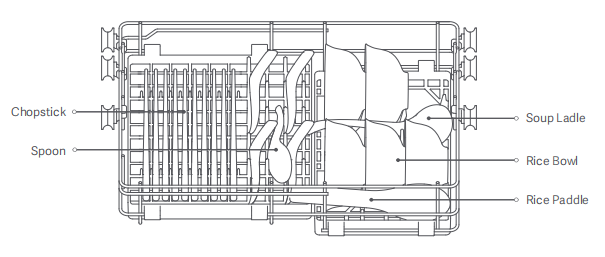
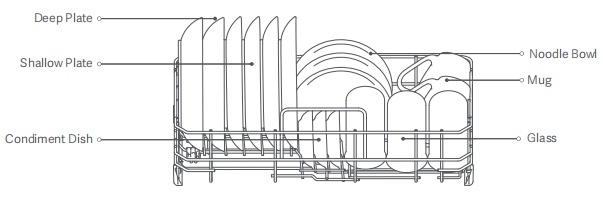
5. Q: How does the Xiaomi Tabletop Dishwasher clean the tableware?
A: 1. Water intake phase: First, water passes through a softener containing resin to remove calcium and magnesium ions;2. Washing phase: High-pressure water sprays clean the surface of the tableware, while high-temperature water expands and softens food residues. Dishwashing powder is used to enhance the cleaning effect, with the maximum wash water temperature reaching 75°C to ensure thorough cleanliness;
3. Rinsing and drying phase: The residual heat accelerates the drying of the dishes;
4. Sterilization and disinfection phase: The 75°C high-temperature wash, combined with 80°C hot air, effectively disinfects and eliminates bacteria. Additionally, the UV dry storage feature ensures the hygiene and cleanliness of the tableware, protecting family health.
Note:
It is normal for the Xiaomi Tabletop Dishwasher to drain water before starting its cycle.
6. Q: What type of drying method does the Xiaomi Tabletop Dishwasher use?
A: The Xiaomi Tabletop Dishwasher uses hot air drying (3.0), utilizing PTC heating for better drying results.Dishwashers go through several drying stages:
1. 1.0 Condensation residual heat drying: This method uses residual heat after washing to dry the dishes. However, it can lead to difficulties in expelling water vapor and condensation issues when temperatures drop. Currently, this type of dishwasher is largely unavailable on the market;
2. 2.0 Cold air ventilation drying: Some dishwashers are equipped with fans that expel water vapor. However, this method is less efficient and can not thoroughly dry the dishes. This approach is found in some entry-level dishwashers and countertop models;
3. 3.0 Hot air drying: This method uses electric heating wires (with higher-end models employing PTC technology) combined with fans to dry dishes using hot air, resulting in a higher level of dryness.
Note:
PTC stands for Positive Temperature Coefficient, referring to a type of ceramic heating element.
7. Q: What are soft water and hard water and what effects do they have on tableware?
A: Soft water refers to water that contains little or no soluble calcium or magnesium compounds. Soft water does not easily produce scale, and using it to wash dishes can enhance the cleaning efficiency of detergents, leaving the tableware looking as good as new.Hard water, contains a higher concentration of soluble calcium and magnesium compounds. While hard water does not pose direct health risks, it can lead to scale buildup in water appliances and reduce the cleaning efficiency of soaps and detergents. Over time, washing dishes with hard water can cause scale deposits on the surface of the tableware, affecting both its appearance and cleanliness.
8. Q: What is the function of the water softener in the Xiaomi Tabletop Dishwasher?
A: The water softener in the Xiaomi Tabletop Dishwasher uses resin to adsorb calcium and magnesium ions from the water, reducing its hardness to some extent. This not only helps keep the tableware shiny and new but also protects the dishwasher's interior, spray arms, and plumbing from scale buildup. Additionally, dishwashers equipped with a water softener can reduce the need for detergents, making them both cost-effective and environmentally friendly.9. Q: What is dishwasher salt?
A: Dishwasher salt, also known as ion exchange resin regenerating agent, mainly consists of sodium chloride and is in the form of pellets. As the volume of water processed increases, the resin becomes saturated with impurities, gradually losing its adsorption capacity and reaching a state of reduced effectiveness. To eliminate the impurities absorbed by the resin, sodium ions (the sodium component in dishwasher salt) are used during a backwash process to exchange and replace the impurities, thereby restoring the adsorption capacity of the ion exchange resin. Therefore, dishwasher salt must be used in conjunction with the water softener.Note:
Adding dishwasher salt allows the water softener to be reused for softening water and improves cleaning performance.
10. Q: Why should dishwasher salt be added to the Xiaomi Tabletop Dishwasher?
A: In some regions, tap water has a high hardness level. Prolonged use of hard water can lead to scale buildup inside the Xiaomi Tabletop Dishwasher and diminish its cleaning effectiveness. Therefore, dishwashers are equipped with water softeners that reduce the hardness of the tap water and decrease the concentration of calcium and magnesium ions, effectively preventing scale formation. The function of dishwasher salt is to regenerate the resin in the water softener, ensuring it continues to operate efficiently.11. Q: Can edible salt be used as a substitute for dishwasher salt?
A: Dishwasher salt must be specifically designed for dishwashers. Regular edible salt should not be used. This is because edible salt contains iodine and other substances that can cause irreversible damage to the regeneration performance of the water softener.12. Q: What are dishwasher powder and dishwasher blocks for the Xiaomi Tabletop Dishwasher?
A: Dishwasher powder and dishwasher blocks (which can be compared to laundry detergent and laundry liquid) are used to soften residues on tableware, remove grease, and enhance cleaning effectiveness. The Xiaomi Tabletop Dishwasher can utilize commercially available dishwasher powder or blocks that are specifically designed for dishwashers. It is strictly prohibited to use dishwashing liquid, as the excessive foam produced can overflow and damage the device.Installation Related
1. Q: How to install the Xiaomi Tabletop Dishwasher?
A: To install the Xiaomi Tabletop Dishwasher, please refer to the following steps:1. The installation of the device mainly involves connecting the inlet and drain hoses and plugging in the power supply. The device should be placed level on the countertop, close to the sink;
Note:
1. The power cord is about 150cm and cannot be removed or cut;
2. The inlet hose is about 150cm and cannot be cut or extended through a connection. If an extension is required, please buy a qualified hose for the extension;
3. The drain hose is about 150cm and can be cut according to the actual demand.
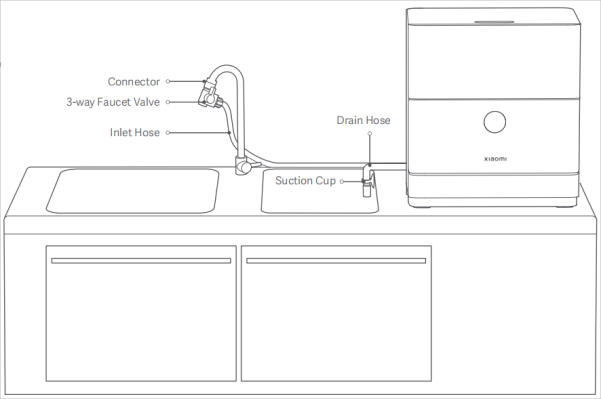

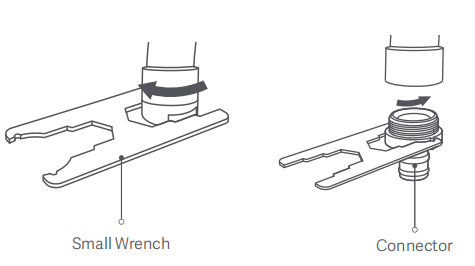
2. Remove the faucet aerator. Manually or using tools such as pliers to remove the aerator without having a slot. Use cloth for additional protection if tools are adopted. Use the included small wrench to remove the aerator with a slot. Choose a wrench socket with a proper size for removal;
Note:
Please keep the aerator properly for future use.
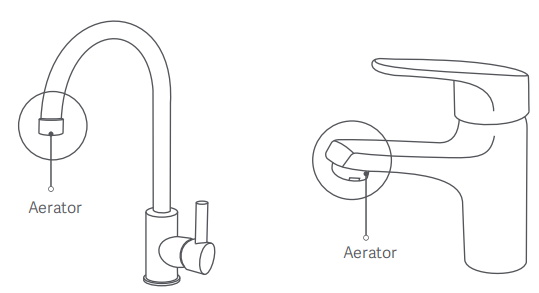
3. Install the connector. Choose a proper connector according to the size and direction of the aerator thread. Gently turn the connector by hand so that the threads engage correctly with the faucet. Then, use the small wrench and hold it horizontally to apply gentle pressure to tighten the connector. After the installation is completed, block the connector by hand and open the faucet to check whether water seeps through the threaded port;
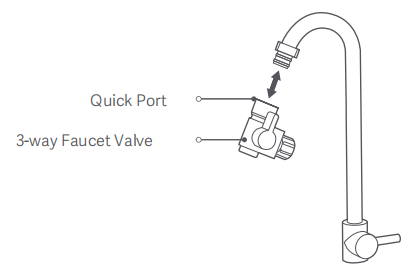
4. Connect the 3-way faucet valve. Hold the 3-way faucet valve, and insert the quick port into the connector already installed in the faucet. When you hear a click sound, the installation of the 3-way faucet valve is completed;
Note:
To remove the 3-way faucet valve, turn off the countertop faucet, remove the inlet hose, and pull the quick port downward.
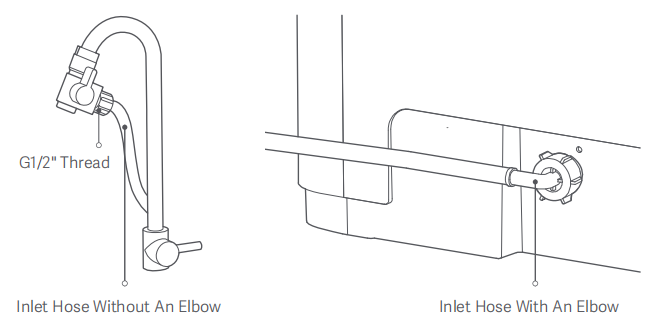
5. Connect the inlet hose. Securely attach the inlet hose without an elbow end to the G1/2" thread of the 3-way faucet valve, then attach the other end to the inlet valve on the back of the dishwasher;
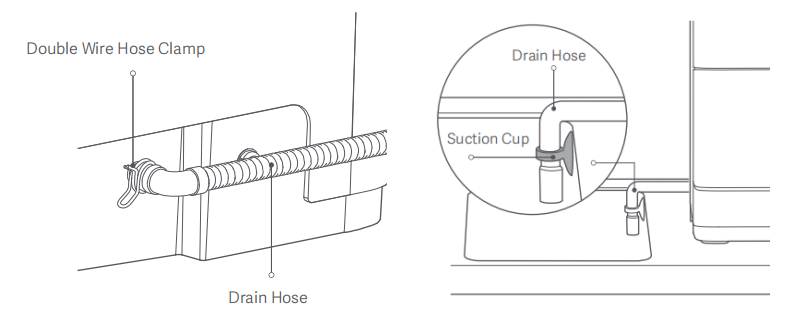
6. Install the drain hose. Insert the drain hose with an elbow end into the outlet on the back of the dishwasher, and install the double wire hose clamp to secure the drain hose to the dishwasher. Secure the other end of the drain hose to the countertop sink using a suction cup.
If the connections on the 3-way faucet valve are mismatched, please refer to the following methods:
1. You can replace the faucet with a compatible one or switch to a faucet with a built-in 3-way function;
2. You can purchase a conversion adapter to match with the faucet: use a 24mm inner thread (fine thread) to convert to a 22mm outer thread (fine thread);
3. Use the soap dispenser hole or drill a hole to install a 3-way or multi-way angle valve, installing the under-sink water pipe like that of the sink faucet;
4. Install the inlet hose at the under-sink angle valve;
5. Extend the hose installation method: install an extension hose with the under-sink angle valve, connecting one end to the inlet hose and passing the extension hose through the soap dispenser hole;
6. If the inlet pipe is near the water heater, use the angle valve of the cold water pipe from the water heater to replace it with a 3-way valve, connecting it to the inlet hose of the dishwasher.
Note:
1. During operation, the exhaust port on the left side of the dishwasher will release humid steam, and the door switch is located at the top of the device. Regardless of the installation method, it is recommended to leave more than 20cm of adequate space around these two areas;
2. When there is a hanging cabinet above the dishwasher, to ensure normal door opening, the distance from the bottom of the cabinet to the top of the dishwasher must be greater than 50mm. If this distance is less than 50mm, the dishwasher must be moved forward by more than 80mm to prevent the top opening button from being blocked by the upper cabinet.
2. Q: What are the grounding instructions for the Xiaomi Tabletop Dishwasher?
A: The grounding instructions for the Xiaomi Tabletop Dishwasher are as follows:| Product standard | Hong Kong version (UK standard) | Taiwan version (Taiwan standard) |
| Model | QMDW0503M | QMDW0504M |
| Grounding instructions | 1. The dishwasher must be connected to a ground wire, which can effectively prevent the risk of electric shock in the event of a fault or damage to the product; 2. Please use a three-prong socket that matches the hole type and is equipped with grounding protection for the dishwasher, which operates at a voltage of 220V-. Ensure that after connecting to the power supply, the ground wire is effectively connected to the public electrical grounding; 3. It is prohibited to use a two-prong power socket for connection, and the use of power sockets with overload protection is also not allowed. | 1. The dishwasher must be connected to a ground wire, which can effectively prevent the risk of electric shock in the event of a fault or damage to the product; 2. Please use a three-prong socket that matches the hole type and is equipped with grounding protection for the dishwasher, which operates at a voltage of 110V-. Ensure that after connecting to the power supply, the ground wire is effectively connected to the public electrical grounding; 3. It is prohibited to use a two-prong power socket for connection, and the use of power sockets with overload protection is also not allowed. |
3. Q: What are the prohibited items for the Xiaomi Tabletop Dishwasher?
A: The prohibited items for the Xiaomi Tabletop Dishwasher are as follows:| Product standard | Hong Kong version (UK standard) | Taiwan version (Taiwan standard) |
| Model | QMDW0503M | QMDW0504M |
| Prohibited items | The dedicated power outlet must have a rated current of ≥10A. Otherwise, it can pose risks of fire, electric shock, and other hazards. | The dedicated power outlet must have a rated current of ≥15A. Otherwise, it can pose risks of fire, electric shock, and other hazards. |
4. Q: What are the installation requirements for the Xiaomi Tabletop Dishwasher?
A: The installation requirements for the Xiaomi Tabletop Dishwasher are as follows:| Product standard | Hong Kong version (UK standard) | Taiwan version (Taiwan standard) |
| Model | QMDW0503M | QMDW0504M |
| Installation requirements | 1. The dishwasher should be installed close to a sewer and a tap water source and plugged into a 3-prong reliably grounded socket with a rated current of no less than 10A; 2. The inlet water pressure should be from 0.04MPa to 0.4MPa and the inlet water temperature should not be higher than 40°C; 3. Make sure the dishwasher can be installed horizontally; 4. Avoid the vent on the upper left side of the dishwasher from directly facing devices such as sockets. This is because the vent can emit high-temperature, high-humidity steam. | 1. The dishwasher should be installed close to a sewer and a tap water source and plugged into a 3-prong reliably grounded socket with a rated current of no less than 15A; 2. The inlet water pressure should be from 0.04MPa to 0.4MPa and the inlet water temperature should not be higher than 40°C; 3. Make sure the dishwasher can be installed horizontally; 4. Avoid the vent on the upper left side of the dishwasher from directly facing devices such as sockets. This is because the vent can emit high-temperature, high-humidity steam. |
1. If a special faucet is used, the specified adaptable connector will be required. The tap faucets with mismatched thread sizes cannot be installed, and you need to replace them with adaptable ones;
2. The following tap faucets cannot be matched or installed: Shower faucet, Square or special-shaped water outlet, Oval water outlet, Water outlet larger than 24mm, Faucet with a height less than 15mm, Faucet with a pull-out water outlet, and All automatic sensor faucets and electric heater faucets.

Product Introduction and Usage
1. Q: What are the package contents of the Xiaomi Tabletop Dishwasher?
A: The package contents of this product include Xiaomi Tabletop Dishwasher × 1, Inlet hose × 1, Drain hose × 1, Double wire hose clamp × 1, Suction cup × 1, 3-way faucet valve × 1, Quick start guide × 1, User manual × 1, Internal fine-thread connector F22 × 1, Internal fine-thread connector F20 × 1, Internal coarse-thread connector F20 × 1, Small wrench × 1, External thread connector M24 × 1, External thread connector M22 × 1, and External thread connector M20 × 1.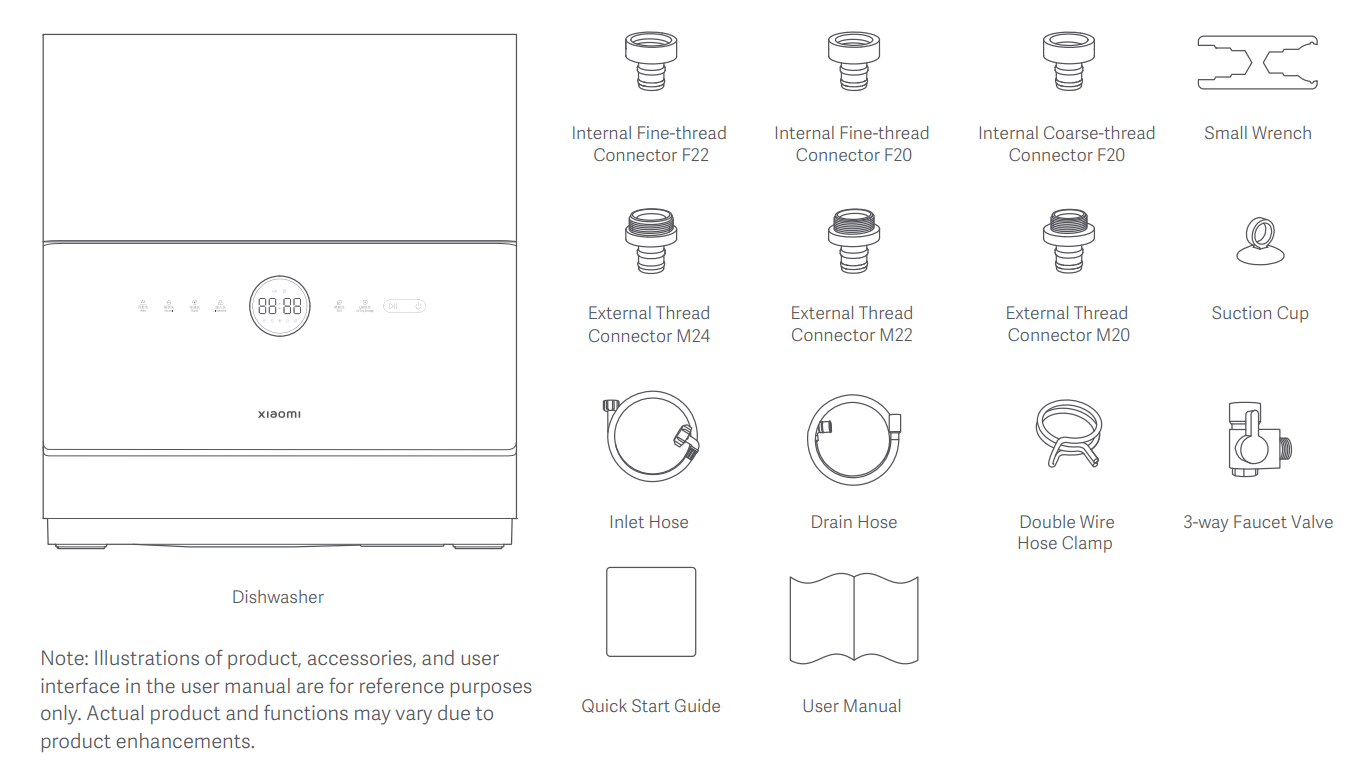
2. Q: What are the introductions for the Xiaomi Tabletop Dishwasher control panel?
A: The introductions for the Xiaomi Tabletop Dishwasher control panel are as follows:1. Once the dishwasher is connected to the power supply, all indicators on the display are lit for 1 second. Then, the dishwasher is turned off. Open the faucet and 3-way faucet valve to allow the dishwasher to be connected to the water source;
2. To turn on the dishwasher, press the power button after the dishwasher is connected to the power supply and water source, and then the indicators will light up. To turn off the dishwasher, press the power button when the dishwasher is in standby mode. The dishwasher will automatically turn off if no operation is performed for 3 minutes in the non-running state, and the display will go out. To forcibly turn off the dishwasher, press and hold the power button for 3 seconds when the dishwasher is running;
3. Press the button on the top to unlock the door, and grip the top groove of the upper door to open it. Close the upper door, and push in the lower door with both hands holding both sides to lock the upper door and lower door tightly;
4. When the dishwasher is in washing status, press the pause button to pause the current washing mode. When the dishwasher is paused, press the pause button to resume the current washing mode;
5. When the dishwasher is in standby status, select and press a washing mode button on the control panel, and then press the pause button to start washing. If you want to change the washing mode when the dishwasher is running, press the pause button and power button in sequence to exit the current washing mode, and the dishwasher will return to the standby status. Then, you can select the desired washing mode;
6. The UV dry storage feature can be manually enabled or disabled when the dishwasher is in standby mode or running status. Press the UV dry storage button to enable or disable the feature, and the UV dry storage indicator will light up or go out correspondingly. When the UV dry storage feature is enabled, the dishwasher automatically enters the UV dry storage status after each washing program is completed.
The default cycle of the UV dry storage feature is 24 hours, and the cycle is automatically reset after each washing operation is completed. To change the cycle, press and hold the UV dry storage button when the dishwasher is in standby mode, and the display blinks. Press the UV dry storage button again to switch the cycle of 24/48/72/96 hours. Stay in the selected cycle unchanged for 3 seconds, and it takes effect automatically. Then the display returns to standby status.
The UV dry storage feature is accompanied by slight fan sounds and vibrations, which is normal. To exit from this feature, first press the pause button to pause and then press the power button to end it. Or you can press the UV dry storage button to disable the feature.
The UV dry storage feature runs for a long period. If there is no operation within 3 minutes after the feature starts, the display automatically goes out for energy saving. In this case, you can press any button to wake up the display.
Note:
Except for the Rapid mode, all washing modes support the UV dry storage feature.
3. Q: What modes does the Xiaomi Tabletop Dishwasher have?
A: There are five modes on the Xiaomi Tabletop Dishwasher: Auto mode, Normal mode, Intensive mode, Rapid mode, and ECO mode.The detailed introductions are as follows:
1. Auto mode: Automatic washing program matching;
2. Normal mode: Washing of daily tableware;
3. Intensive mode: Washing of heavily greasy tableware;
4. Rapid mode: Rapid washing of lightly greasy tableware;
5. ECO mode: Energy-saving washing that saves water and power.
Note:
Every mode supports the drying function except the Rapid mode.
4. Q: How long does the wash cycle take for the Xiaomi Tabletop Dishwasher and how to choose the right program for different modes of tableware?
A: The duration of different wash programs varies from 40 minutes to 3 hours and 15 minutes. For normally used tableware, you can select the Normal mode or Auto mode. For tableware with stubborn stains, you can choose the Intensive mode or Auto mode. For lightly soiled tableware, the Rapid mode is suitable. If you want to save water and energy, select the ECO mode. Other programs can be used based on your actual needs.5. Q: What is the UV dry storage feature for the Xiaomi Tabletop Dishwasher?
A: After the wash cycle is completed, the Xiaomi Tabletop Dishwasher enters the UV dry storage stage. During this stage, the PTC fan and UV light operate intermittently, keeping the tableware dry and effectively disinfected for long-term storage.Note:
The UV dry storage feature is available for all modes except the Rapid mode.
6. Q: How to add the dishwasher salt to the Xiaomi Tabletop Dishwasher?
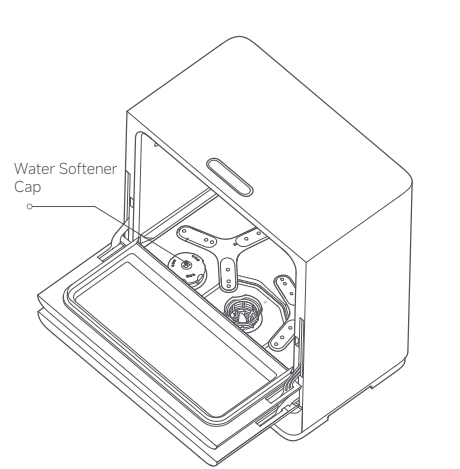
A: To add the dishwasher salt to the Xiaomi Tabletop Dishwasher, please refer to the following steps:1. Add once for multiple uses. Add more only when the Out of dishwasher salt indicator lights up on the screen;
2. Unscrew the water softener cap counterclockwise to remove it;
3. For the first use, add about 500g, and manually pour water while stirring until the softener is filled. Make sure the liquid is not overflowing. After the dishwasher salt is added, it is recommended to run the dishwasher in the Rapid mode with no load. For the subsequent adding, add directly to the water softener. It is normal to find the water softener full of water;
4. Tighten the water softener cap clockwise.
Note:
1. Do not substitute edible salt or industrial salt for the dishwasher salt. Otherwise, the water softener will become damaged and no longer be used. Dishwasher salt should be purchased separately;
2. Do not overtighten, as it can be difficult to open later;
3. After adding the salt, it’s recommended to run the Rapid mode with no load to prevent any overflow saltwater from corroding the interior.
7. Q: How to add the dishwasher blocks for the Xiaomi Tabletop Dishwasher?
A: To add the dishwasher blocks for the Xiaomi Tabletop Dishwasher, please refer to the following steps:1. Please add the dishwasher blocks manually before each washing. Because the dishwasher does not notify if no detergents are added, and the washing effect can be degraded;
2. For a single wash, it’s recommended to measure about 18g of dishwasher powder using the cap and place it on the base;
3. Put in 1 block if using dishwasher blocks.
Note:
1. Dishwasher powder or blocks can be purchased separately;
2. Do not add dishwasher powder or blocks if the device is not in use;
3. Do not use dishwashing liquid or any detergent not specifically designed for the dishwasher.
8. Q: Can dishwashing liquid be added to the Xiaomi Tabletop Dishwasher?
A: Dishwashing liquid should not be used in the Xiaomi Tabletop Dishwasher. Instead, you should use specially formulated dishwasher powder or blocks. The main reason for not using dishwashing liquid is that it produces too much foam, which can lead to false overflow or leaks, slow down or stop the spray arm, and result in unclean dishes. Additionally, excessive foam can overflow into the base, creating a risk of electric shock and damage to electrical components.9. Q: How to place the tableware in the Xiaomi Tabletop Dishwasher?
A: To place the tableware in the Xiaomi Tabletop Dishwasher, please refer to the following steps:1. Before placing tableware in the dish rack, clean off the larger food residues so as not to affect the washing performance. The dishwasher sprays water from the bottom up. Place the bowls
and cups with a downward tilt, which ensures the water flow can
fully rinse the tableware and helps prevent water from remaining
in the tableware. Do not place bowls, cups, plates, or other tableware upright, upside down, or in an overlapped manner. Otherwise, water is accumulated, which is not conducive to cleaning or drying. After placing tableware in the dish rack, turn the spray arms to ensure that they do not touch any tableware;
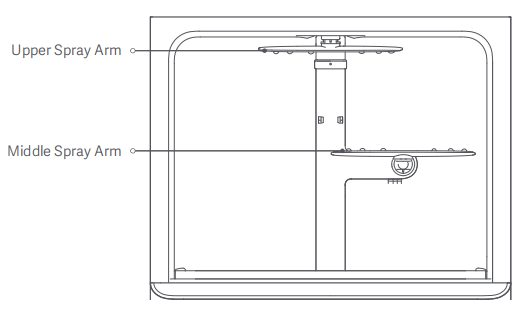
2. Place the tableware in the upper dish rack. The upper rack can be used to place small-sized tableware, such as chopsticks, rice paddles, and rice bowls. Keep the openings of the tableware tilted downwards. When placing the tableware, ensure the tableware and the upper spray arm do not touch so that the arm can turn without obstruction;
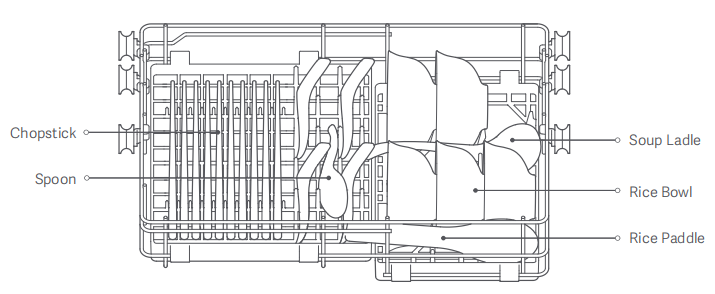
3. Place the tableware in the lower dish rack. The lower rack is mainly for placing tableware like deep plates, shallow plates, noodle bowls, mugs, and condiment dishes. Keep the openings of the tableware tilted downwards. Turn the lower spray arm to ensure it does not touch the tableware;
4. For tableware made of gold, silver, or aluminum, the surface smoothness will decrease after repeated washing. For tableware fading easily like antique tableware, glass products, and general plastic, washing in the dishwasher can lead to poor surface color and texture. It is recommended not to frequently wash them in the dishwasher. For tableware that is easy to mold, such as wooden and bamboo tableware, should be taken out in time after washing.
Note:
1. The dishwasher is not suitable for washing larger items such as pots and lids, which can lead to poor washing results. Never put tableware or cookware with Teflon coatings in the dishwasher;
2. For hard-to-clean items such as baking pans, tea cups that have been in use for years, and tableware that has been left overnight, use the Intensive mode two or more times in a row, depending on the cleaning difficulty. If the tableware is still not clean after intensive washing, use other cleaning tools to remove the stains;
3. After washing, the plastic inner tub and the upper dish rack cannot be completely dried, and a small amount of residual water can be under the filter assembly, which is normal.
10. Q: What are the functions of the filter in the Xiaomi Tabletop Dishwasher?
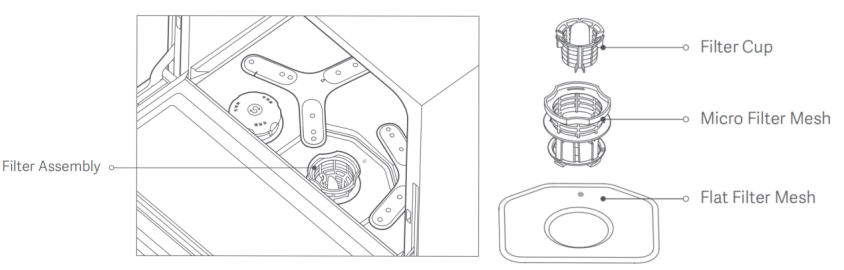
A: 1. To ensure that the Xiaomi Tabletop Dishwasher maintains good washing performance and effects for a long time, wash the filter assembly regularly and check that the filter assembly is not clogged with residues;2. The filter assembly is used to separate water from food residues. It is recommended to remove the filter cup after each washing, pour out the food residues, and rinse the cup under running water until clean. Clean the whole filter assembly once a week, and the flat and micro filter meshes can be cleaned with a soft brush;
3. Install each part of the cleaned filter assembly back into the dishwasher in order. If any part is missed or not installed properly, the washing effect can be degraded and even tableware damage can occur;
4. If you notice limescale buildup inside the dishwasher, it is recommended to place 20-25 grams of citric acid on the inner door and run the Rapid mode. This can effectively remove limescale from both the interior of the dishwasher and the surfaces of the dishes;
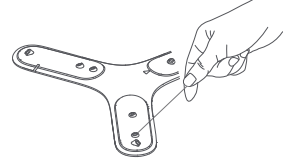
5. Every 4 to 6 months of use, it is recommended to check and clean the spray arm to prevent small residues from clogging the spray nozzles. Use thin, pointed objects to clean the spray arm, and be careful not to scratch the spray arm.
11. Q: How to clean the filter assembly for the Xiaomi Tabletop Dishwasher?
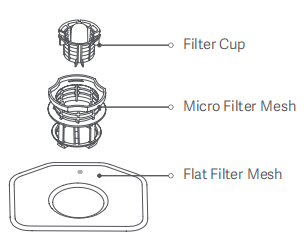
A: The function of the filter assembly is to prevent larger food debris or other objects from entering the wash pump. After multiple wash cycles, food residues can clog the filtration system.The Xiaomi Tabletop Dishwasher's filter assembly consists of three levels of filters:
1. Turn the micro filter mesh counterclockwise;
2. Remove the micro and flat filter meshes by pulling them upwards;
3. Remove the filter cup from the micro filter mesh by pulling the filter cup upwards.
12. Q: Can open the Xiaomi Tabletop Dishwasher door while it is running?
A: You should not open the door while it is running. If you must open it, it is recommended to press the pause button first to ensure that the spray arms come to a complete stop before opening the door, to avoid any water splashing out due to inertia.13. Q: Can add dishes while operating the Xiaomi Tabletop Dishwasher?
A: It is not recommended to add dishes while operating the Xiaomi Tabletop Dishwasher. Because the dishwasher operates according to specific cleaning steps. Adding dishes mid-cycle can result in missing these steps, which can affect the cleaning effectiveness.14. Q: Does the Xiaomi Tabletop Dishwasher need to be used with a water purifier?
A: The Xiaomi Tabletop Dishwasher has a water softener that helps to soften the water, so there is no need to connect it to a water purifier. Additionally, home water purifiers have a low flow rate, and even if connected, they can not meet the dishwasher's normal usage requirements.15. Q: Does the Xiaomi Tabletop Dishwasher need to be used with a garbage disposal?
A: The function of a garbage disposal is to grind food waste (such as bones and vegetable scraps) and discharge it directly into the drain. When using the Xiaomi Tabletop Dishwasher, food residues should be disposed of first before placing the dishes into the dishwasher. Not having a garbage disposal does not affect the normal operation of the dishwasher.16. Q: Does the Xiaomi Tabletop Dishwasher support washing fruits and vegetables?
A: The Xiaomi Tabletop Dishwasher does not support washing fruits and vegetables. However, a dedicated washing program can be developed in the future.17. Q: How long is the warranty of the Xiaomi Tabletop Dishwasher?
A: The main unit of the Xiaomi Tabletop Dishwasher has a warranty of 2 years.Networking Related
1. Q: Does the Xiaomi Tabletop Dishwasher support integration with the Mi Home/Xiaomi Home APP?
A: This Xiaomi Tabletop Dishwasher does not support integration with the Mi Home/Xiaomi Home APP.FAQs and Troubleshooting
1. Q: How to open or close the door of the Xiaomi Tabletop Dishwasher?
A: 1. Open the door: Press the button on the top to unlock the door, and grip the top groove of the upper door to open it;2. Close the door: Close the upper door, and push in the lower door with both hands holding both sides to lock the upper door and lower door tightly;
3. If the screen shows “-- --”, the issue could be due to the doors not being closed or not closing tightly. Please ensure the dishwasher is properly shut. Additionally, the door sensor switch can be malfunctioning. Please turn off the water and power supply, and contact the local after-sales service center.
Note:
If closing the door with one hand, it can cause one side of the door not to close tightly, affecting the washing process.
2. Q: What to do if water remains on the top of the Xiaomi Tabletop Dishwasher's inner after washing?
A: 1. The drying process mainly targets dishes and utensils. The dishwasher’s inner tub is made of hydrophilic plastic, so it’s normal to see water droplets on the walls;2. It is recommended to activate the UV dry storage function to enhance the drying effect. A few water droplets inside are normal;
3. It’s advised to use 3-in-1 dishwasher blocks or detergent pods for effective cleaning and improved drying results.
Note:
Every mode supports the UV dry storage function except the Rapid mode.
3. Q: Why is there water (or yellowish water stains) inside the new Xiaomi Tabletop Dishwasher?
A: Before leaving the factory, the Xiaomi Tabletop Dishwasher undergoes water inspection and aging tests, leaving a small amount of water in the pipes that can’t be fully dried. Yellow water stains come from resin water due to the built-in water softener, which uses yellow resin. Any residual water can leak due to transportation and settle on the inner tub or casing, which is normal. Wipe it clean or run an empty Rapid mode before regular use.4. Q: Is it normal for the Xiaomi Tabletop Dishwasher to prompt out of dishwasher salt when first used?
A: This prompt is normal, as no water or dishwasher salt (specific salt for dishwashers, not edible salt) is added to the softener at the factory. The Xiaomi Tabletop Dishwasher will operate normally for the first use without salt. However, for continued use, please add salt promptly to maintain the softener’s function.5. Q: What to do if the Xiaomi Tabletop Dishwasher isn’t cleaning or drying properly?
A: 1. Check if dishes are arranged correctly to ensure the spray arm’s rotation isn’t obstructed;2. Ensure dishwasher salt is in use and at an adequate level;
3. For non-standard dishes, allow extra spacing between items. Choose a suitable wash mode based on the amount and dirtiness of the dishes. For best results, select a longer wash mode with a higher temperature;
4. Check if the filter is clogged.
6. Q: Why do white stains appear on tableware when using the Xiaomi Tabletop Dishwasher after washing?
A: 1. Using too much dishwasher powder can cause white stains. Adjust the amount of powders based on the number of dishes being washed;2. Check if softening salt has been added. Softening salt reduces water hardness, which can cause white stains (limescale) if not used regularly in areas with hard water;
3. In regions with water hardness above 500ppm, installing a water softening device at the dishwasher’s water inlet is recommended.
7. Q: What to do if there is excessive foam during washing when using the Xiaomi Tabletop Dishwasher?
A: This could be due to low-quality dishwasher powder, which can produce too much foam during washing when using the Xiaomi Tabletop Dishwasher. Please use a high-quality brand of dishwasher powder.8. Q: What to do if there are white powders (limescale) on the Xiaomi Tabletop Dishwasher inner wall?
A: After a period of use, limescale can appear on the inner wall and tableware due to water quality.To remove the limescale, please refer to the following steps:
1. Place clean dishes (or dishes with limescale after washing) in the Xiaomi Tabletop Dishwasher and run the Intensive mode without detergent;
2. Run the dishwasher without dishes on the Intensive mode. After 5 minutes, press the pause button and open the door. It is recommended to add citric acid to the inner wall. The white vinegar can also be used as an alternative. Add 15-20 grams of citric acid, or 200mL of white vinegar (up to 300mL for heavy scaling), and resume the mode. This should effectively remove the limescale.
9. Q: Is there a lot of residual water left in the Xiaomi Tabletop Dishwasher after washing and will it become unhygienic over time?
A: There can be a small amount of residual water left after washing. If the Xiaomi Tabletop Dishwasher is unused for more than 7 days, especially in summer, slight odors can develop. Activating the UV dry storage function will help keep the inner wall and dishes dry.10. Q: What to do if the inner wall of the Xiaomi Tabletop Dishwasher is wet after washing?
A: You can activate the UV dry storage function to keep the inner wall and tableware dry.11. Q: Does the Xiaomi Tabletop Dishwasher have a disinfection function?
A: The Xiaomi Tabletop Dishwasher does not have a disinfection program like a sterilizer. However, the dishwasher has a disinfection effect during the washing process with high-temperature water. Additionally, you can activate the UV dry storage function, which offers four modes of UV drying for 24 hours, 48 hours, 72 hours, or 96 hours. The UV light operates during drying and has a bacteriostatic effect.12. Q: Why does the washing duration vary each time when using the Auto mode function on the Xiaomi Tabletop Dishwasher?
A: The Auto feature uses a turbidity sensor to automatically adjust the washing time and increase the rinsing cycles based on the degree of soil in the wash water. Therefore, the washing duration depends on how greasy the dishes are.13. Q: Why does the Xiaomi Tabletop Dishwasher start on its own when not in use?
A: The Xiaomi Tabletop Dishwasher will automatically start when the UV dry storage function is activated. You can manually turn off this feature on the device.14. Q: Does it affect the use of the Xiaomi Tabletop Dishwasher if the dishwasher powder become damp and clump?
A: A slight clumping of the dishwasher powder due to moisture does not affect the use of the Xiaomi Tabletop Dishwasher. However, it’s best to keep the powders dry. After use, make sure to seal the plastic bag of dishwasher powder tightly and store it in a dry place.15. Q: What to do if the screen of the Xiaomi Tabletop Dishwasher displays the E1 code (water shortage fault)?
A: First, turn off the power, then check if the faucet and the inlet 3-way faucet valve are fully opened. Straighten the inlet hose and check for any abnormalities, ensuring there are no kinks, squeezes, or blockages. Finally, confirm if the water pressure is adequate (it should be no less than 0.04MPa. Otherwise, a booster pump can be needed). After these checks, turn the power back on and start any wash mode. If the “E1” code still appears, please contact the local after-sales service center for inspection.16. Q: What to do if the screen of the Xiaomi Tabletop Dishwasher displays the E2 code (heater fault)?
A: There is a fault in the heating circuit. Please turn off the power and water supply, and contact the local after-sales service center for inspection and repair.17. Q: What to do if the screen of the Xiaomi Tabletop Dishwasher displays the E3 code (washing water shortage fault)?
A: 1. Please turn off the power and ensure the dishes are arranged correctly, then turn the power back on;2. Please turn off the power, check that the filter is clear, and turn the power back on;
3. Please turn off the power, check that the filter is properly installed, and turn the power back on;
4. If problems continue, please turn off the water and power supply and contact the local after-sales service center for inspection.
18. Q: What to do if the screen of the Xiaomi Tabletop Dishwasher displays the E4 code (temperature sensor fault)?
A: The temperature sensor can be damaged or the current water temperature is outside the acceptable range. Please turn off the power and water supply, and contact the local after-sales service center for inspection and repair.19. Q: What to do if the screen of the Xiaomi Tabletop Dishwasher displays the E6 code (overflow fault)?
A: Water has entered the base cover, causing a short circuit in the leak switch. You need to turn off the power and water supply and contact the local after-sales service center for inspection and repair.20. Q: What to do if the screen of the Xiaomi Tabletop Dishwasher displays the E7 code (water inlet fault)?
A: This can be due to a fault in the water inlet valve or other reasons. Please turn off the power and water supply, and contact the local after-sales service center for inspection and repair.21. Q: What to do if the screen of the Xiaomi Tabletop Dishwasher displays the Ed code (communication fault)?
A: There is a communication issue. Please wait for the signal to return to normal or contact the local after-sales service center for inspection and repair.22. Q: Why does the Xiaomi Tabletop Dishwasher make noise?
A: 1. During the washing process, water flows against the plastic inner tub of the dishwasher, creating a rhythmic water sound due to the strong impact of the water flow;2. The sound of air during drying. When the dishwasher uses hot air for drying, a large volume of air is drawn in and expelled, resulting in significant noise from the air intake on the right side. The noise will stop once the drying cycle is complete.
23. Q: Can the Xiaomi Tabletop Dishwasher wash wooden or bamboo utensils?
A: Wooden, bamboo, and low-temperature plastic utensils should not be washed in the dishwasher. The high-temperature water can cause these materials to warp. Additionally, wooden and bamboo utensils absorb water, making it difficult to achieve effective drying. If stored for an extended period after washing, they can develop mold.Note:
The fibrous cells in wood and bamboo absorb a lot of water during washing. Due to differences in absorption rates and expansion coefficients among the cells, warping and distortion can occur. Therefore, it is not recommended for the dishwasher to wash wooden or bamboo utensils.
24. Q: Why is there a smell of disinfectant inside the Xiaomi Tabletop Dishwasher after washing?
A: This is not actually a disinfectant smell. First, some detergents have a strong scent. Additionally, the reaction between the detergent and residual chlorine in tap water at high temperatures can produce a similar odor.25. Q: Why does the new Xiaomi Tabletop Dishwasher have a plastic smell?
A: There are many plastic components in the washing and drying systems of the dishwasher. When the Xiaomi Tabletop Dishwasher is unboxed or during the first few uses, a plastic smell can be noticeable. However, this will dissipate quickly during operation.26. Q: Why is the protective film on the outside of the Xiaomi Tabletop Dishwasher not neat?
A: During the manufacturing process, part of the film needs to be peeled back to avoid being pressed down during assembly, which could prevent you from removing it later. The protective film is only for protection during transport. It should be removed before actual installation and use.27. Q: Why are these bowls, such as those used for steaming eggs, dry rice bowls, mixing bowls for starch, or burnt pots, not cleaned properly in the Xiaomi Tabletop Dishwasher?
A: Dishware such as those used for steaming eggs, dry rice bowls, mixing bowls for starch, or burnt pots are not cleaned effectively in the current industry, as the stains have strong adhesion that is difficult to wash off, and high-temperature water is not effective at dissolving them.Note:
Regular detergents contain amylase, which can break down starch, while steaming eggs primarily involve protease, which requires specialized detergents containing protease for better cleaning. Rice and dry flour are mostly regular starch when wet and hot, making them easy to clean, but when dry and cold, they contain resistant starch, which is harder to break down by amylase, thus complicating cleaning.
28. Q: Can the Xiaomi Tabletop Dishwasher be used without adding dishwasher salt?
A: Adding dishwasher salt is one of the measures to continuously reduce the hardness of the wash water and effectively protect your dishware. For better washing and protection, it is recommended to add dishwasher salt promptly as indicated by the Xiaomi Tabletop Dishwasher.29. Q: How to stop the UV dry storage function of the Xiaomi Tabletop Dishwasher if the dishes have been removed?
A: 1. While the UV dry storage function is active, press the UV dry storage button again to exit this function;2. Press and hold the power button for 3 seconds to force a shutdown.
30. Q: What to do if the Xiaomi Tabletop Dishwasher suddenly shuts down during operation?
A: 1. Check if the washing cycle has been completed;2. Check if there is a power interruption at the dishwasher’s outlet;
3. Once the outlet is confirmed to have power, try to restart the device and see if it can run the washing program.
If issues persist, please contact the local after-sales service center for inspection.
31. Q: What to do if the dish rack of the Xiaomi Tabletop Dishwasher changes color?
A: 1. The discoloration of the dish rack can be due to the fading of utensils. Avoid washing items that are prone to color loss;2. It could also be due to food residues staining the dish rack, such as curry. It is recommended to dispose of food scraps before placing items in the dishwasher. Stains caused by certain foods can often be removed through multiple washes.
32. Q: What to do if there are impact sounds inside the Xiaomi Tabletop Dishwasher?
A: 1. The sound can be due to the spray arm colliding with the utensils. Pause the operation, open the door, and check if there is any contact between the utensils and the spray arm. After rearranging the utensils, try again;2. It could also be the sound of small utensils colliding. Avoid placing very small items in the dishwasher for washing.
33. Q: What to do if the metal utensils washed in the Xiaomi Tabletop Dishwasher rust?
A: 1. This can be due to the cap of the softener not being tightened, causing the dishwasher salt solution to spill out. Make sure the cap of the softener is secured tightly;2. It could be that the salt was not cleaned up after spilling when adding dishwasher salt. Please clean up any spills promptly;
3. The rusting can also be due to the utensils themselves being prone to rust, which is not caused by the dishwasher.
34. Q: What size is the water inlet hose connection of the Xiaomi Tabletop Dishwasher?
A: The water inlet hose connects to the water source on one end with a standard 1/2 inch fitting, with specific dimensions: outer diameter 2cm (20mm) and inner diameter 1.27cm (12.7mm). The end connecting to the dishwasher inlet valve is a standard 3/4 inch fitting, with an inner diameter of 2.5cm (25mm).35. Q: What are the height and dimensions of the water inlet hose for the Xiaomi Tabletop Dishwasher?
A: The outer diameter of the water inlet hose is 12.5 ± 0.5mm.The lowest point of the inlet hose should be approximately 50mm to 55mm from the bottom of the device (the height of the back anti-water strip is 50mm).
36. Q: What are the lengths of the inlet and drain hoses for the Xiaomi Tabletop Dishwasher?
A: The Xiaomi Tabletop Dishwasher comes with the standard inlet and drain hoses. The inlet hose is approximately 150cm and cannot be cut or extended. If special installation conditions apply, you can purchase a qualified extension hose. The drain hose is also approximately 150cm and can be cut according to actual needs.37. Q: What are the dimensions of the drain hose for the Xiaomi Tabletop Dishwasher?
A: The outer diameter of the drain hose connecting to the Xiaomi Tabletop Dishwasher is 20mm, and the outer diameter at the drain outlet is 21mm. Both ends have an inner diameter of 15mm.38. Q: Can the drain hose of the Xiaomi Tabletop Dishwasher still drain properly if the outlet end is mounted high?
A: The drainage end of the Xiaomi Tabletop Dishwasher can drain even if the outlet end is installed high. As long as it is not raised more than 60cm, it can drain normally.39. Q: What to do if there is a sudden power outage during the washing process in the Xiaomi Tabletop Dishwasher?
A: 1. The Xiaomi Tabletop Dishwasher has a power outage memory function. If there is a power failure during washing, it will automatically go to the first step of the current stage of draining once power is restored;2. If the washing program is interrupted due to power failure, the dishwasher will not drain until power is restored.
40. Q: What are the water pressure requirements for installing the Xiaomi Tabletop Dishwasher?
A: The water inlet pressure for the Xiaomi Tabletop Dishwasher should be between 0.04MPa and 0.4MPa.41. Q: Can the Xiaomi Tabletop Dishwasher be installed as a built-in unit?
A: During operation, the air outlet on the left side of the Xiaomi Tabletop Dishwasher will release humid steam, and the door switch is located at the top of the device. If you want to use built-in installation, it is recommended to leave more than 20cm of adequate space around these two areas. Do not allow the air outlet to directly face devices that cannot be exposed to water such as sockets, as the air outlet can emit high-temperature, high-humidity steam.42. Q: What to do if the Xiaomi Tabletop Dishwasher is too large to fit?
A: You can utilize the windowsill space or the corner space beside the stove by customizing or purchasing ready-made support brackets or triangular support brackets online to complete the installation and placement.43. Q: Why are there water droplets after the Xiaomi Tabletop Dishwasher has dried?
A: 1. Check if there are any dishes blocking the right lower corner air outlet of the dishwasher;2. The drying process mainly targets dishes and utensils. The dishwasher’s inner tub is made of hydrophilic plastic, so it’s normal to see water droplets on the walls. It is recommended to activate the UV dry storage function to enhance the drying effect. A few water droplets inside are normal. Additionally, it’s advised to use 3-in-1 dishwasher blocks or detergent pods for effective cleaning and improved drying results.
44. Q: What precautions should be taken when cleaning pots in the Xiaomi Tabletop Dishwasher?
A: 1. The lower dish rack of the Xiaomi Tabletop Dishwasher can hold a 26cm milk pan. If you don't place dishes in the lower dish rack, it can be used to wash pots;2. It’s best to avoid putting pots with Teflon non-stick coating in the dishwasher. The dishwasher blocks, powders, and liquids are strongly alkaline, and along with the heating process during washing, can damage the non-stick coating.
45. Q: What type of motor does the Xiaomi Tabletop Dishwasher use?
A: The Xiaomi Tabletop Dishwasher uses a fixed-frequency motor. The core performance of a dishwasher is its water efficiency rating. Based on actual inspection data, the performance difference between AC and DC motors is minimal under the same conditions. The advantages of an AC motor are its broader application, simpler and more stable system, and better cost-effectiveness.46. Q: Why does the Xiaomi Tabletop Dishwasher have gaps?
A: A certain level of gap is normal. During the design phase, considerations were made for aesthetics and manufacturability to minimize screw use and instead use snap connections. This structure improves overall appearance by hiding screws, though it can create small gaps. These gaps do not affect normal use.47. Q: Will contact with water affect the normal operation of the Xiaomi Tabletop Dishwasher?
A: The Xiaomi Tabletop Dishwasher has undergone water-splash inspection. Daily splashes or minor water exposure on the exterior do not impact functionality.48. Q: What to do if dishwashing detergent accidentally enters the Xiaomi Tabletop Dishwasher?
A: It is recommended to let the Xiaomi Tabletop Dishwasher rest for a while. Then start the device and perform several cycles of water intake and drainage without initiating a wash cycle. About 90 seconds after starting, force the device to drain by pressing and holding the power button for 3 seconds.49. Q: What precautions should be taken when adding dishwasher salt to the Xiaomi Tabletop Dishwasher?
A: 1. Do not substitute edible salt or industrial salt for the dishwasher salt. Otherwise, the water softener will become damaged and no longer be used;2. To add dishwasher salt, unscrew the water softener cap counterclockwise to remove it. For the first use, add about 500g, and manually pour water while stirring until the softener is filled. Make sure the liquid is not overflowing. After the dishwasher salt is added, it is recommended to run the dishwasher in the Rapid mode with no load. For the subsequent adding, add directly to the water softener. It is normal to find the water softener full of water;
3. It is available for use several times after filling the dishwasher salt;
4. Using the dishwasher without salt does not affect cleaning performance. The dishwasher salt primarily helps soften water and prevent scaling.
50. Q: Why does the Xiaomi Tabletop Dishwasher still prompt out of dishwasher salt after adding dishwasher salt?
A: After adding dishwasher salt, it's necessary to stir and add water as well.If the dishwasher still prompts out of dishwasher salt, please refer to the following methods:
1. The dishwasher salt takes time to dissolve, so wait for full saturation;
2. There can not be enough salt added to reach a saturated level;
3. Check if there is a mistake in positioning when adding dishwasher salt;
4. If the issue persists, try stirring a few times, or contact the local after-sales service center for further assistance.
51. Q: Where to place dishwasher powder or blocks in the Xiaomi Tabletop Dishwasher?
A: Each time you wash, add the dishwasher powder or blocks separately by placing them on the base of the Xiaomi Tabletop Dishwasher’s interior.52. Q: What to do if accidentally put dishwasher powder or blocks in the Xiaomi Tabletop Dishwasher's salt compartment?
A: First, try to remove as much of the dishwasher powder or blocks as possible with a tool, then rinse the salt compartment several times with clean water (turn off the device, let it drain automatically, and repeat about three times). Afterward, follow the correct method for adding salt: add salt, add water, and stir.53. Q: Parameters related to the Xiaomi Tabletop Dishwasher
A: The parameters related to the Xiaomi Tabletop Dishwasher are as follows:| Product name | Xiaomi Tabletop Dishwasher | |
| Version | Hong Kong version (UK standard) | Taiwan version (Taiwan standard) |
| Model | QMDW0503M | QMDW0504M |
| Rated voltage | 220V~ | 110V- |
| Rated current | ≥10A | ≥15A |
| Rated power | 1500W | 900W |
| Weight | Net weight: 18.5kg Gross weight: 23.7kg | |
| Dimensions | Package: 670mm×470mm×733mm Product: 550mm×350mm×598mm | |
54. Q: Does the Xiaomi Tabletop Dishwasher have a fruit and vegetable washing mode?
A: The Xiaomi Tabletop Dishwasher does not have a dedicated fruit and vegetable washing function and is not recommended for washing produce.55. Q: How many spray arms does the Xiaomi Tabletop Dishwasher have?
A: The Xiaomi Tabletop Dishwasher has a total of 4 spray arms across 3 levels: two at the bottom, one in the middle, and one at the top. The four spray arms provide power to break down food residues. The lower spray arms at the bottom increase the spray frequency by 30%, releasing 34 high-temperature, high-pressure water jets to remove debris thoroughly.56. Q: What are the wash times for different modes on the Xiaomi Tabletop Dishwasher?
A: 1. Intensive: 183 minutes at 75°C;2. Normal: 135 minutes at 75°C;
3. Auto: 192 minutes at 60°C-75°C;
4. ECO: 177 minutes at 56°C;
5. Rapid: 40 minutes at 55°C.
Note:
These times include both washing and drying cycles. With future software upgrades, the modes and times can be subject to change.
57. Q: Can the Xiaomi Tabletop Dishwasher be transported lying down?
A: The Xiaomi Tabletop Dishwasher can be transported lying down. However, it is recommended to upright transport with packaging. When upright, the packaging provides the best protection for the device.58. Q: Will using hot water affect the Xiaomi Tabletop Dishwasher?
A: 1. The Xiaomi Tabletop Dishwasher should not take in excessively hot water. A temperature of 40°C or lower is recommended;2. If the water temperature reaches 80°C, the dishwasher will display an E4 error. The dishwasher will pause while the alarm is active. If the temperature returns to normal within 3 minutes, the alarm will clear and operation will resume. Otherwise, it will continue to display the alarm, activate the drain pump for 2 minutes, and then terminate the program. Short-term exposure to high-temperature water should not impact the dishwasher’s service life.
59. Q: What is the height of the plumbing interface at the back of the Xiaomi Tabletop Dishwasher above the cabinet countertop splash guard?
A: The plumbing interface at the back of the Xiaomi Tabletop Dishwasher is 3cm above the cabinet countertop splash guard.60. Q: Will the amount of tableware placed in the Xiaomi Tabletop Dishwasher affect water consumption?
A: Different modes will result in varying water consumption. However, the number of dishes will not affect the water consumption.61. Q: What to do if the water inlet hose cannot pass through the soap dispenser hole for the Xiaomi Tabletop Dishwasher?
A: If installation under the kitchen counter is required, it is recommended to use an adapter and purchase an extension hose (the extension hose can go through the soap dispenser hole), or enlarge the hole.62. Q: How to remove and install the upper and lower dish racks of the Xiaomi Tabletop Dishwasher?
A: Both the upper and lower dish racks can be removed. The upper dish rack is installed along the roller track (the track is between the two wheels), while the lower dish rack can be installed along the track.63. Q: Why does the Xiaomi Tabletop Dishwasher have power, and the internal indicator is on, but it cannot start?
A: Please check if the upper and lower doors are closed properly. When closing the lower door, press down on both sides with both hands to ensure the door is fully closed.64. Q: Can the Xiaomi Tabletop Dishwasher wash the grease filter of a range hood?
A: The grease filter of a range hood has heavy oil stains. It is recommended to use a dedicated range hood degreaser. The stains on the range hood are stubborn, and due to long-term accumulation, they can harden, requiring a specialized degreaser for cleaning.65. Q: What are the specific descriptions of the different washing modes and functions of the Xiaomi Tabletop Dishwasher?
A: 1. Auto: Automatic washing program matching;2. Normal: Washing of daily tableware;
3. Intensive: Washing of heavily greasy tableware;
4. Rapid: Rapid washing of lightly greasy tableware;
5. ECO: Energy-saving washing that saves water and power;
6. UV dry storage feature: Suitable for keeping tableware dry continuously after washing is complete.
66. Q: Why are there white powder residues on the bowls and chopsticks after washing in the Xiaomi Tabletop Dishwasher?
A: 1. The local water hardness is high;2. The effectiveness of the detergent used in the dishwasher is insufficient. It is recommended to use 3-in-1 dishwasher gel;
3. The selected washing mode is not powerful enough.
67. Q: Parameters for the upper and lower dish racks of the Xiaomi Tabletop Dishwasher
A: The weight of the upper dish rack is approximately 840g (without tableware). The upper dish rack dimensions are 43cm × 28cm, while the lower dish rack dimensions are 46cm × 28cm.Note:
The above measurements are obtained through manual measurement. There can be slight deviations.
68. Q: How far should the Xiaomi Tabletop Dishwasher be from the stove?
A: The Xiaomi Tabletop Dishwasher should be kept at least 150mm away from the heat source. It's advisable to keep the device as far as possible.69. Q: Is it normal for the Xiaomi Tabletop Dishwasher's filter to have a lot of accumulated water?
A: It is normal for the Xiaomi Tabletop Dishwasher to have some water accumulation at the bottom, which can be inside the water tank. If it’s just a little, that’s normal. When the dishwasher is powered on, it will first drain before new water comes in for washing, so there’s no need to worry about this issue.70. Q: How to clean the residue at the bottom after removing the Xiaomi Tabletop Dishwasher's filter?
A: The next time the washing mode starts, the drainage pump will activate and discharge the residue from the bottom. If you want to remove the residue now, you need to clean it with a cloth.71. Q: Can the dish racks in the Xiaomi Tabletop Dishwasher be adjusted?
A: The upper dish rack can be adjusted, and the trays can be removed to place at different height levels.The different height levels of the upper dish rack are as follows:
1. Default position from the factory, in this state, it can wash five sets of dishes according to the instructions;
2. The left tray of the upper dish rack is raised one level, allowing placement of large plates under 10 inches, such as fish platters;
3. The right tray of the upper dish rack is raised one level, allowing for the washing of frying pans while still providing ample space below.
72. Q: Why can’t the Xiaomi Tabletop Dishwasher filter remove the residue?
A: The Xiaomi Tabletop Dishwasher uses a removable filter. It is recommended to rinse the dishes with water before placing them in the dishwasher for better results. After cleaning the dishes, it is advisable to regularly remove and rinse the filter to facilitate future cleaning of the dishwasher.73. Q: Why is the Auto mode time on the Xiaomi Tabletop Dishwasher always displayed 03:12?
A: The Auto mode time changes during the main wash stage. It starts with a countdown of 192 minutes, and after the first pre-wash phase, the countdown time will change.74. Q: Does the Xiaomi Tabletop Dishwasher come with an on-site installation service?
A: There is currently no on-site installation service available. Please refer to the user manual and after-sales installation videos for installation methods.75. Q: Can the Xiaomi Tabletop Dishwasher be repaired?
A: 1. Only trained professionals are allowed to repair the dishwasher. Unauthorized repairs by other individuals can lead to serious consequences;2. If the dishwasher malfunctions, please refer to the troubleshooting methods in the user manual before contacting the local after-sales service center;
3. If the fault cannot be resolved, please shut off the water supply, cut off the power, and contact the local after-sales service center for further assistance.
76. Q: What are the specifications of the 3-way faucet valve for the Xiaomi Tabletop Dishwasher?
A: The general water outlet interface has an outer diameter of 20mm with a 1/2” external thread. The active joint should match your home water valve joint.77. Q: What is the maximum length that the water inlet hose for the Xiaomi Tabletop Dishwasher can be extended?
A: The water inlet hose can be extended by 3m. Adjustments should be made according to your home water pressure. If the water pressure is low, it can affect the Xiaomi Tabletop Dishwasher's water intake, leading to error notifications.
Does it help?
Yes
No