
Xiaomi Microwave Oven FAQ
Summary
1. Q: Selling PointsA: The selling points of the Xiaomi Microwave Oven:
20 Litre Capacity: Meet the daily needs of the whole family
700W Cooking Power: Comes with a glass tray, 360° rotation for fast heating
35 minutes Programmable Timer: Timer knob operation, with ultra-long lasting to allow you to cook all your favorite meals
5 Power Levels: Offer scientific heating options, adaptable to various food
Quick Defrost: Independent defrosting mode, Keep the food delicious.
Easy-to-clean cavity: The turntable Shaft can be removed for cleaning, all you need is to wipe gently and there will be no dead end.
2. Q: Accessory List
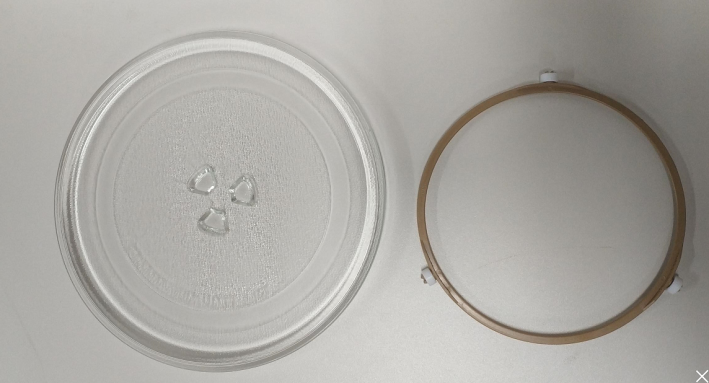
A: Glass Tray*1, Turntable Shaft*1.
3. Q: Product Overview
A: The names and illustrations of the Xiaomi Microwave Oven parts and accessories are shown below:
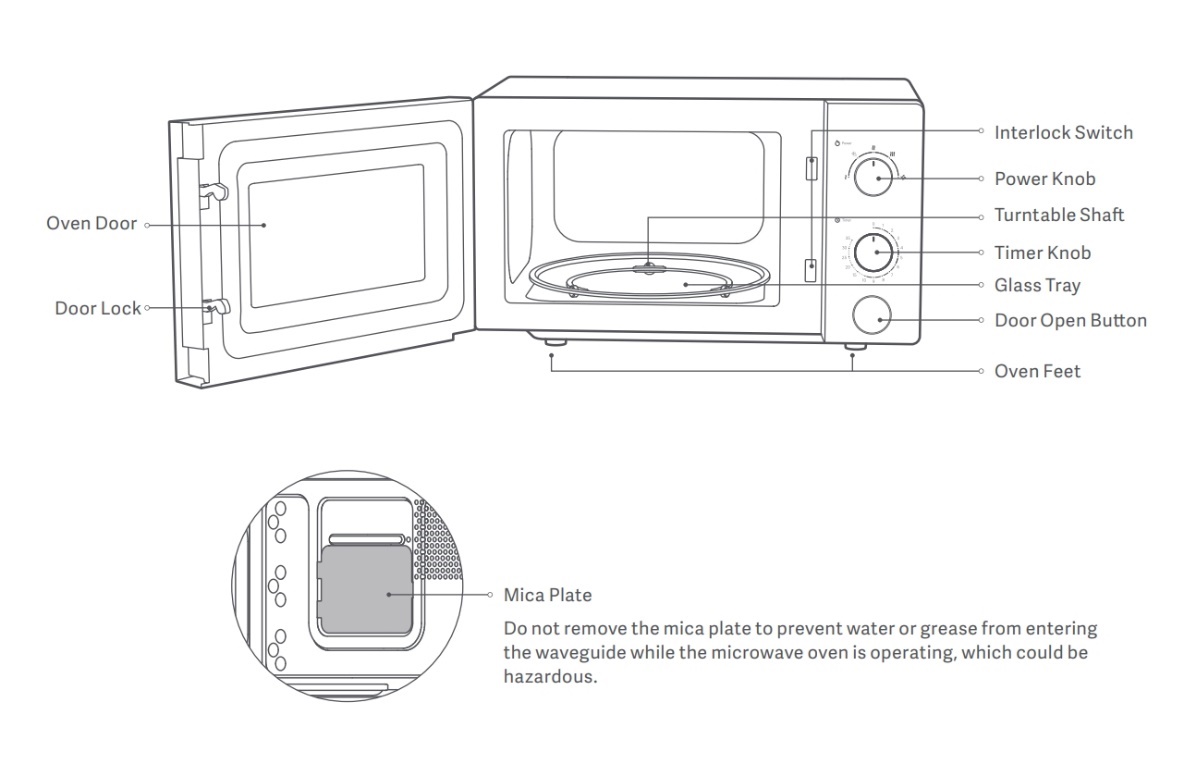
Note:
Ensure that the oven door is locked correctly and securely before operating. If the door or door seals are damaged, don’t operate the oven until it has been repaired by professionals.
4. Q: Defrost Time Table
A: For the best result, the suggested defrost time will be adjusted according to the different weights selected:
| No. | WEIGHT(g) | TIME(MINUTES) |
| 1 | 200 | ~ 4 |
| 2 | 400 | ~8 |
| 3 | 600 | ~12 |
5. Q: Control Panel/ Display
A: Here are the instructions for the control panel and the display of the Xiaomi Microwave Oven:
Timer settings: Rotate the knob left or right to adjust the microwave time. The maximum time should not exceed 35 minutes. If the set time is less than 10 minutes, please turn the knob to a position greater than 10 minutes and then turn it back to the desired time.
Power control: 5 power levels in total:
High--100% microwave output, suitable for quick cooking;
Medium-high--80% microwave output, suitable for relatively fast cooking;
Medium--55% microwave output, suitable for cooking over moderate heat;
Defrost--30% microwave output, suitable for food defrosting;
Low--17% microwave output, suitable for keeping food warm.
6. Q: Internal Heating Characteristics
A: Different from conventional heating, microwave heating is a kind of internal heating, that involves an energy conversion from electromagnetic energy to thermal energy rather than heat transfer. Microwave energy is delivered directly to the material through molecular interaction with the electromagnetic field. Since microwaves can penetrate the material and supply energy, heat can be generated throughout the volume of the material resulting in volumetric heating. Besides, the oven door is sealed when overheating, which results in an insulated environment that lacks the possibility of heat dissipation. Therefore, the internal temperature is higher than the external temperature, and the vapor pressure difference drives the internal water to penetrate the surface, accelerating the migration of water evaporation rate.
Note:
Advantages: 1. quick and convenient; 2. high thermal efficiency, energy saving; 3. even heating.
7. Q: Effects of microwave oven radiation levels on humans and animals
A: Although there is an amount of microwave radiation when the oven is working, which allows food with water or grease to be cooked, the design of microwave ovens ensures that the microwaves are contained within the oven and can only be present when the oven is switched on and the door is shut. For your reference, the amount of radiation that a microwave oven produces is as much as a 40W fluorescent tube, which means there's almost no harm to humans and animals if operates properly.
8. Q: Possible damage of microwave
A: Microwave is a form of electromagnetic radiation like radio, infrared, or visible light. Microwaves occupy a place in the electromagnetic spectrum with frequency above ordinary radio waves and below infrared light. Therefore, electromagnetic radiation with this frequency and wavelength will not cause cancer.
Characteristics: Microwaves can be reflected by metal, so they are reflected within the metal interior of the oven where they are back and forth through and absorbed by food, to strengthen the thermal efficiency. However, metal utensils should not be used in the microwave oven to slow down the heating or even arcing or sparking. The Xiaomi Microwave Oven adapts cold rolled sheets, with metal grids on the oven door. Besides, the Xiaomi Microwave Oven also comes with an auto power-off when the oven door feature is opened, which prevents the microwave from leaking.
Although the microwave is also called radiation, it is a kind of non-ionizing radiation, which does not have enough energy to knock electrons out of atoms. unlike X-ray, a form of ionizing radiation that can alter atoms and molecules and cause damage to cells in organic matter.
9. Q: Differences between Turntable Microwave Oven and Flatbed Microwave Oven
A: The flatbed microwave oven is an upgraded version of the turntable microwave oven, The working principle of them is similar but not totally the same.
1. The turntable microwave oven serves to rotate the food on the glass tray by the turntable shaft while it's being heated. The microwave is emitted from a fixed place that is located on the side of the cavity. So the rotation helps to ensure even cooking by exposing all sides of the food to the microwave energy directly. Therefore, compared to the flatbed microwave oven, the turntable microwave oven heats food faster;
2. The flatbed microwaves don't have a turntable shaft to distribute the heat throughout the food being cooked (or heated). The rotating turntable is gone, and the heat is distributed evenly through the foods via the ceramic base of the microwave which has a rotating antenna underneath it. flatbed microwave ovens circulate the microwaves throughout the oven cavity to cook the food evenly;
3. The turntable microwave oven has the advantage of fast heating speed, while the disadvantage is that the turntable shaft and the tray are not easy to clean and the cooking space is also limited;
4. The flatbed microwave oven has the advantage that the whole base of the inside of the microwave can be utilized for heating food in multiple dishes as there is no turntable or tray that your food has to fit onto. Besides, with no turntable to work around or remove when it's time to clean up, the flatbed microwave is far easier to clean. No awkward spots, just a clear open space that is easy to wipe over and remove any spills or stains. However, its heating or cooking may need much more time than the turntable microwave oven.
10. Q: Principle of Microwave Oven Heating
A: A microwave oven is an electric oven that heats and cooks food by exposing it to electromagnetic radiation in the microwave frequency range. It involves an energy conversion from electromagnetic energy to thermal energy to heating food effectively.
Microwave is a special kind of as called as light, a form of electromagnetic radiation just like visible light. However, because the wavelength of microwaves exceeds the range of perception of the human eye, they are invisible.
A microwave oven takes advantage of the electric dipole structure of water molecules, fats, and many other substances in the food, using a process known as dielectric heating. These molecules have a partial positive charge at one end and a partial negative charge at the other. In an alternating electric field, they will constantly spin around. The electric field's energy is absorbed by them, as rotational energy (meaning, they spin). Then they hit other molecules and make them move faster as well, sharing their increase in energy deeper into the substance, as molecular rotations, vibrations, or other movements signifying an increase in the temperature of the food. So once the electrical field's energy is initially absorbed, heat will gradually spread through the object, and the food is cooked.
11. Q: Characteristics of microwaves
A: Microwaves can be reflected by metal, so they are reflected within the metal interior of the oven where they are back and forth through and absorbed by food, to strengthen the thermal efficiency. However, metal utensils should not be used in the microwave oven in case of slowing down the heating or even arcing or sparking. The Xiaomi Microwave Oven adapts cold rolled sheets, with metal grids on the oven door. Besides, the Xiaomi Microwave Oven also comes with an auto power-off when opening the oven door feature, which keeps the microwave from leakage.
Instructions & FAQs
1. Q: What are the specifications of the Xiaomi Microwave Oven?
A: Rated Voltage: 220—230V~;
Rated Frequency: 50Hz;
Rated Input Power: 1100W;
Rated Microwave Output Power: 700W;
EEI: Rank 3;
Rated Microwave Frequency: 2450MHz;
Rated Capacity: 20L;
Dimensions:
Outside: 456×343×264mm;
Inside: 301.5(W)*289.2(D)*219.2(H)mm;
Package: 510×388×340mm;
Weight:
Net: 10.9kg;
Gross: 12.1kg.
2. Q: What are the cavity, door, glass tray made of?
A: The materials of different components of the Xiaomi Microwave Oven are shown below:
Inner (Cavity): Cold rolled sheets, with epoxy coating;
Oven door & observation window: Tempered glass;
Glass tray: Silica;
Waveguide mask: Mica plate;
Heat insulation sheet: PET;
Door frame seals: ABS.
3. Q: What to check when receiving the product?
A: Remove the packaging from the Xiaomi Microwave Oven and then carefully inspect the microwave oven for damage. Such as:
(1). Whether the oven body has no signs of impact or is being heavily pressed;
(2). Whether the oven door is flatbed, and the door open button and lock are smooth and flexible;
(3). Whether the metal insulation mesh on the oven door is bent or deformed;
(4). Whether the power cord is broken or loose.
Note:
If you observe the above conditions, please contact our local official service center or your seller for further assistance. They will help you in this regard.
4. Q: What are the precautions before installation and use?
A: Installation:
(1). Use the microwave oven on a flatbed surface in a ventilated, dry, and non-corrosive environment, away from high temperatures and steam;
(2). Do not place any objects on top of the microwave oven. To ensure adequate air circulation, place the microwave oven at least 85 cm above the floor, at least 5 cm on each side of the walls, at least 10 cm from the back wall, and at least 20 cm from the overhead cabinet;
(3). The insulated bracket on the back of the furnace is not removable and acts as a limit itself;
(4). Place the microwave oven where the power cord can be easily connected and disconnected, and ensure proper grounding so that in case of electrical leakage, the grounding wire can create a current loop to prevent electric shocks;
(5). Ensure that the microwave oven is operated with the oven door closed;
(6). Do not operate the microwave oven when it is empty, as this may damage the microwave oven or pose a safety risk;
(7). When using the microwave oven for the first time, there might be residues or grease from the manufacturing process inside the cavity. Therefore, heating may result in an odor or even produce white smoke, which is normal. Please refer to the cleaning and maintenance instructions to deodorize the microwave oven.
Note:
1. Keep the microwave oven more than 5 m away from televisions, radios, and antennas to avoid interference;
2. Do not use the microwave oven inside a cabinet.
5. Q: How to operate the Xiaomi Microwave Oven?
A: Operation steps:
(1). Connect the microwave oven to the power supply. Make sure the timer knob is set to the "0" position and do not place any objects near the ventilation openings of the microwave oven to ensure proper heat dissipation;
(2). Place food on the glass tray and close the oven door. Attention: Food must be in proper utensils;
(3). Select a power level for microwave cooking;
(4). Set the cooking time. If the set time is less than 2 minutes, turn the timer knob to approximately the 3 minutes position, and then turn it back to your desired time position;
(5). The microwave oven program starts running. During operation, if you open the door, the microwave oven immediately stops running. It continues running when the door is closed;
(6). After cooking is completed, the microwave oven beeps and stops heating, and the oven light goes off. If you take out the food in advance, please manually turn the timer knob back to the "0" position to prevent the microwave oven from running empty.
6. Q: How to avoid explosion and boiling while microwaving?
A: To prevent boiling over, bursting or splattering, please make sure:
1. Warning: Liquids and other foods must not be heated in sealed containers since they are liable to explode. Bottles with lids or nipples are considered sealed containers;
2. When heating liquid foods, use wide-mouth containers and leave enough space between the food and the container's rim to prevent boiling over;
3. Microwave heating of beverages can result in delayed eruptive boiling, therefore care must be taken when handling the container;
4. Before heating round-shaped foods like potatoes, chestnuts, and sausages, pierce them with a knife or fork to prevent bursting or splattering;
5. Eggs in their shell and whole hard-boiled eggs should not be heated in microwave ovens since they may explode, even after microwave heating has ended.
7. Q: How to check if the Xiaomi Microwave Oven works properly?
A: Place about 300ml water in a ceramic pot on the glass tray in the microwave oven and heat on high power for 3 minutes. After heating is completed, if the water steams, it can prove that the Xiaomi Microwave Oven works properly.
8. Q: Why there's odor/white smoke when using the microwave for the first time?
A: When using the microwave oven for the first time, there might be residues or grease from the manufacturing process inside the cavity. Therefore, heating may result in an odor or even produce white smoke, which is normal.
Please place a few lemon slices in a cup in the microwave oven and heat on high power for 2-3 minutes to deodorize the microwave oven.
9. Q: What is the status of the oven light during microwaving? Is the oven light still on when you open the oven door?
A: During cooking, the status of the oven light changes as follows:
1. During operation, the oven light inside the cavity goes on;
2. During operation, if you open the door, the oven light is still on;
3. After cooking is completed, the oven light goes off and goes back to the standby status.
10. Q: Is there any protection if the door is opened during microwaving?
A: During operation, if you open the door, the microwave oven immediately stops running to protect from the microwave leakage.
11. Q: Will the microwave oven keep working if the door is accidentally opened and forget to close during microwaving?
A: No, if you open the door during operation, the microwave oven immediately stops running. It will not continue running until the door is closed.
12. Q: How to select microwave oven utensil?
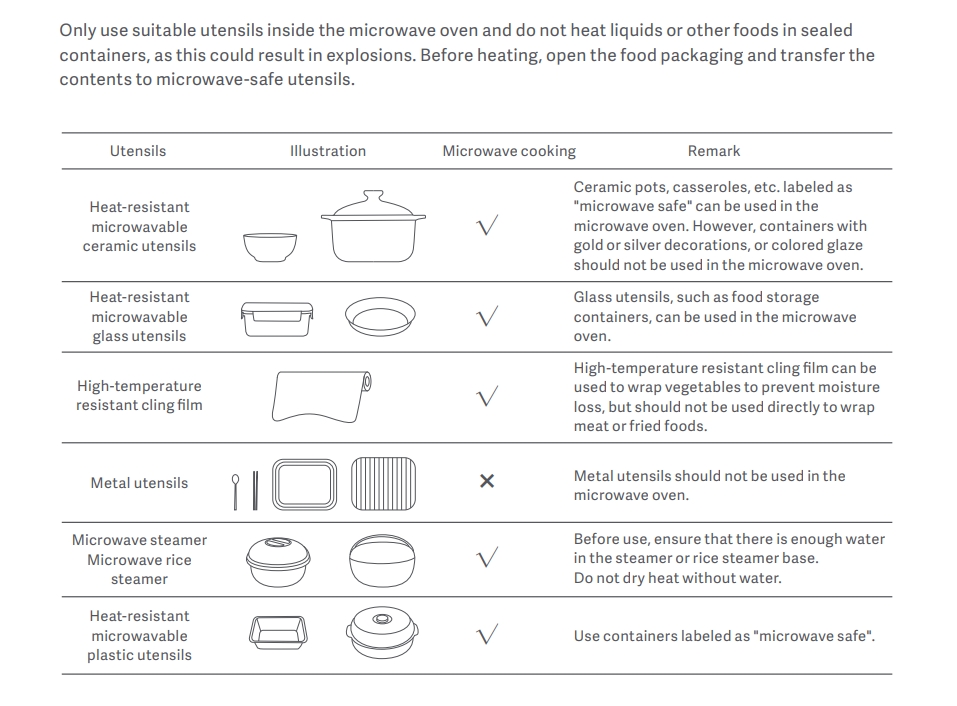
A: Utensils and materials permitted and not permitted in the microwave oven are shown below:
Note:
After cooking, the glass tray should be cooled down naturally. Do not rinse with cold water, otherwise it will cause the glass tray to burst.
13. Q: What is not permitted for microwaving?
A: Here are utensils, foods and materials that are not permitted in the microwave oven:
1. Aluminium/tin foil: Aluminum/tin foil will burn in the microwave oven. For instance: boxed or bagged milk, with its socket, bottom, or inner wall is made of aluminum foil or tin foil which will burn in the microwave oven. Besides, heated in sealed containers are liable to explode;
Proper way: Pour the milk into a heat-resistant bottle or cup for heating.
2. Eggs in their shell and whole hard-boiled eggs: Eggs in their shell and whole hard-boiled eggs should not be heated in microwave ovens since they may explode, even after microwave heating has ended;
Proper way: Crack and whip raw eggs, or slice the boiled eggs before microwaving.
3. Metal utensils: Do not use metal utensils, including those with gold or silver trims, as they may damage the microwave oven or pose a safety risk of arcing or sparking;
4. Some fruits: Putting fruits in the microwave is never a good idea. The fruit peel may generate an electric field in your microwave oven, resulting in sparking or exploding. For instance, grapes, blueberries, cherries, huckleberries, oranges, pears, and apples are not suitable for microwaving;
5. Foods with high oil or fat content: Do not heat foods with high oil or fat content, as the temperature of the oil can become very high and lead to situations where oil splashes all around and makes the cavity hard to clean;
6. Hard-shelled nuts: Nuts such as chestnuts, and walnuts need to be slit on the shell as large as you can before microwaving.
14. Q: Why there's noise while using the microwave oven?
A: Microwaves make all kinds of sounds while running. Most of these are normal and should not be a cause of concern. Food and other materials in the microwave are typically the sounds you're hearing.
1. A sizzling sound when turning on the microwave: The normal sound of starting the magnetron;
2. A popping sound when starting the microwave: The startup sound when the transformer works at high voltage and high frequency;
3. A banging sound during operation: This is because the adjustment of the microwave oven's power is realized based on the intermittent power supply to the high-voltage area (transformer and subsequent components). When the transformer is powered, it will make a bang sound;
4. A whirring sound during operation: The resonant frequency of the magnetron is much higher than the frequency that the human ear can hear. The whirring sound that comes from the cooling fan of the magnetron, is a normal phenomenon;
5. Buzzing during operation: This sound comes from transformers, diodes and capacitors, which vibrate and hum as the voltage gradually increases, which is normal.
Note:
The noise the Xiaomi Microwave Oven may make is within 65dB(A). It is the normal working sound, please feel free to use it.
15. Q: Why does the microwave oven make a loud bang noise when microwaving?
A: When the microwave oven is turned on or operating, the startup of the transformer will make a bang sound. Besides, when a high-power current acts on the transformer, it will produce a vibrating sound, and the sound may be amplified in the cavity for resonance. It is the normal working sound, please feel free to use it.
16. Q: Why does the microwave make popping noises when heating meat?
A: It is due to the characteristic of the microwave oven that the heating begins at the internal of the meat. A popping sound is normal for foods with high fat, the reason for it is that the water and oil inside are vaporized by heat but the steam cannot be released because of the fat and skin outside.
Therefore, when heating foods with high oil or fat content, please use the special plastic wrap designed for the microwave oven to cover the food and tie some small holes, or add the microwave oven lid to prevent the oil from contaminating the cavity of the microwave oven when it bursts.
Besides, after each use, wipe away any food or grease splatters inside the oven to clean and maintain, otherwise there will be some damage to the microwave oven over time.
17. Q: Why is steam coming out of the ventilation openings? And why is water coming out from under the oven door?
A: Steam emergence is a normal phenomenon during cooking. Sometimes, the steam is too thick, gathered in the oven, condensed into water and overflowed from under the oven door.
18. Q: Why does steam coalesce when microwaving?
A: Gathered steam is a normal phenomenon during cooking.
During cooking, the water and oil inside the food are heated and evaporated, so the water content inside the oven increases. In general, the covered food is less water-coagulated than the food without a cover. Therefore, ensuring adequate air circulation is important.
19. Q: Can the power level and time be adjusted while microwaving?
A: The power level and time can be adjusted during cooking.
20. Q: How to select the cooking time?
A: It is suggested to start with a short cooking time and then add time depending on the result of cooking. If the set time is too long, the food may be overcooked, burned, or even on fire.
21. Q: Can metal utensils or frying pans be used in the microwave oven?
A: When using frying pans or microwavable utensils, please use a heat-resistant insulator such as a ceramic plate to separate them from the glass tray, in case the glass tray is overheated and bursting. Besides, the cooking time should not be too long to exceed the specified range.
22. Q: How to set the timer precisely if the set time is less than 10 minutes?
A: If the set time is less than 2 minutes, turn the timer knob to approximately the 3 minutes position, and then turn it back to your desired time position;
Note:
This is due to the mechanical knob itself has a certain amount of intrinsic error. If the set time is 2 minutes, the angle is not large enough after subtracting the intrinsic error, resulting in a larger error and insufficient heating time.
23. Q: Why the foods in sealed containers must not be heated?
A: Because when a sealed container is heated, the contents inside can expand as they warm up. If the container is completely sealed without any way for the expanding air or gases to escape, it can lead to a dangerous increase in pressure. This pressure buildup can cause the container to explode or rupture, leading to potential injuries and making a mess.
Note:
Do not heat liquid or food in a sealed since it may explode. For instance, food in feeding bottles, baby food jars, canned food, eggs in their shell and whole hard-boiled eggs.
24. Q: Can aluminium foil or tin foil trays be used in the microwave oven?
A: No. Please use ceramic pots, casseroles or glass utensils. Do not use metal utensils, including those with gold or silver trims or coloured glazes, as they may damage the microwave oven or pose a safety risk. Before heating foods covered by aluminium foil or tin foil, please remove the foil.
25. Q: How to place food correctly when using the microwave oven?
A: Please place thicker parts of the food towards the outer edges of the glass tray. Microwaves tend to cook more intensely around the edges, so this helps the thicker portions receive slightly more exposure to the heat.
26. Q: Can the position of food be adjusted while microwaving?
A: Yes. Adjusting the position of food during the microwaving process can help promote even cooking. You can rotate the dish or reposition thicker parts as you need.
27. Q: How to check if food is cooked?
A: You can check texture and color to check if the food is properly cooked. For your reference, here is a general guide for you:
There should be vapor or steam spillage throughout the whole food, not just partially or around the edges. Meat should be not visibly bloody and flake easily, vegetables should be tender but not mushy, fish should be opaque and flake easily, and pasta should be soft but not overly mushy.
28. Q: Should the food be set aside for a while after microwaving?
A: Yes, allowing food to rest or stand for a short while after microwaving can have several advantages, as resting food after microwaving allows the heat to be distributed more evenly throughout the whole dish, and food continues to cook even after the microwaving due to residual heat. Setting aside the food helps complete the cooking process for more consistent results, especially for dishes with multiple ingredients or varying thicknesses.
29. Q: When is it necessary to flip food while microwaving?
A: When halfway through cooking thick cuts of meat like chicken breasts or thighs, steaks and burgers, open the oven door and flip the food to ensure a more even heating.
30. Q: Can food be stirred while microwaving?
A: If necessary, you can open the oven door and stir the food once or twice from the outside during cooking.
31. Q: Why large pieces of food are unevenly heated while microwaving?
A: It relates to the food you try heating. When trying to cook thick pieces of food, it is hard for the microwave to penetrate. It is recommended to cut the food into small pieces before microwave cooking.
Note:
For better cooking results, you can keep an eye on the cooking progress of the food and adjust the time according to your taste preference to prevent overheating. Besides, you can open the oven door, flip the food, and close the door to continue cooking when halfway through cooking.
32. Q: Can the microwave oven be operated when it is empty?
A: No. Do not leave the microwave oven empty, as this may cause damage to the microwave oven.
Note:
Microwaves work by agitating water molecules in food, generating heat. When there's no food or liquid to absorb the microwave energy, the waves can bounce around inside the empty cavity. This can lead to a buildup of energy, potentially damaging the magnetron or other internal parts of the microwave.
33. Q: Should the power plug be unplugged each time after using the microwave oven?
A: The Xiaomi Microwave Oven in standby mode can still consume a small amount of electricity (~1W). If it is used frequently, it can be used without unplugging; if it is not used for a long time, it can be unplugged and stored away.
34. Q: Why do bread and steamed buns become hard after microwaving?
A: Microwaves work by exciting water molecules in food, causing them to generate heat. During the microwave process, moisture within the bread or buns evaporates. It's recommended to put bread or steamed buns into a bowl with a little water for microwaving.
35. Q: What to do if the water or oil is spilled into the cavity accidentally?
A: Please unplug the power plug first. Use a a dry soft cloth to wipe the oven cavity. Then keep ventilated and wait for the water to dry before use.
36. Q: Is it normal if there is a gap between the microwave oven door and the outer cover?
A: It's normal design to have a gap between the microwave oven door and the outer cover. The door is designed with seals and mesh screens to prevent microwaves from leaking out. The gap provides space for the door to open and close smoothly without compromising the effectiveness of these seals.
37. Q: What to do if there's a gap on the left side of the oven door? Will it lead to microwave leakage?
A: 1. The oven door switch of the Xiaomi Microwave Oven is a bearing mechanical construction. The gap provides space for the door to open and close smoothly without compromising the effectiveness of these seals, which is normal;
2. The normal gap shouldn't cause microwave leakage. Before leaving the factory, Xiaomi Microwave Oven went through several strict microwave leakage tests, only to reach the strictest safety standards products can be put into the market. Please feel free to use it.
38. Q: Can microwave energy leak out through the oven door's observation window?
A: No. Microwave ovens are designed with an observation window made of special glass and metal grid barrier that is designed to block microwave energy from escaping while allowing you to see inside. The observation window only allows visible light to go through instead of microwaves.
39. Q: Where does the mushy odor from while microwaving?
A: If the cavity has not been cleaned or maintained for a long period, the residues or grease may cause a mushy odor. Please after each use, first wipe away any food or grease splatters inside the oven with a damp cloth and then with a dry cloth to prevent black smoke or fire.
40. Q: How to deodorize the microwave oven if there's an odor after a period of use?
A: You can use the following three methods to eliminate lingering odors in the cavity.
1. Place a few lemon slices in a cup in the microwave oven and heat on high power for 2-3 minutes;
2. Place a glass of black tea in the microwave oven and heat on high power for 2-3 minutes;
3. Place some orange peels in the microwave oven and heat on high power for 1 minute.
41. Q: Does the Xiaomi Microwave Oven need a dedicated power outlet?
A: No. The Xiaomi Microwave Oven only needs normal power outlets that ensure proper grounding.
42.Q: Where are the ventilation openings of the Xiaomi Microwave Oven?
A: The ventilation openings of the Xiaomi Microwave Oven are on the left side of the oven, which looks like shutter mesh.
43. Q: Can the Xiaomi Microwave Oven be frequency converted?
A: No, the Xiaomi Microwave Oven is fixed-frequency. Please look forward to our future products.
44. Q: Does the oven door need regular cleaning and maintenance?
A: Yes, maintaining the microwave oven door is important for both hygiene and safety reasons. Please check the door lock and interlock switch to prevent debris from accumulating inside. Also keep the door seal clean, to ensure that the door can close and seal properly.
45. Q: How to care for and maintain the Xiaomi Microwave Oven in daily life?
A: Regular cleaning and maintenance of the microwave oven can help extend its service life.
Note:
After using the microwave oven, promptly unplug the power plug. Do not use abrasive cleaning materials or detergents.
(1). Microwave oven surface: Dampen a soft cloth in warm water and apply an appropriate amount of detergent to wipe the surface of the microwave oven;
(2). Oven door: Wipe the door, sides, seals, and adjacent parts clean with a so cloth dampened with warm water;
(3). Control panel: Take care when cleaning the panel. Wipe it gently with a cloth slightly dampened with water;
(4). Oven cavity: After each use, use a soft cloth dampened with warm water to clean the interior of the oven cavity and the glass-ceramic plate, and remove food residues that could cause localized overheating;
(5). Glass tray and turntable shaft: Cleaning and washing by applying an appropriate amount of detergent. After both two accessories are dry, place the turntable shaft on the bottom track of the cavity, and then place the glass tray on the turntable shaft. Ensure that the turntable shaft, bottom track, and glass tray fit securely.
46. Q: Is it normal if the oven has a popping sound or sparks while using it?
A: Please check if:
1. Using metal utensils;
2. Using stainless steel utensils;
3. There's too much grease or residues in the cavity.
Notes:
1. If utensils are not allowed to be used in the microwave oven, please change them immediately;
2. If there's too much grease or residues in the cavity, please refer to the cleaning and maintenance instructions to clean the cavity;
3. If using ceramic or glass utensils, please check if they are labeled as "microwave safe". If not, please stop using it in the microwave oven, otherwise, the glass will blow out or may cause a fire
47. Q: Why do some home power outlets trip as soon as the microwave is turned on?
A: Microwaves draw a significant amount of power when they start. For your reference, the input power of the Xiaomi Microwave Oven is over 1000W. If the circuit breaker itself is weak, it may trip.
Besides, if the circuit where the microwave is plugged in already has other high-power appliances running on the same circuit, it can exceed the circuit's capacity and cause the breaker to trip.
48. Q: Why can't my Xiaomi Microwave Oven cook food as fast as the manual states?
A: Here are some reasons that may cause the difference:
1. Check the instructions to see if they are being followed exactly and identify the reasons for different set times;
2. The recommended set times are for reference only. To prevent overcooking, please master your microwave cooking techniques;
3. The size, weight, and shape of the food affect the cooking time.
Note:
If the voltage is lower than 210V, the heat will become slow; if the oven door is not closed properly or the voltage is lower than 190V, the heating will stop. Please refer to the instructions and adjust flexibly.
49. Q: What may cause damage to the glass tray during operation?
A: To prevent the glass tray to be broken, please pay attention to the following details:
1. The glass tray should be cleaned and maintained after it cools down;
2. Do not place hot food or containers on the cooled glass tray;
3. Do not place cold food or containers on the hot glass tray.
50. Q: Why does the microwave oven auto power off after running under the high power level for a while and cannot be turned on for a few minutes?
A: Microwave ovens often have built-in safety features to prevent overheating, and one such safety measure is an automatic thermal cutoff or overheating protection. Please check the material and quantity of the food you are cooking.
For your reference, here is the principle of overheating protection: There is a thermal sensor inside the microwave just around the magnetron. When the internal temperature reaches a certain level, indicating potential overheating, the sensor triggers the cutoff mechanism. This mechanism shuts off the power to the microwave, allowing it to cool down.
If the microwave runs for a short period but triggers the cutoff mechanism, please check if the ventilating system works properly.
51. Q: Is it a product quality issue if there are holes that are leaking light in the cavity? May it cause microwave leakage?
A: The holes do not affect the normal use of the Xiaomi Microwave Oven.
1. These holes serve specific purposes and are intentionally designed as part of the microwave's construction. Ventilation holes in the cavity are designed to allow for proper airflow and prevent the buildup of heat during operation. This helps keep the interior dry and reduces the risk of mold or unpleasant odors;
2. These holes only allow light and air to through, and reflect microwaves for safety. Microwave ovens are designed with specific safety standards to prevent microwave radiation from leaking out of the oven. Please feel free to use it.
52. Q: Why does the steamed bun just taken out of the refrigerator become dry and hard, even on fire after microwaving?
A: Please do not put frozen steamed buns or bread into the microwave immediately. The proper way is to defrost before heating.
Defrost: Rinse frozen bread or steamed buns under the faucet quickly to cover the surface with water. Then put them into a plastic bag which is labeled as microwave safe. Please make sure the bag is not sealed, or you can use a toothpick to make a few holes in the bag to release the gas produced during the heating. Heat on defrost mode for 1-2 minutes.
Heating: Here are a general guide:
1. After defrosting, heat on low power for 1-2 minutes. Do not heat for too long. Otherwise, the bread or steamed buns may be on fire;
2. Please do not heat on medium power or high power. It may cause the buns to dehydrate quickly and be hard in the inner part to be not able to bit;
3. After microwaving, please take out the buns quickly, otherwise the hot buns may be soaked by the vapour inside the bag, which may make the buns lose their original flavor and not be delicious.
Troubleshooting
1. Q: Why does the Xiaomi Microwave Oven not power up?
A: Please refer to the following troubleshooting methods:
1. Check if connect the microwave oven to a dedicated power outlet securely;
2. Check if the power outlet works properly;
3. Open the oven door to check if the light is on, if the screen flickering, and if the key buzzer makes a sound.
If the above troubleshooting methods can't resolve the issue, please contact our local official service center or your seller for further assistance. They will help you in this regard.
2. Q: What to do if the microwave does not operate?
A: Please refer to the following troubleshooting methods:
1. Check if the light is on when the microwave oven is turned on;
2. If the light is on, please put a cup of water into the oven, and heat on high power to see if the water becomes warm or hot after microwaving;
3. If the water does not become hot, there may be issues with the microwave oven itself. Please contact our local official service center or your seller for further assistance.
3. Q: What to do if the microwave stops cooking before the set time is up?
A: 1. This could happen because of the overheating protection. Allow the microwave to cool down for a while, and put the microwave oven on a flatbed surface in a ventilated, dry, and non-corrosive environment before using it again;
2. Please check if the ventilating system works properly. For instance, you can check if the fan is spinning.
If the above troubleshooting methods can't resolve the issue, please contact our local official service center or your seller for further assistance. They will help you in this regard.
4. Q: Why isn't the microwave oven light on?
A: The light does not go on when the oven door is closed in the standby mode of the microwave oven, or after the cooking process. On the contrary, the light is on when the oven door is opened in the standby mode of the microwave oven, and during cooking.
If the above details can't answer your problem, please contact our local official service center or your seller for further assistance. They will help you in this regard.
5. Q: Why does the microwave oven not heat up or heat up slowly?
A: Put a cup of water into the microwave oven, and heat it at high power for 3 minutes to check if the water becomes hot after heating. If the water does not become hot, there may be issues with the microwave oven itself. Please contact our local official service center or your seller for further assistance.
6. Q: Can users disassemble and repair the microwave oven?
A: No.
Warning:
There are microwave radiations and high voltage. It is hazardous for anyone other than a competent person to carry out any service or repair operation that involves the removal of a cover that gives protection against exposure to microwave energy.
7. Q: If the Xiaomi Microwave Oven has blown a fuse, can replace the fuse to fix it?
A: It's important to note that a blown fuse can be a symptom of a short circuit of internal wiring. It needs to find the short-cut component, replace it and the fuse to fix the microwave oven completely.
8. Q: Will the microwave oven work properly if the heat-resistant sticker on the oven door is broken?
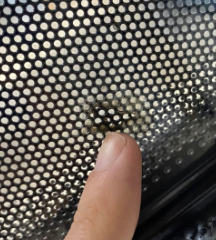
A. Yes. The heat-resistant sticker or film on the microwave oven door is designed to withstand high temperatures and acts as a protective layer. Without the sticker, the grease and water vapour from the heating of the product will enter the door frame and seals, resulting in rust and damage to the iron mesh of the door.
Note:
The sticker issue is usually caused by microwave focusing.
It is recommended to replace the heat-resistant sticker or the oven door.
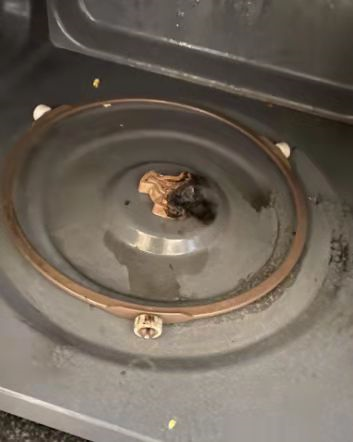
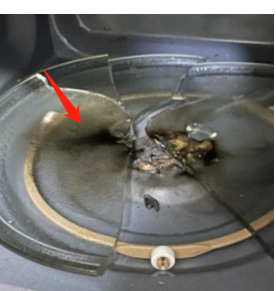
9. Q: What to do if the turntable shaft melts after microwaving?
A: Here are 3 possible reasons why the turntable shaft melts after microwaving:
1. The turntable motor does not work;
2. The glass disk is not put into the slot;
3. The microwave oven is operating empty.
Resolution: Please check the microwave oven situation (including fire gear, heating time, food type, heating utensils, etc.) and confirm how severely the turntable shaft melts. If it is slightly melting, you can change a new turntable shaft as a replacement. If the melting is more serious, for instance, the motor melts too, please change the turntable shaft and the motor component.
Note:
Please ensure that the turntable shaft, bottom track, and glass tray fit securely each time before using. Please do not leave the microwave oven empty, and make sure not to use metal utensils.
10. Q: What to do if the mica plate is scorched or burnt after microwaving?
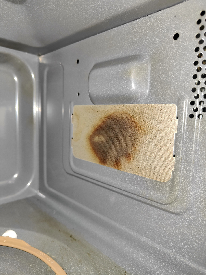
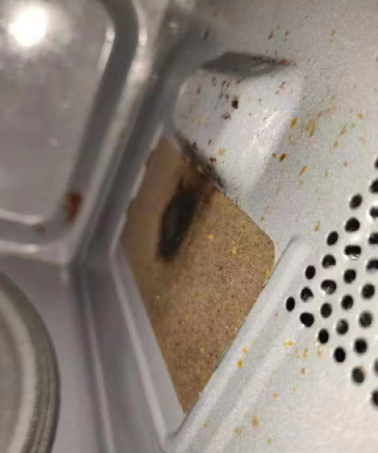
A: The mica plate burnt because of oil, grease or residues splashed on it for a long time and carbonized after heating. After heating fish, meat and other food, the oil and proteins splashed because of the high temperature and stuck to the mica plate. They are too close to the heat source which makes them easy to burn. Therefore, after a long period, the mica plate is scorched or burnt.
Resolution: Replace the mica plate with a new one, refer to the cleaning and maintenance instructions to clean the microwave oven, and clean up the food residue and grease after use.
Note:
If the mica plate is damaged, food residues may go through the cavity into the magnetron, which will cause the magnetron damage. So if using the microwave oven to heat food frequently, please pay attention to the internal cleaning and maintenance of the microwave oven.
After using it for a long period, there may be firing, arcing or sparking in the cavity. Please unplug the power plug, and check the cavity of the oven. If the mica plate shows burnt traces, it may be because the mica plate is scorched or burnt.
11. Q: Why and what to do if there's arcing or sparking in the cavity?
A: To avoid a fire in the microwave oven's cavity, please pay attention to the following details:
1. Do not heat food in sealed;
2. When heating food in plastic or paper containers, please remove the strings first. Keep an eye on the microwave oven due to the possibility of ignition;
3. Do not place flammable or combustible materials near the microwave oven;
4. Do not heat foods with high oil or fat content, as the temperature of the oil can become very high and lead to situations beyond control;
5. After each use, first wipe away any food or grease splatters inside the oven with a damp cloth and then with a dry cloth to prevent black smoke or fire;
6. If food is heated in disposable utensils, please keep an eye on the cooking progress of the food.
Note:
If smoke is observed, switch off or unplug the appliance and keep the door closed to stifle any flames.
Does it help?
Yes
No