

Description of common issues:
Troubleshooting related issues: the phone's buttons do not rebound after the button is pressed, the buttons cannot be pressed down, the power button/volume button does not rebound after being pressed, the buttons feel like they are pressed in a sponge, and the volume buttons cannot be pressed.
Consultation related issues: Can a new type of UV film be used recently? Is the optical curing adhesive of the film harmful to the mobile phone? Will the glue of the film affect the screen? Can ultraviolet light illuminate the screen of the mobile phone?
Fault description:
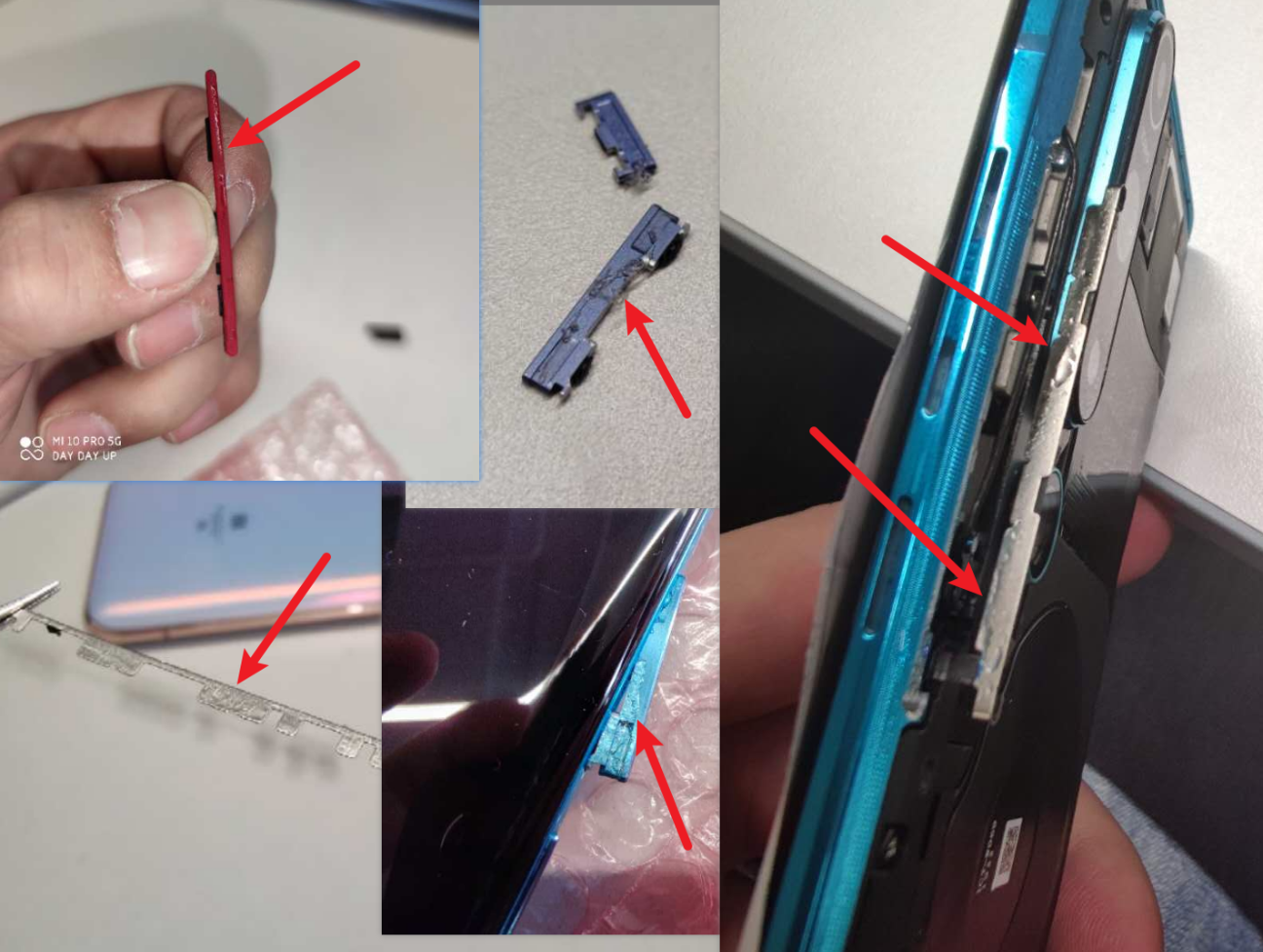
The physical buttons on the side of the device sometimes feel sticky, cannot bounce when pressed, cannot be pressed, and bounce very slowly when pressed. Part of the malfunction phenomenon If you carefully observe the joint between the button and the body, you can see traces of white powder or light-colored liquid.
Note: The physical buttons on the side generally refer to the volume button and the power button. Some models have other special buttons, for example, Black Shark has a separate game space push button.
Troubleshooting related issues: the phone's buttons do not rebound after the button is pressed, the buttons cannot be pressed down, the power button/volume button does not rebound after being pressed, the buttons feel like they are pressed in a sponge, and the volume buttons cannot be pressed.
Consultation related issues: Can a new type of UV film be used recently? Is the optical curing adhesive of the film harmful to the mobile phone? Will the glue of the film affect the screen? Can ultraviolet light illuminate the screen of the mobile phone?
Fault description:
The physical buttons on the side of the device sometimes feel sticky, cannot bounce when pressed, cannot be pressed, and bounce very slowly when pressed. Part of the malfunction phenomenon If you carefully observe the joint between the button and the body, you can see traces of white powder or light-colored liquid.
Note: The physical buttons on the side generally refer to the volume button and the power button. Some models have other special buttons, for example, Black Shark has a separate game space push button.
Suggestion:
Recently, we discovered that there are problems such as button failure, sticky buttons, and side buttons not popping up. After our initial disassembly of these devices and analysis, many of them are pasted with a new type of "UV film", which causes malfunctions due to glue leakage. If the mobile phone has been affixed with this kind of film and the related buttons, screens, and fingerprints are malfunctioning, please go to the after-sales service for testing as soon as possible; if you have not yet applied this kind of film, it is recommended to be cautious when purchasing the film, and do not buy this kind of film for the time being.
FAQ:
Q:Why does the film damage the buttons and fingerprints of the device?
A: Unlike the general film, the UV film adopts the method of separating the glue and the outer protective glass. When applying the film, you need to drop the glue on the screen first, and then place the film squeeze glue to the entire screen, and then use the UV lamp to cure. Recently, there are many users with button failures. After preliminary disassembly analysis and confirmation, a mixture of polyethylene glycol liquid was found on the side keys of many failed machines. It is suspected that most of them are caused by incomplete curing and leakage of the UV film glue. The specific ingredients and sources are still being confirmed; In addition, since most of the current models use under-screen optical fingerprints, the protective glass layer and glue layer of the UV film may cause the light of the fingerprint sensor to shift, which may affect the normal use of fingerprint recognition in some cases.
Q:Shouldn't the glue be sticky? Why can I still go to the button?
A: After our investigation and research, the "glue" of the UV film is actually not very sticky. After filling the gap between the outer protective glass and the screen protective glass, the glue is cured by the UV lamp provided by the film vendor. , In order to achieve the bonding effect. However, the curing range of the small ultraviolet lamp is limited, and the glue may leak when the glue is not completely cured, which can easily cause the failure of peripheral devices such as buttons.
Q:There is no problem with other mobile phones using this film. Is there a problem with the structure design of your mobile phone?
A: Judging by the filming method, it may be related to the operating method, the characteristics of the UV glue, the length of the curing time and the difference in the curing radiation intensity; the curved design on both sides of the curved screen itself will also make it easier for the liquid to contact the middle frame. It is more likely to leak to the keys. If the protection is not good or the glue is too much, it may leak into the earpiece, and there is a risk of silence or abnormal sound from the earpiece. Generally speaking, it is mainly caused by the characteristics of the glue, and it is recommended that you treat it with caution.
Q:How to distinguish between UV film and other films?
A: The normal film, the protective film and the adhesive are all together, such as tempered film or high-permeability film. Generally, remove the protective layer on the back of the film and stick it on the screen before it can be used. The protective film of the UV film is a piece of non-sticky glass on the front and back. The glue and the film are separated. When applying the film, you need to manually drop the glue on the screen and cover the protective glass, and then you need to irradiate it with a small UV lamp for a period of time. You can read the introduction before you buy, as long as the glue and the protective film are separated, it is basically this kind of UV film.